Room by Room: The Complete Electrical Safety Walkthrough of Your Home
Published on October 15, 2026

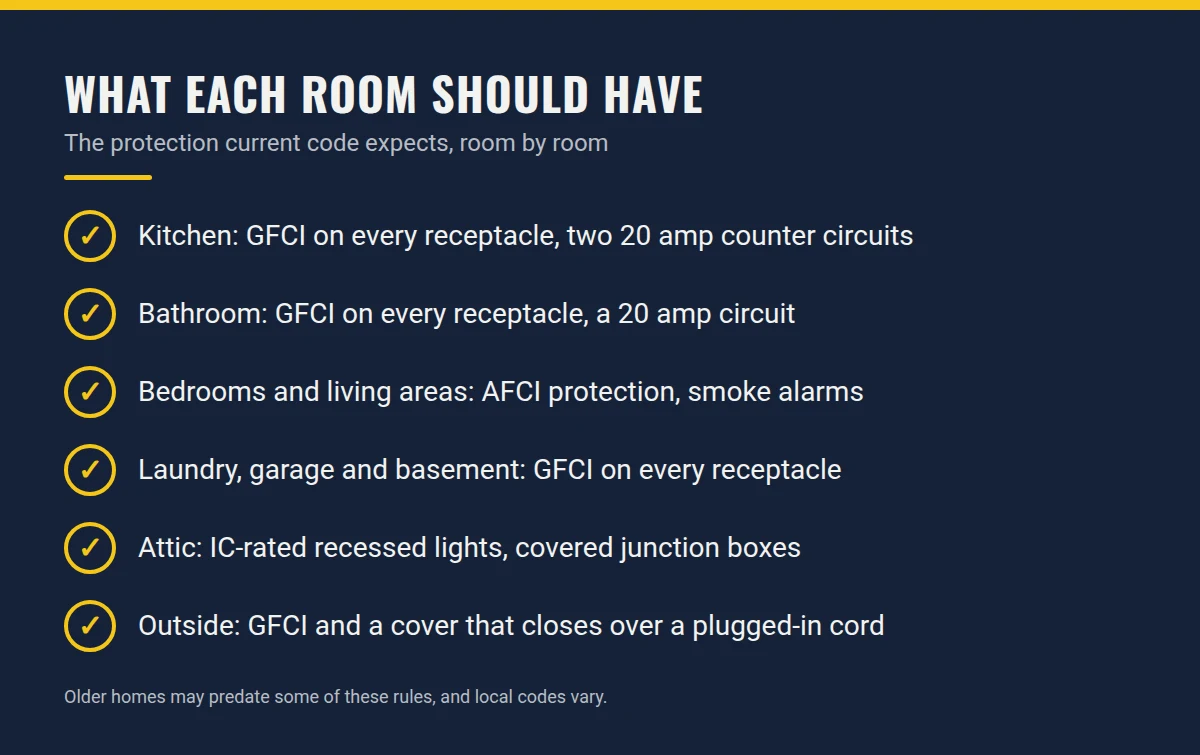
Most people only think about their wiring when it fails: a breaker that will not stay on, an outlet that smells hot. But a house gives warning long before that, and it does so room by room. The National Electrical Code (NEC) treats each room differently, asking for shock protection (ground-fault circuit interrupters, or GFCIs) where people and water meet, fire protection (arc-fault circuit interrupters, or AFCIs) where people live and sleep, and tougher hardware wherever the weather reaches. Our guide to AFCI vs GFCI protection explains each device. The stakes are real. The National Fire Protection Association (NFPA) estimates that US fire departments responded to an average of 46,652 home electrical fires a year from 2020 to 2024, fires that killed an average of 527 people a year, and the kitchen, the bedroom and the attic were the most common places for them to start.
This is a walkthrough, not a catalog of everything that can go wrong. Start at the panel, then work through the kitchen, the bathroom, the bedrooms and living areas, the laundry, the garage, the basement, the attic and the outside of the house. Each room gets its hazard, the protection current code expects, a few minutes of checks, and a link to our deeper guide on that hazard. Most houses fit into one evening, and the last section sorts what you find into three piles: what cannot wait, what to fix tonight, and what to book an electrician for.
One rule comes before all of it. If anything you find is hot, smoking, sparking or smells like burning plastic, or if anything gives you a shock or a tingle, stop the walkthrough. If there is smoke or flame, get everyone out and call 911 from outside. If there is no fire, switch that circuit off at the panel if you can reach it safely, and call a licensed electrician. A sagging or downed line outside belongs to the utility and to 911. Never go near it.
Before You Start: The Kit, the Panel, and the Ground Rules
You need very little, and none of it is expensive:
- A phone for light, photos and notes. A clear picture of anything you are unsure about is the fastest way to brief an electrician later.
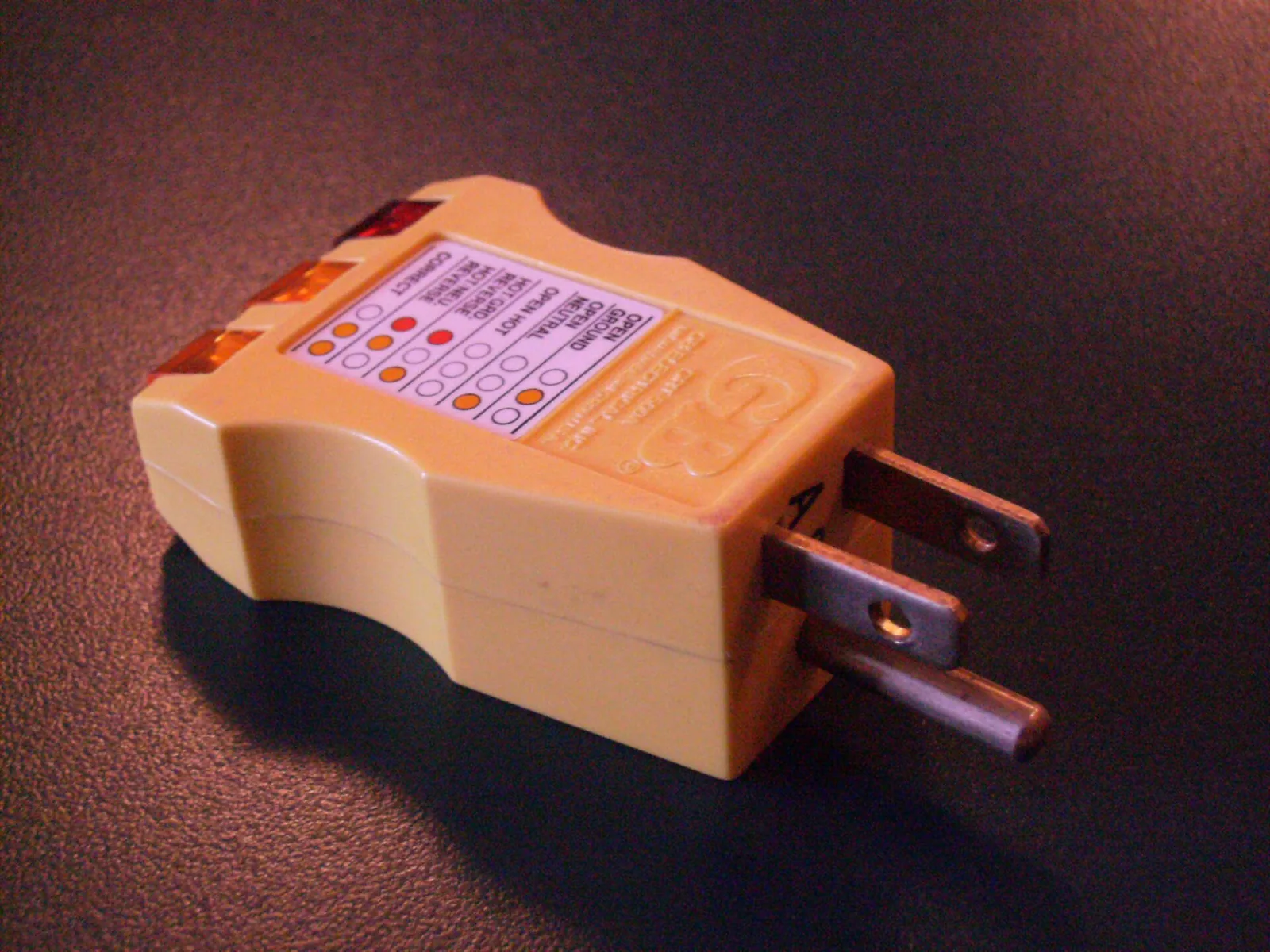
- A plug-in receptacle tester with a GFCI test button. It is the small three-light plug sold in any hardware store, and it is the one tool here that tells you something you cannot see.
- A lamp or night-light that you know works, for outlets the tester will not fit and for checking which outlets go dead when a GFCI trips.
- A step stool for the smoke alarms, and a headlamp for the attic.
Read the lights against the chart printed on the tester. The patterns flag the common faults: an open ground, an open neutral, an open hot, and a hot wire swapped with the neutral or the ground. A “correct” reading is a pass, not a clean bill of health. UL 1436, the standard these testers are built to, says they are not intended to be a comprehensive instrument or to determine the quality of the grounding circuit, and their instructions typically list other blind spots, such as two hot wires or a neutral and ground swapped with each other.
The tester’s GFCI button leaks a small current from the hot slot to the ground pin, which should trip whatever GFCI protects that outlet. That only works on a grounded circuit. A GFCI on an old two-wire circuit can work perfectly and still ignore the tester, and a HUD notice to housing inspectors warns that the tester will then wrongly report the GFCI as broken, so use the TEST button on the GFCI itself. Those ungrounded GFCIs should carry the “No Equipment Ground” label that the Consumer Product Safety Commission (CPSC) says goes on them.
CPSC’s own GFCI test needs no tester at all. Plug in a lamp and switch it on, press the GFCI’s TEST button, and the lamp should go out. Press RESET, and it should come back on. If either step fails, the GFCI needs an electrician. CPSC advises running that test at least once a month and after a power failure.
The ground rules: you are looking, touching the outside of things, pressing TEST buttons and plugging in a tester, not removing cover plates or the panel’s inner cover. Expect your house to miss some of what follows. Wiring is generally judged by the code in force when it was installed, as our explainer on whether old wiring is really grandfathered lays out, but a missing protection where water and people meet is still worth adding.
Start at the panel. Open the panel door, but not the metal cover behind it, and look for four things:
- A directory that matches the house. The code requires every circuit to be legibly identified on the panel’s directory. If yours says “misc” and “spare,” fixing it takes a helper and a lamp, not an electrician.
- Breakers with TEST buttons. Those are AFCI, GFCI or dual-function breakers, and each one protects every outlet on its circuit, including outlets with no buttons of their own. Pressing TEST should trip the breaker. To reset it, push the handle firmly to OFF and then back to ON.
- Anything that does not belong. Rust or water stains, scorch marks, a breaker that feels warm or buzzes, a burning smell, or an open slot where a breaker is missing and nothing closes the gap. Unused openings in a panel are required to be closed.
- Clear floor in front. The code wants working space at least 3 feet deep and 30 inches wide (or the panel’s width, if that is wider), kept free of storage. Our guide to where a panel is allowed to live covers the rest.
The Kitchen: Water, Heat, and the Biggest Plug-In Loads
The kitchen puts the house’s heaviest plug-in appliances (kettles, toasters, air fryers, coffee makers, microwaves) within reach of a sink, and it is where the largest share of home electrical fires start, 15 percent in NFPA’s count. That is why the code stacks two kinds of protection here.
What should be there. Under the 2026 NEC, as Minnesota’s Department of Labor and Industry summarizes it for one-family homes, kitchen receptacles need GFCI protection and kitchen circuits need AFCI protection. The countertop receptacles are fed by at least two 20 amp circuits and spaced so that no point along the counter wall is more than 24 inches from one. The 2026 edition also requires GFCI protection for dishwashers, electric ranges, wall ovens, cooktops and microwaves in new installations, whether they are hardwired or plugged in.
What to check.
- Plug the tester into each countertop receptacle and press its GFCI button. The outlet should go dead, and you should be able to restore it at a GFCI receptacle (often the one nearest the sink) or at a breaker. Note which outlets died together and where their protector is.
- Look behind the toaster, the coffee maker and the microwave for browned faceplates and for cords pinched against the wall.
- Check that plugs grip. A plug that sags out under its own weight has worn contacts, and worn contacts make heat. The U.S. Fire Administration (USFA) advises replacing any wall outlet that a plug does not fit snugly.
- Touch the plug of a heavy appliance after it has run for a while. Warm can be normal. Too hot to hold is not.
- Look for the refrigerator or the microwave plugged into an extension cord or a power strip. USFA’s rule is that major appliances plug directly into a wall outlet, and our guide to extension cord fire safety explains why.
The Bathroom: Where Shock Risk Peaks
The bathroom puts wet skin, metal plumbing and handheld appliances such as hair dryers within a few feet of each other. It is the textbook setup for a serious shock, and CPSC dates the code’s bathroom GFCI requirement to 1975, so a bathroom wired before then has no shock protection unless someone added it later.
What should be there. GFCI protection on every bathroom receptacle, and a 20 amp circuit feeding the bathroom receptacles. Receptacles may not sit within 3 feet horizontally and 8 feet vertically of the tub rim or shower threshold, and light fixtures in damp or wet spots must be marked for those locations. Breakers do not belong in a bathroom at all.
What to check.
- Test each receptacle with the tester’s GFCI button, then press TEST on the GFCI device itself. If an outlet has no buttons and neither test cuts its power, it has no shock protection. In an older bathroom, that is the most valuable thing an electrician can add.
- Find out whether a space heater lives here. It usually shares the bathroom circuit with a hair dryer, a combined load the circuit was never sized for, as our space heater guide shows.
- Put the hair dryer and the curling iron away unplugged, out of reach of the sink.
A tingle from a faucet, a towel bar, a tub or a metal fixture ends the walkthrough. It means current is somewhere it should not be, and it is an emergency call. Our guide to a shock from a cover plate explains why a repeating tingle that trips nothing is so serious.
Bedrooms and Living Areas: Where Fires Turn Deadly
In NFPA’s figures, fires that started in a bedroom were 12 percent of home electrical fires but 21 percent of the deaths, and fires that started in a living room were 7 percent of the fires but 27 percent of the deaths. Fires between midnight and 8 a.m. made up 22 percent of the total and 52 percent of the deaths. These are the rooms where cords get crushed under furniture and rugs, where power strips carry chargers, lamps and the occasional heater, and where people are asleep when something starts to burn.
What should be there. AFCI protection on the circuits serving bedrooms, living and family rooms, dining rooms, dens, closets, hallways and similar rooms, to catch the arcing in damaged cords and loose connections that starts these fires. Tamper-resistant receptacles, marked “TR,” wherever a receptacle is new or replaced. Enough receptacles that no point along the floor line of a wall is more than 6 feet from one, so lamps and chargers reach without a cord across the room. And under the residential building code, a smoke alarm in every bedroom, outside each sleeping area and on every level, plus carbon monoxide alarms outside the bedrooms in homes with fuel-burning appliances or an attached garage.
What to check.
- Lift the rugs. A cord under a rug or pinched in a doorway can be crushed for years without anyone seeing the damage.
- Pull the bed, the sofa and the TV stand out an inch, and look at the plugs and cords behind them.
- Count what is plugged into each power strip. A strip plugged into another strip, or a strip feeding a heater, goes on tonight’s list.
- Look for phone and laptop chargers lying in or under the bedding.
- Press the test button on each smoke alarm and read the date on the back of any you can reach. Our guide to hardwired smoke alarms explains the 10-year clock.
- Watch the ceiling fans run. A fan that wobbles hard, or a canopy that has dropped away from the ceiling, may hang from a box that was never rated for it; see what is holding up your ceiling fan.
- In closets, look for a bare-bulb fixture near stored clothes or boxes. The code bans open bulbs in clothes closets and requires clearance between any closet fixture and the storage space.
The Laundry Room: The Dryer and the Wall Behind It
The laundry room’s biggest fire risk is the clothes dryer, and the usual cause is mundane. USFA’s most detailed study of dryer fires estimated about 2,900 a year in residential buildings from 2008 to 2010, with failure to clean the leading factor at 34 percent, and its newer figures still rank it first, at 31 percent for 2018 to 2020.
What should be there. GFCI protection for the laundry-area receptacles, AFCI protection for laundry circuits, and a 20 amp circuit for the laundry receptacles. The 2026 NEC also adds GFCI protection for new clothes dryer installations.
What to check.
- Pull the lint screen and clean it, and make that a habit for every load. Then look at the duct behind the dryer. USFA’s advice is to make sure it is not damaged, crushed or restricted, to check that the outdoor vent covering opens while the dryer runs, and to replace coiled foil or plastic duct with rigid metal duct.
- Look at the dryer’s plug and receptacle. Older houses often have three-prong dryer receptacles with no separate ground, and a newer dryer with a four-prong cord should never be forced onto one with an adapter. Our guide to 240 volt circuits explains the difference.
- Look for browning at the dryer receptacle, and notice any burning smell while the dryer runs.
- Test the washer’s receptacle and any utility sink receptacle with the tester’s GFCI button.

The Garage: Cords, Chargers, and a Concrete Floor
The garage pairs a concrete floor, which makes anyone standing on it a better path to ground, with wet cars, power tools, freezers and chargers. It is also where temporary wiring becomes permanent.
What should be there. GFCI protection on every garage receptacle, a 20 amp circuit for the garage receptacles, and at least one receptacle in each vehicle bay.
What to check.
- Test every receptacle you can reach. If a GFCI keeps tripping with a freezer or a tool plugged in, do not swap it for a plain receptacle. Repeated trips often point to leakage somewhere in the appliance or the wiring, and our guide to why a breaker keeps tripping helps narrow it down.
- Look for extension cords stapled along the walls, run under doors, or feeding a freezer or a workbench year-round. A cord that never gets unplugged is standing in for a circuit that should exist.
- A car’s charging cord goes straight into a receptacle, never through an extension cord, and a Level 2 charger needs a dedicated circuit of its own. E-bikes and scooters are better charged here than in a hallway or a bedroom, on a hard floor away from anything that burns; see our e-bike charging guide.
The Basement: Water, Old Wiring, and Weekend Projects
Basements combine moisture, the house’s oldest wiring in plain view, and whatever wiring past owners added on weekends.
What should be there. Current code calls for GFCI protection on all basement receptacles, finished or unfinished. Earlier editions required it only in unfinished basements, which is why a finished basement from a decade or two ago may have none. The 2026 NEC also lists sump pumps among the appliances that need GFCI protection in new work. Junction boxes must stay accessible, and unused openings in boxes and panels must be closed.
What to check.
- Test the receptacles. If the sump pump plugs into a GFCI, know where it resets, and consider a battery-powered high-water alarm so that a trip nobody notices does not turn into a flooded basement.
- Shine a light along the joists. Look for wires twisted together and taped with no box around them, boxes with no cover, cable hanging in loose loops, and porcelain knobs and tubes that may still carry power.
- Look for a dehumidifier or a freezer running off an extension cord, and for water stains on or above the panel.
- Never walk into a basement with standing water if receptacles, cords or the panel could be in it. Consumer Reports puts it plainly: do not go in if outlets or power cords are underwater. Our after-the-flood guide covers who cuts the power and what has to be replaced.
The Attic: Heat, Insulation, and Wiring Nobody Has Seen in Years
Attics hold some of a house’s oldest wiring, buried in insulation and baked every summer, and NFPA counts the attic or ceiling as the origin of 9 percent of home electrical fires. Step only on joists or a floored path, mind the roofing nails, and touch no wiring. And look before you climb in. A loose, pebble-like fill in gray-brown or silver-gold, rather than fluffy batts, may be vermiculite, which the Environmental Protection Agency (EPA) says to assume contains asbestos and to leave undisturbed. If you see it, look from the hatch and leave the rest to professionals.
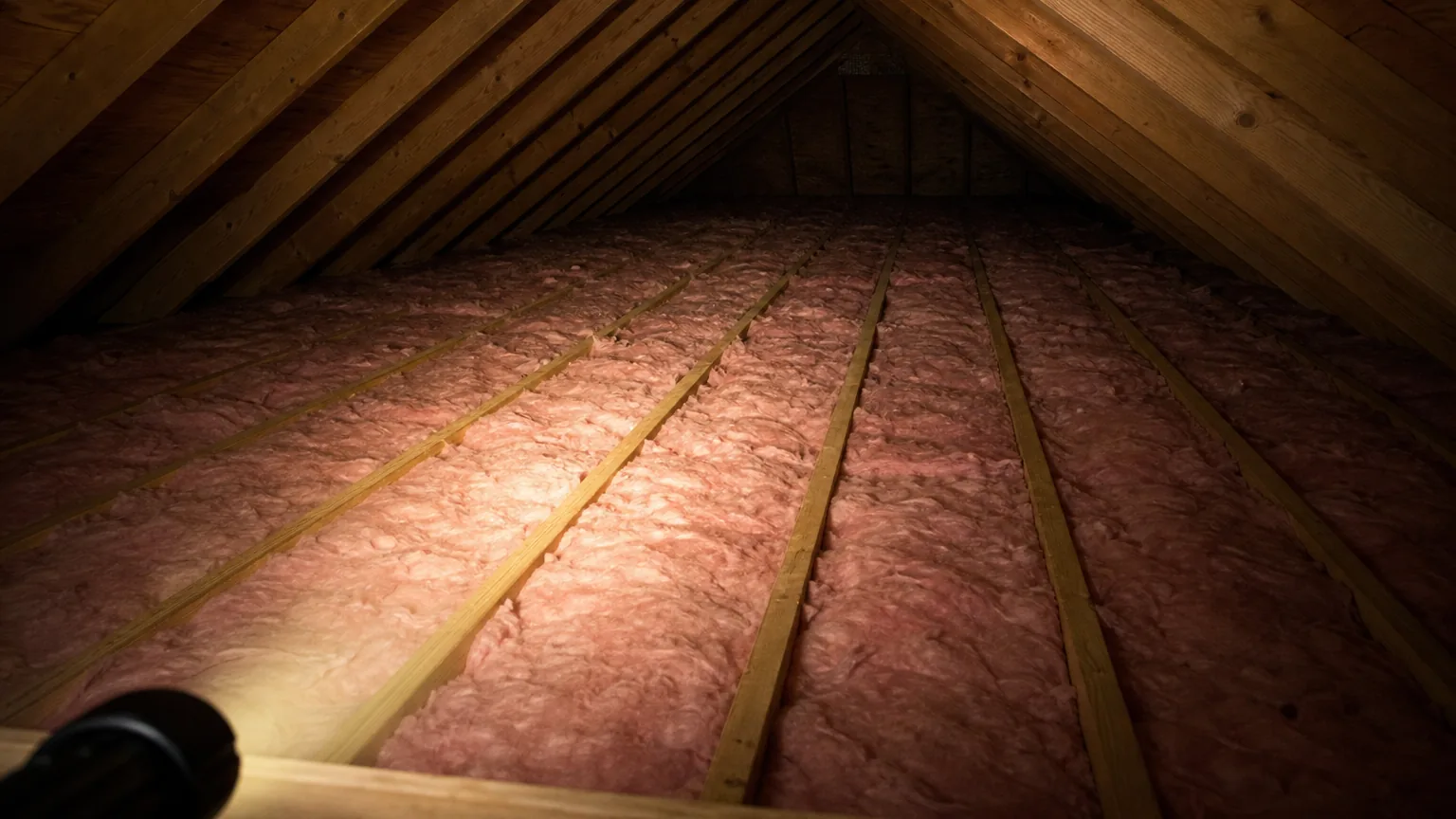
What should be there. Recessed lights that poke up into insulation must be rated for insulation contact and marked “IC.” Junction boxes need covers and must be reachable without tearing anything open. And knob-and-tube wiring (single wires strung along porcelain knobs and through porcelain tubes) should not be buried in insulation. The code rule quoted on a City of Berkeley inspection form bars concealed knob-and-tube in attics and walls insulated with loose, rolled or foamed-in-place material that envelops the wires. Department of Energy weatherization guidance notes that some jurisdictions allow it once certain conditions are met, and Berkeley’s condition is a certification letter from a licensed electrical contractor.
What to check.
- Find the tops of the recessed light housings. One that is buried in insulation without an IC rating can overheat.
- Look for knob-and-tube wiring under or inside the insulation. Porcelain knobs or tubes with insulation packed around them go straight onto the electrician list.
- Look for chewed cable jackets and droppings. Rodents strip insulation down to bare copper.
- Look for open splices and boxes without covers, especially above old light fixtures and bath fans.
The Outside of the House: Receptacles, Cords, Lines, and What Is Buried
What should be there. GFCI protection on every outdoor receptacle. Weather-resistant receptacles, marked “WR,” under an “extra duty” cover that stays weatherproof with a cord plugged in. And at least one receptacle at the front of the house and one at the back that you can reach from the ground.
What to check.
- Test each outdoor receptacle with the GFCI button. Look for cracked or missing covers, and for flat covers that only close when nothing is plugged in.
- Follow every cord that runs across the lawn, into a shed or through a window. A cord that feeds something every day is a circuit that does not exist yet.
- Look up at the service drop, the wires running from the pole to your house. Branches in the wires, a mast pulled away from the wall or a damaged meter are the utility’s to fix. Call them, and keep ladders and pruning poles well clear, as our guide to overhead power line contact explains.
- If you have a pool, a hot tub or a dock, its wiring deserves its own inspection; our guide to electric shock drowning covers what to look for.
- Before you plant a tree, set a fence post or dig for any reason, call 811. PHMSA, the federal pipeline safety agency, says the call is free, that even small projects like planting trees or shrubs need it, and that it should go in 48 to 72 hours before you dig.
The Triage: Right Now, Tonight, or This Month
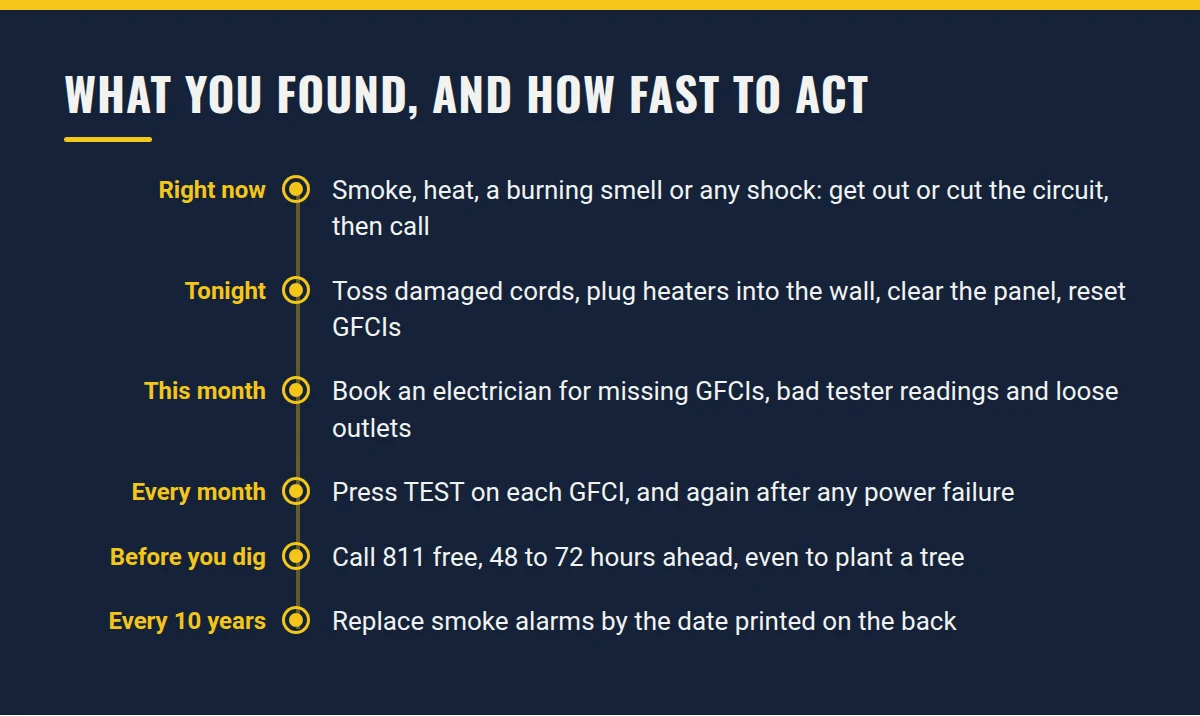
By the end of the evening you will have a list. Sort it into three piles.
Call now. These do not wait for morning:
- Smoke or flame anywhere: get everyone out and call 911 from outside.
- A burning smell, or an outlet, switch, cover plate, plug or breaker that is hot, discolored or buzzing: switch that circuit off if you can do it safely, and call an electrician.
- Any shock or tingle from a fixture, an appliance, a faucet or a cover plate. If it happens in more than one room, call the utility as well. If someone was shocked, read what to do in the hour after an electric shock.
- A breaker that trips again the moment you reset it.
- Water in or on the panel, or standing water near live receptacles.
- A damaged service drop, mast or meter, or a line on the ground: stay well away and call the utility or 911.
Fix tonight yourself:
- Throw away damaged cords, take cords out from under rugs, and break up power strips plugged into other strips.
- Plug space heaters straight into a wall outlet, 3 feet from bedding and curtains.
- Clear the space in front of the panel.
- Reset any tripped GFCI, and label each protected outlet with where its reset lives.
- Test every smoke alarm, and replace the batteries in alarms that take them.
- Clean the lint screen.
- Start fixing the panel directory.
Book an electrician this month:
- A GFCI missing where the code now expects one, or a GFCI that will not trip or will not reset.
- A tester reading of an open ground, an open neutral or reversed wiring.
- Receptacles that no longer grip a plug.
- Rooms that run on extension cords, which need more receptacles.
- Knob-and-tube wiring in insulation, recessed lights buried without an IC rating, open splices and uncovered boxes.
- Open slots or rust at the panel. (Scorch marks or heat there belong on the call-now list.)
- A dryer receptacle and cord that do not match.
Whoever does the electrical work, check their license and insurance before they start, and expect a permit for most of it.
The Bottom Line
A house shows you where it is weak if you walk through it with the right questions. GFCIs where there is water, AFCIs where people live and sleep, weather-rated hardware outside, and covered, reachable connections everywhere: one evening with a phone and a plug-in tester will show you which of those are missing. Fix the simple things tonight, book the rest with a licensed and insured electrician, and treat heat, burning smells, sparks and shocks as emergencies. Codes and permit rules vary by municipality and by the code edition your town has adopted, so confirm the details with your local building department and your electrician.
Further reading (sources)
- NFPA Research on home electrical fires from 2020 to 2024, including where they start and when they turn deadly
- Minnesota Department of Labor and Industry with its 2026 NEC inspection checklist for one-family homes
- Washington State Department of Labor & Industries on the most common violations in homeowner wiring, including IC-rated recessed lights
- International Code Council for the IRC’s required smoke alarm locations
- CPSC covering how to test a GFCI and the years the code added each location
- UL Standards & Engagement from the scope of UL 1436, the standard for plug-in receptacle testers
- HUD in a 2011 notice on why a plug-in tester cannot trip an ungrounded GFCI
- U.S. Fire Administration with its study of clothes dryer fires and how to vent a dryer
- USFA for appliance, cord and outlet safety, with newer dryer fire figures
- Consumer Reports with expert advice for home emergencies, including a flooded basement
- EPA on leaving vermiculite attic insulation undisturbed
- City of Berkeley with its knob-and-tube wiring safety report and attic insulation rule
- U.S. Department of Energy covering when weatherization crews may insulate over knob-and-tube wiring
- PHMSA on calling 811 before any digging project