Ten Feet From the Wire: Overhead Power Line Contact and the People It Kills
Published on September 18, 2026
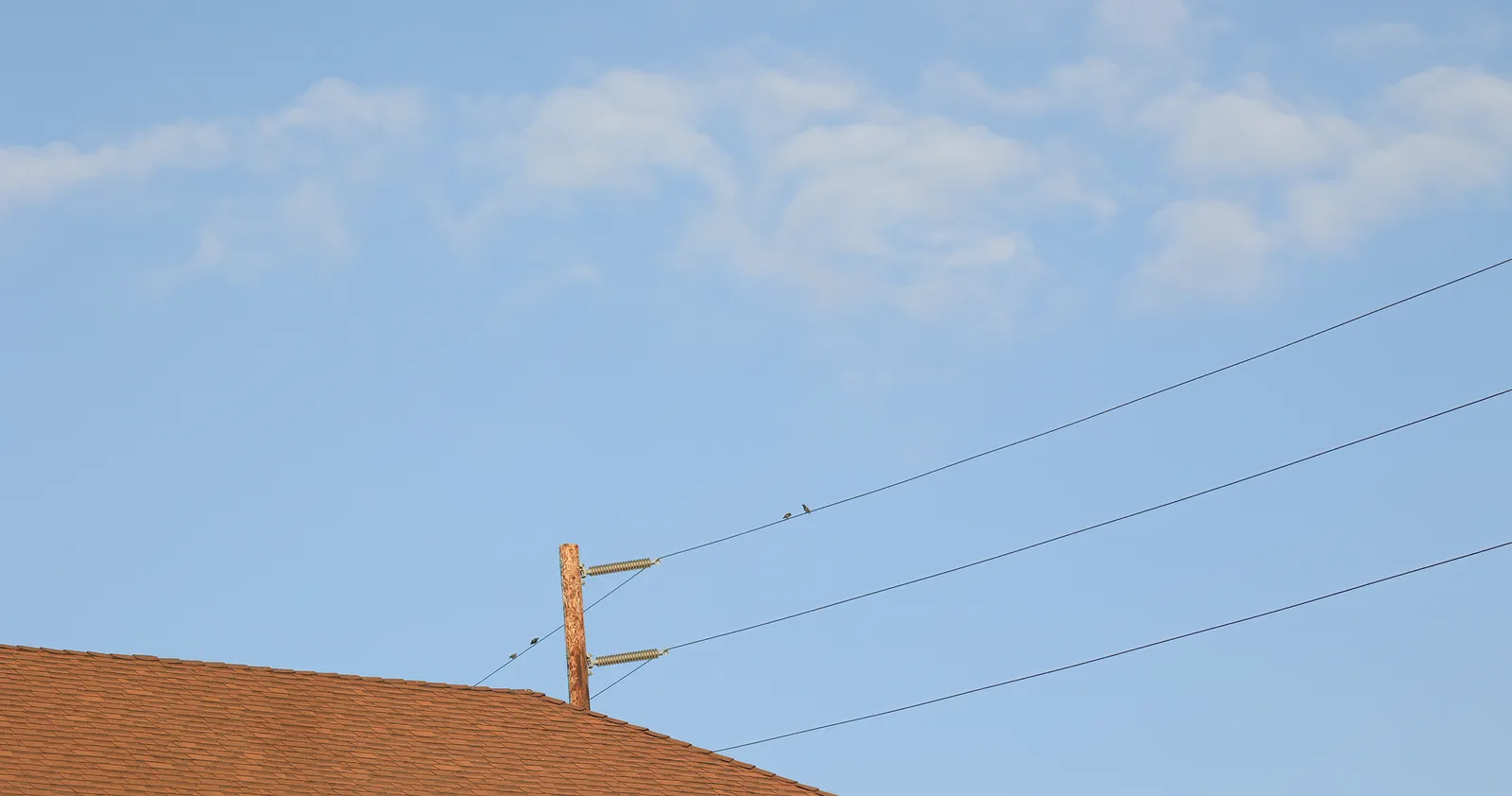
The wire running from the pole to the corner of your roof looks like part of the house. It has been there longer than you have, it sags a little in August, birds sit on it, and nothing about it announces that it is bare metal carrying enough current to stop a heart. Every year a few dozen Americans find out what it really is, and most of them are not electricians. They are painters on extension ladders, roofers moving staging, gutter cleaners, tree trimmers, farm workers carrying irrigation pipe, and homeowners walking a twenty foot aluminum ladder across the lawn with the top end in the air.
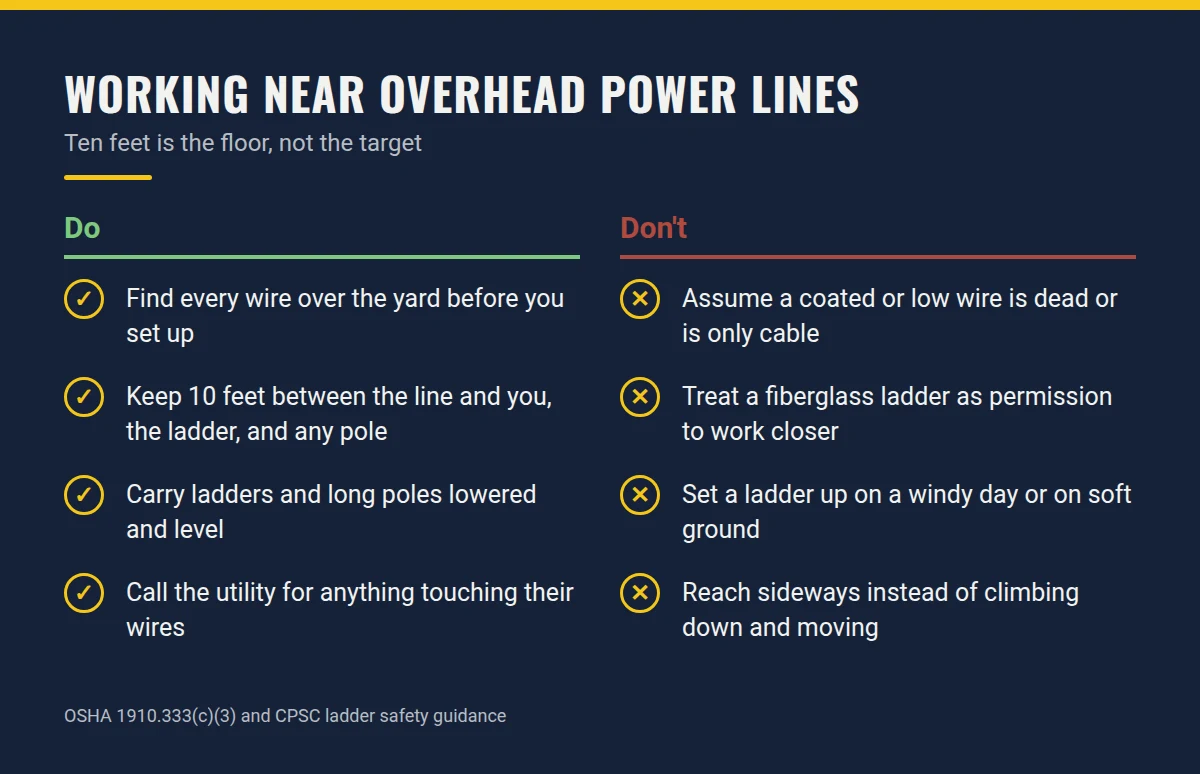
If you take one number away from this article, take ten feet. That is the distance federal workplace rules require untrained people to keep from an overhead line at ordinary distribution voltage, and it applies to you, the ladder, the pole saw, the gutter section you are carrying, and anything else that can close the gap. One thing overrides everything below: if a wire is down, or if a ladder or a vehicle is touching one right now, stop reading, keep everyone well back, and call 911 and your utility.
Who Actually Dies on Overhead Lines
The federal Census of Fatal Occupational Injuries counted 130 workers killed by exposure to electricity in 2024 and 142 in 2023. Those are workplace deaths only, and they are the visible part of the problem. The shape of it comes from a landmark review of seven years of American fatality and injury records by Cawley and Homce, which found that contact with overhead power lines caused 41 percent of all electrical fatalities, and that construction, roughly 7 percent of the workforce at the time, absorbed 44 percent of the deaths.
Read that again with the occupations in mind. The single largest category of electrical death in the country was not someone working inside a panel. It was someone outdoors, holding or standing on something long, who came up into a wire. A burn center series published by Salehi and colleagues in the Journal of Burn Care and Research found the same pattern outside the United States: contact with overhead cables was the most common cause of the injuries they treated, and construction workers were the group most at risk.
Homeowners are in this data too, just not in the occupational half of it. The Consumer Product Safety Commission is aware of 15 non-work-related electrocution deaths between 2000 and 2009 in which someone used a ladder that touched an electrical wire around the home. Fifteen deaths over a decade sounds small until you consider how narrow the activity is. These were people cleaning gutters, painting trim, and fixing a chimney flashing on a Saturday.
Where the Wires Actually Run, and What Each One Is
Almost nobody can name the wires over their own yard, which is the root of the problem. There are usually three tiers, and they are not equally dangerous in the same way.
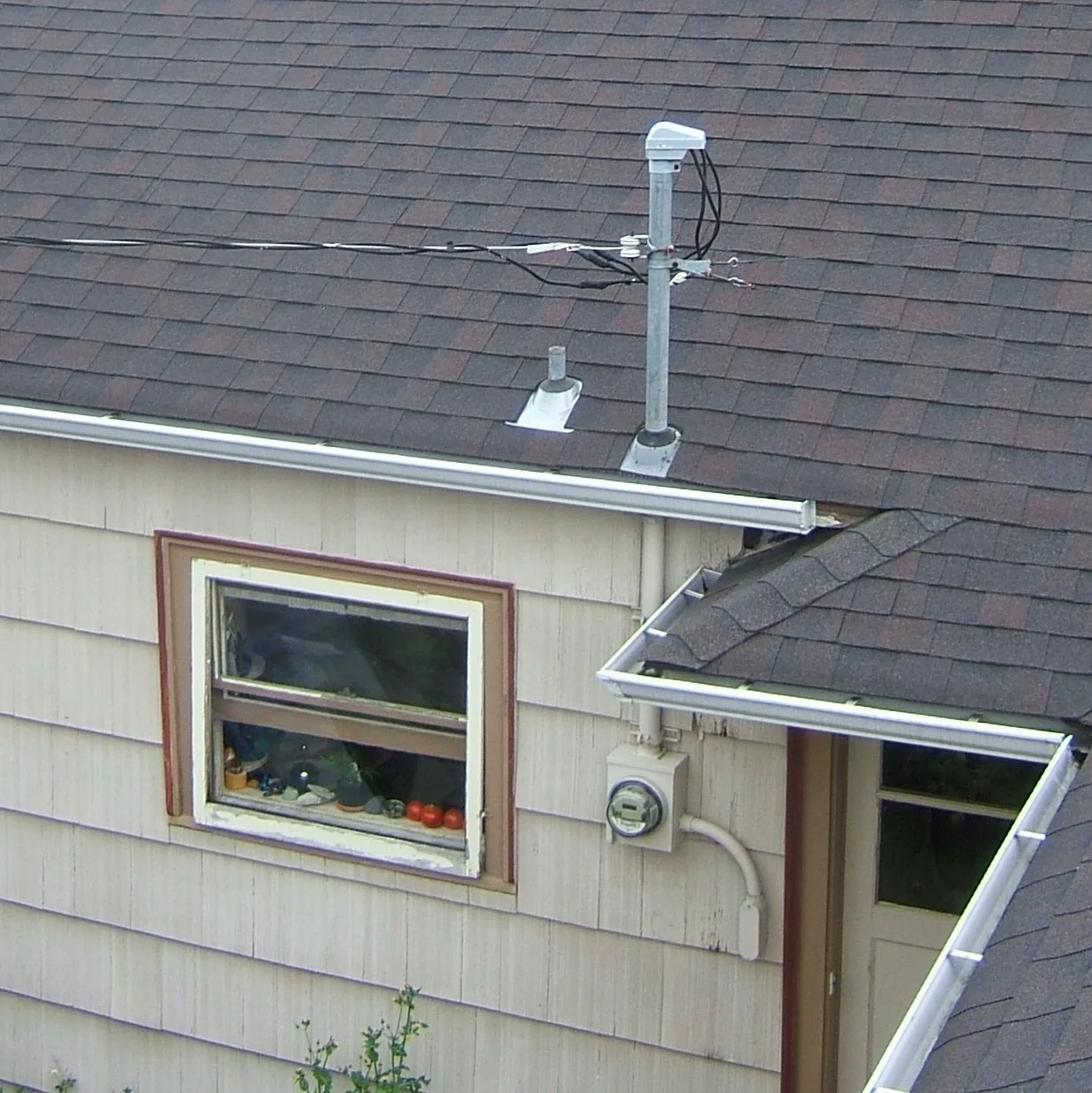
Your service drop is the lowest and closest. It runs from a pole to the weatherhead on top of your mast, carries 120/240 volts, and is the wire most likely to be within reach of a ladder because the code lets it be low. Minimum heights run about 10 feet above finished grade where only pedestrians can get to it, 12 feet over residential property and driveways, and 18 feet over public streets and anywhere trucks drive. Ten feet is the height of a basketball rim. A person on the third rung of a step ladder is already in it.
The utility’s own conductors sit at the top of the pole and are a different animal. Primary distribution commonly runs at 7,200 volts to ground and climbs from there, and it is typically bare. Nothing you own protects you at that voltage, and the current does not need a touch. It only needs a short enough gap.
Communications cables hang lowest on the pole, below the electric space. They are also the reason people get casual, because a homeowner who decides the low wire is “just the cable” is guessing. The CPSC puts it bluntly: power lines and phone lines often look similar, so assume every overhead wire carries electricity. And the gray or black covering on some lines is weatherproofing meant to extend the life of the conductor. It is not insulation and it is not intended to protect against electrocution.
Knowing which wire belongs to whom also tells you who to call, and that boundary is worth understanding before you need it. Our walkthrough of how power gets from the transformer to your outlet maps the service point where the utility’s property ends and yours begins.
Ten Feet Is a Floor, Not a Target
The number comes from OSHA’s general electrical safety rule for unqualified persons. Working in an elevated position near unguarded energized overhead lines, an untrained person must stay at least 10 feet away for voltages up to 50 kV, adding 4 inches for every 10 kV above that. The same distance applies on the ground: an unqualified person may not bring any conductive object closer than that, and the rule defines conductive broadly, treating anything without an insulating rating for the voltage involved as conductive. Vehicles with extendable structures get the same 10 feet.
Two things make that number more conservative than it reads. First, professionals working from a boom use double it. The crane standard for lines up to 350 kV requires 20 feet of clearance unless the employer determines the actual line voltage and works to a specific table, or the utility has deenergized and visibly grounded the line. Second, the distance has to survive everything that goes wrong after you set up. Wind gusts. A ladder foot sinking into soft lawn. Reaching sideways instead of climbing down and moving. The CPSC’s own precaution is far more generous than ten feet: place the ladder so the distance to the nearest overhead line is at least twice the length of the ladder, and never work on a windy day, because a single gust can shift a ladder into a wire.
A Fiberglass Ladder Is Not Permission to Get Close
The CPSC does advise using a ladder that does not conduct electricity, fiberglass with non-conductive side rails, when working near overhead wires. Then it adds the sentence almost everyone skips: non-conductive ladders should be kept clean to maintain their non-conductive safety properties.
That is not a housekeeping note. A fiberglass rail is a tested insulator when it is clean and dry in a laboratory. The ladder leaning against your garage has a decade of wet paint, aluminum oxide from the rungs, lawn dirt, road salt and algae on it, and every one of those is a conductive film bridging the part that was supposed to protect you. The rungs, the top cap, the rung locks and the pulley are metal regardless. A fiberglass ladder is a last line of defense against a mistake, not a license to work closer than you otherwise would.
Metal ladders and wood ladders with metal reinforcement wire conduct outright, and the CPSC notes they can shock or kill anyone touching the ladder or touching the person on it. If a metal or wood ladder is what you have, the agency’s precautions are to keep it clean and dry, check the location of all overhead wires before setting it up, put it on solid level ground with a flat board under a foot on soft ground, and tie it off if you can.
Notice how many of the recorded deaths do not involve climbing into a wire at all. They involve moving the ladder, or the ladder moving on its own.

The Long Things People Forget They Are Holding
A ladder at least looks like a hazard. The objects that kill people quietly are the ones that feel like yard tools.
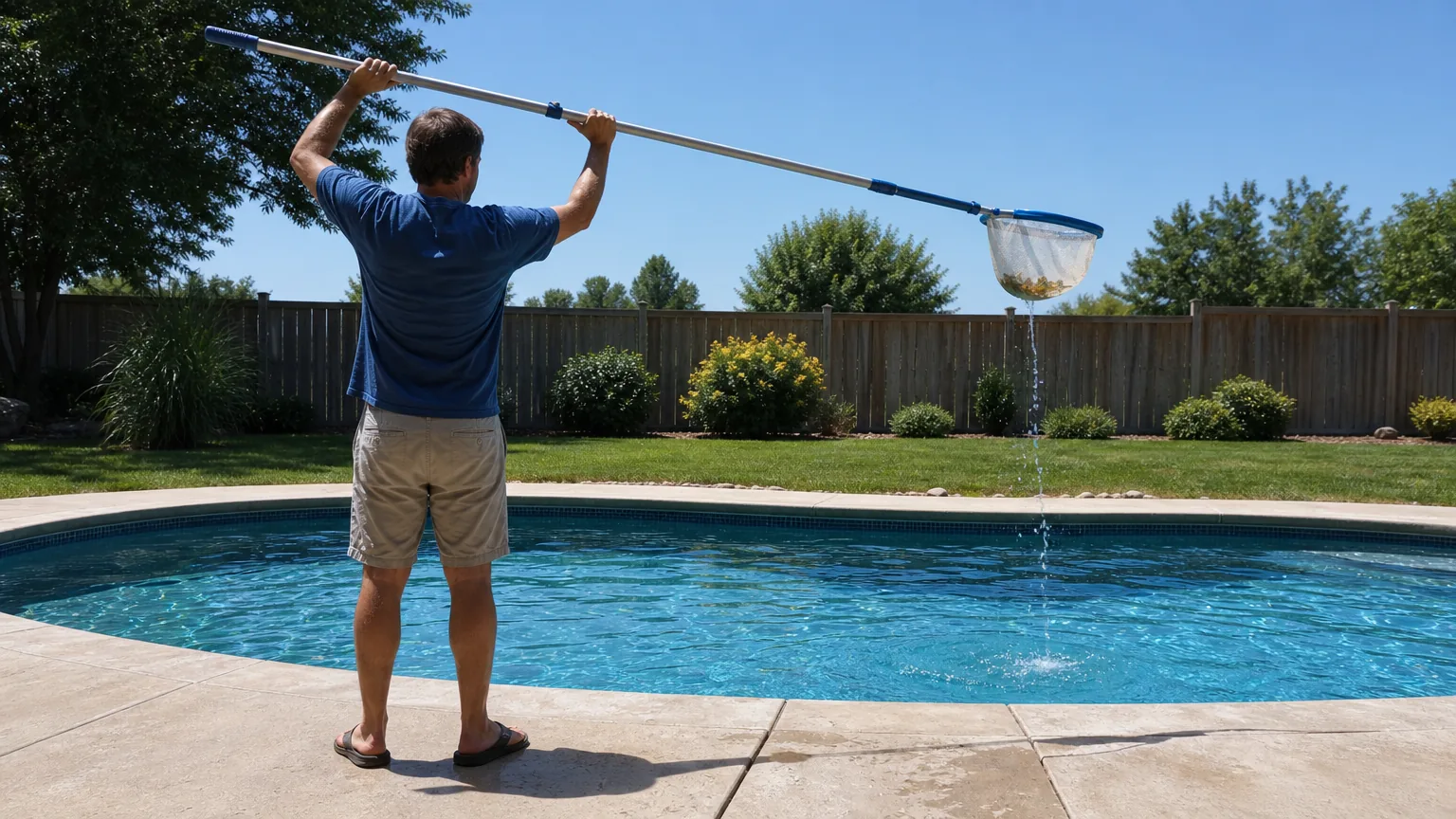
Pool skimmer poles. The National Electrical Code keeps overhead service drop conductors at least 22.5 feet above the maximum water level of a pool, spa, hot tub or fountain, and forbids putting a new pool under a lower one. That is more than double the minimum height allowed over your lawn, and the reason is a telescoping aluminum pole swung overhead by someone watching the water instead of the sky.
Irrigation pipe. A NIOSH fatality investigation in Colorado describes a wheat farm worker moving a siderow sprinkler system built from 30 foot sections of 4 inch aluminum pipe. He lifted a section to vertical and it touched a 7,200 volt line 27 feet above the field. The current entered his right hand and left through his left foot. He was working alone, and other farm workers found him two hours later. OSHA’s agricultural materials note that about 62 farm workers are electrocuted each year in the United States, most often through grain augers, oversized wagons, combines and other tall equipment brushing a line.
Everything else with reach. Antenna and satellite masts, flagpoles, portable basketball hoops being wheeled to a new spot, scaffold frames, pole saws, extension poles for rollers and gutter scoops, and the ladder itself when it is carried upright. The CPSC’s third precaution is to lower the ladder whenever you carry or move it, and to have a second person help, precisely because a long ladder is unwieldy and the top end goes where you are not looking.
Tree Work Near the Wires Is a Separate Trade
Trimming branches away from utility conductors is not landscaping with a longer saw. OSHA treats line-clearance tree trimming as its own regulated activity under the power generation and distribution standard, with its own training requirements even for trimmers who are not qualified electrical employees. A general tree service that has never done line clearance is, under the federal rule, an unqualified person, and owes the wire the same ten feet you do.
The branch itself is part of the hazard. Any power line, the CPSC warns, can let electricity flow into a piece of metal or another object such as a wet tree branch that touches it. A limb resting against a conductor is not a limb. It is an extension of the conductor, and cutting it while it is in contact puts you in series with the line.
The practical rule for a homeowner is simple. If a branch is in or near your service drop or the utility’s pole wires, that is the utility’s call, not a tree company’s. Most utilities will clear their own conductors, and vegetation management around overhead lines has become a major program for them, especially in fire-prone regions where a branch slapping a wire can start something far worse. Our guide to public safety power shutoffs and utility undergrounding explains how seriously that side of the business now takes overhead clearance.
If Contact Happens: The Rules That Feel Wrong
Nearly every instinct in this situation is the wrong one. Learn the counterintuitive version now, because there is no time to reason it out later.
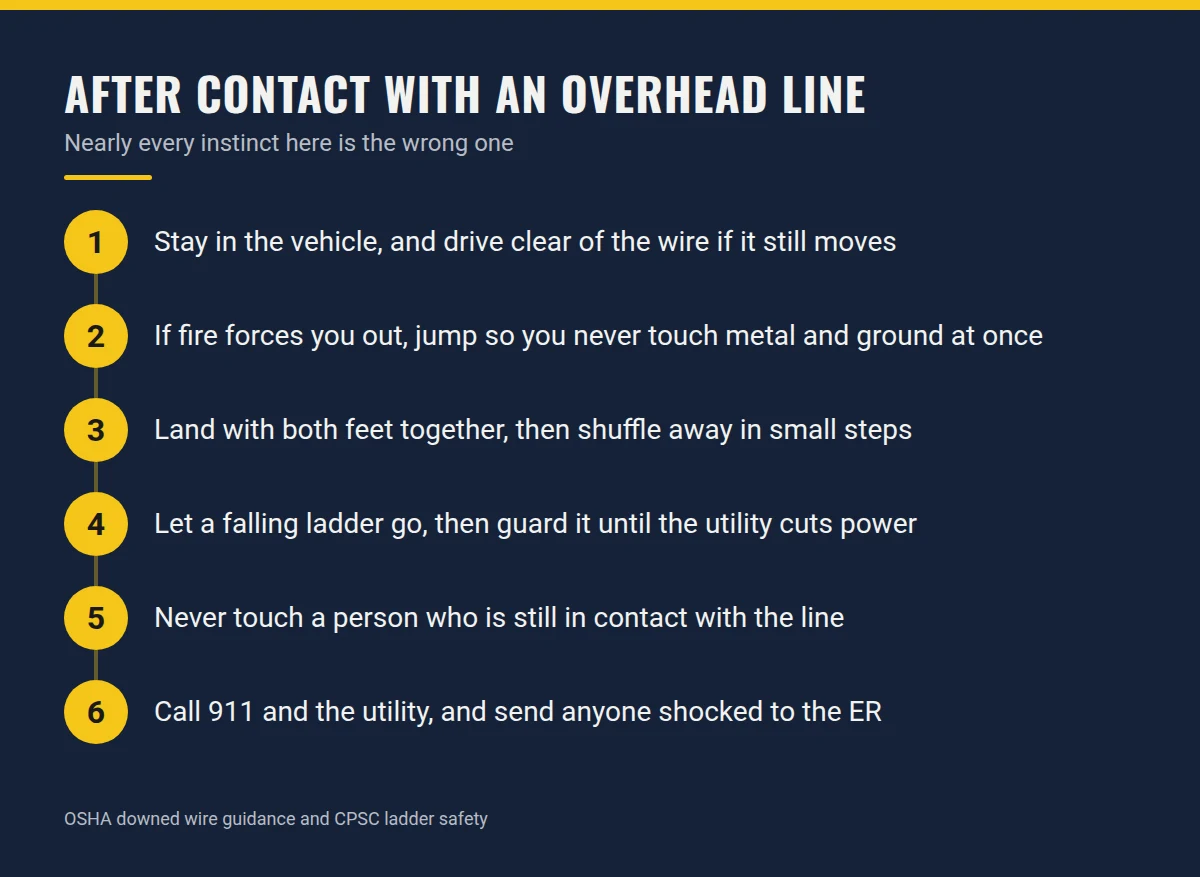
Stay in the vehicle. If a line comes down across your car while you are inside it, stay in the car and drive clear of the wire if the car still moves. If it does not, stay put, call 911, and wave people off. Getting out is what kills, because stepping down makes you the connection between an energized vehicle and the ground.
If fire forces you out, jump, then shuffle. OSHA’s instruction is to jump clear so that you are never touching the equipment and the ground at the same time, land with both feet together, and then shuffle away in small steps while keeping your balance. Current spreading outward from a contact point forms rings of falling voltage in the soil. A normal stride can land each foot in a different ring, and the difference between them drives current up one leg and down the other. Small shuffling steps keep both feet at nearly the same voltage.
Let a falling ladder go. If a ladder starts to go into a line, release it. Do not try to steer it, and do not walk away and leave it lying there where a neighbor or a child might grab it. Stand guard at a distance and have someone call the power company to cut the line before anyone moves it.
Never touch a person who is still in contact. Grabbing them puts you in the same circuit, which is exactly how one death becomes two. The CPSC’s guidance is to use something non-conductive, such as a long piece of dry wood or a rope, to push or pull them loose. Be honest with yourself about that: nothing in a garage is a rated insulating tool at distribution voltage, so the real answer is getting the power cut, and the wood or rope is a last resort while that call is being made.
Assume the downed wire is live. OSHA’s downed-wire guidance is emphatic. Circuits do not always stay off when a line falls, because reclosers automatically try to restore power after an interruption. A fallen wire can energize fences, water pipes, bushes and trees, buildings, and telephone and cable and fiber lines, and even manhole castings and rebar in pavement. Nothing about a still, silent wire means it is dead.
Anyone who took current goes to the emergency room, including someone who stood up, dusted off, and says they feel fine. High voltage injuries do damage along the current path that is invisible from outside, and rhythm problems can show up hours later. Our guide to what happens in the hour after an electric shock covers what the ER checks and why the visible burn is the least useful thing to look at.
For the call itself, the utility owns the wire and the pole and is who you want for anything overhead. Dial 911 as well when someone is hurt, when a line is down where people are, or when there is fire. If you are unsure which number solves your problem, our outage triage walkthrough sorts it out.
Before Anyone Goes Up, Have the Short Conversation
Whether it is you or a contractor, the survey happens from the ground, before anything is leaned against the house. Walk the perimeter and find where the drop lands on your mast. Trace it back to the pole and note everything it passes over. Then walk the arc the ladder will swing through if it slips, and the path it will travel while being carried.
If you are hiring, ask three questions. Has the crew looked at where the service drop lands, and does their plan keep ten feet from it? If the work genuinely cannot happen ten feet away, who is calling the utility? Many utilities will install temporary insulating covers over a drop or disconnect it for scheduled work when you ask with enough notice, and terms and lead times vary by utility, so ask yours early rather than the morning of. And is the company carrying current liability and workers compensation coverage, because a fall from a ladder on your property is the claim you never want to test. Our list of questions to ask before hiring covers the licensing and insurance checks in full, and they are worth running on a painter or a roofer, not just an electrician.
The Bottom Line
Overhead line contact kills people who were not thinking about electricity, which is what makes it so hard to prevent with warning labels. The defenses are unglamorous: know where the wires over your property run, treat every one of them as live and uninsulated, keep ten feet between the wire and anything you or your ladder can reach, carry long things horizontally, and never work near a line on a windy day. If contact does happen, stay in the vehicle, let the ladder go, shuffle rather than stride, and never reach for the person still touching it. None of that requires a tool or a permit. It requires looking up before you look at the gutter.
Further reading (sources)
- U.S. Consumer Product Safety Commission on why ladders and electricity do not mix
- 29 CFR 1910.333 for the approach distances unqualified people must keep from overhead lines
- 29 CFR 1926.1408 with the twenty foot clearance required for equipment working near power lines
- OSHA covering how to work safely around downed electrical wires
- OSHA from its agricultural guidance on tall equipment and overhead lines
- Bureau of Labor Statistics on fatal work injuries by event, including exposure to electricity
- Cawley and Homce for the share of American electrical fatalities caused by overhead line contact
- Salehi and colleagues with a burn center series on the epidemiology of occupational electrical injury
- NIOSH investigating a farm worker killed when aluminum irrigation pipe touched a 7,200 volt line
- EC&M on vertical clearance requirements for overhead conductors
- EC&M for the code rules keeping service drops clear of pools and spas
Feature photo by David Brown on Pexels.