The Charge That Stays After You Unplug: Microwave Capacitors and the Appliances You Should Never Open
Published on October 21, 2026
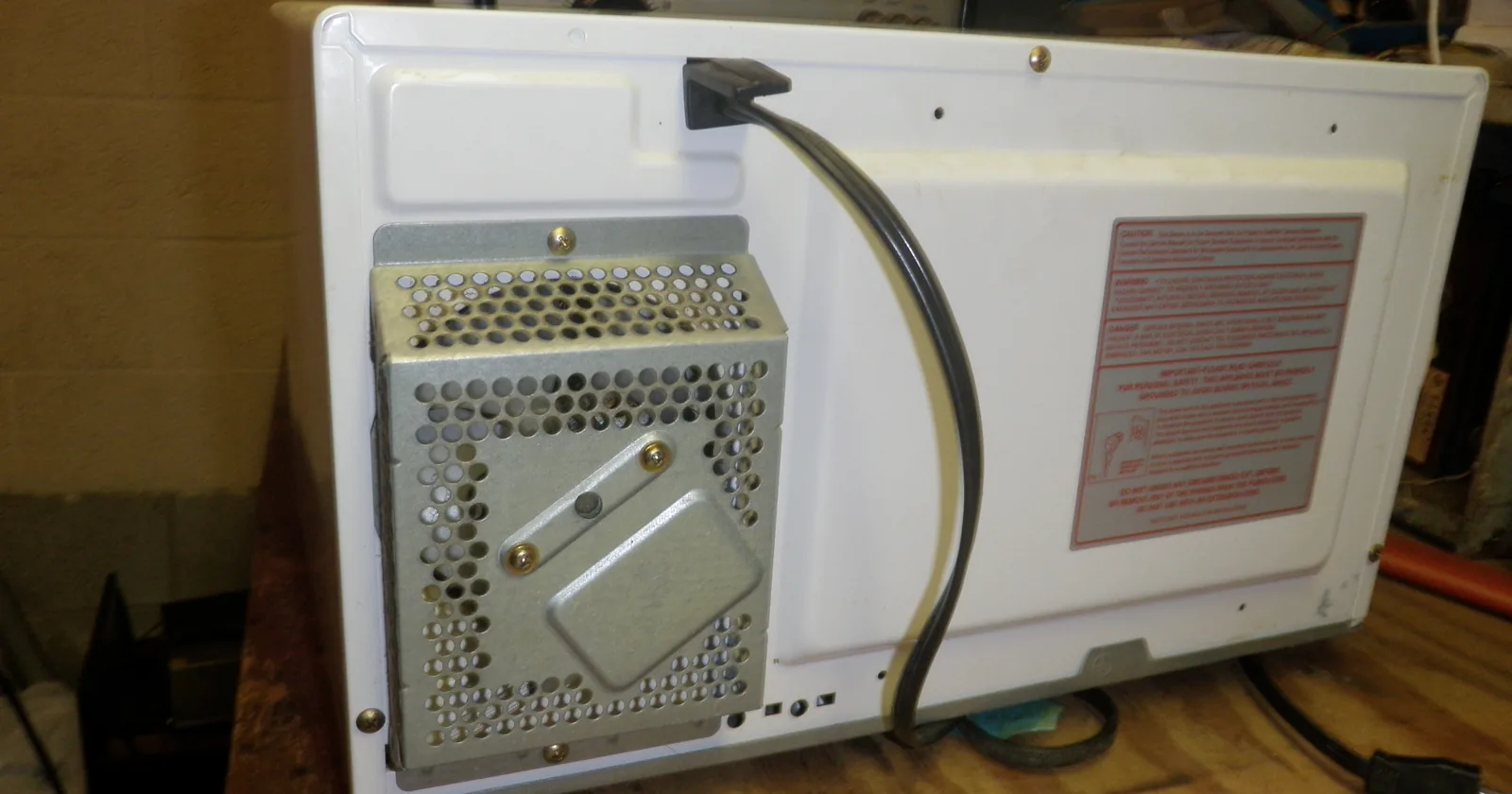
The microwave quits halfway through reheating dinner. The light comes on and the turntable turns, but the food stays cold. Ten minutes of searching online says it is probably a cheap fuse or a door switch, that the part costs a few dollars, and that all you need is a screwdriver. You pull the plug first, because you are careful, and you assume the dangerous part is over.
That assumption is the problem. The U.S. Consumer Product Safety Commission (CPSC) warns against do-it-yourself microwave repair in plain terms: microwave ovens use high voltage, and the possibility of an electrical shock “still exists even after the oven is disconnected from the power source.” From 2006 through 2008, the agency counted an average of two electrocution deaths a year among consumers trying to repair one.
This guide covers what sits behind the cover, why unplugged is not the same as safe, what investigators found when people died working on these ovens (trained technicians among them), why the transformer inside has become a killer in its own right, which other appliances hold a charge, what you can safely check yourself, and when to repair or replace. If someone has just been shocked by an appliance, go straight to the section on sparks, smoke and shocks: do not touch them while they are still in contact with it, cut the power at the plug or the breaker if you can do it safely, and call 911.
Off, Unplugged, and Discharged Are Three Different Things
Electricians and appliance technicians think about a machine in stages, and the stages matter more than the button on the front.
Off at the keypad. The oven is not cooking, but it is still plugged in. Technical Safety BC, British Columbia’s regulator for electrical equipment and other technical systems, notes in an engineering report on microwave hazards that power reaches the oven’s components whenever it is plugged in, whether it is running or not, and that a fault in the controls could energize the high voltage circuit as well. Most microwaves have no switch that cuts the power when the outer cover comes off, because the cover takes tools to remove. Federal workplace rules make the same point for professionals: under OSHA’s electrical safety standard, push buttons, selector switches and interlocks “may not be used as the sole means” of de-energizing equipment.
Unplugged. The 120 volts from the wall are gone. Energy the oven has already stored is not necessarily gone with it, and that is the subject of most of this article.
Discharged and verified. This is the only state in which anyone should put a hand inside. The same OSHA standard requires stored electrical energy to be released before work starts: “Capacitors shall be discharged and high capacitance elements shall be short-circuited and grounded.” Anyone who handles those capacitors along the way is to treat them as energized. Getting a microwave to this stage takes training, tools rated for the voltage and a meter that can confirm the result, which is why the appliance service technicians British Columbia qualifies are taught a rule worth memorizing: “Dangers don’t go away even when the microwave is unplugged.”
What Is Behind the Cover
A microwave oven turns 120 volt household power into the high voltage its magnetron needs to produce microwaves. In Technical Safety BC’s description, a step-up transformer raises the incoming power to around 2,000 volts, and a high voltage capacitor working with a diode roughly doubles that, to about 4,000 volts at the magnetron. Newer inverter models get there differently, converting the incoming power to direct current and switching it at high frequency, but what comes out the other end still has to be high enough to run the magnetron.
Four findings from the engineering report explain why that circuit behaves nothing like the wiring in your walls:
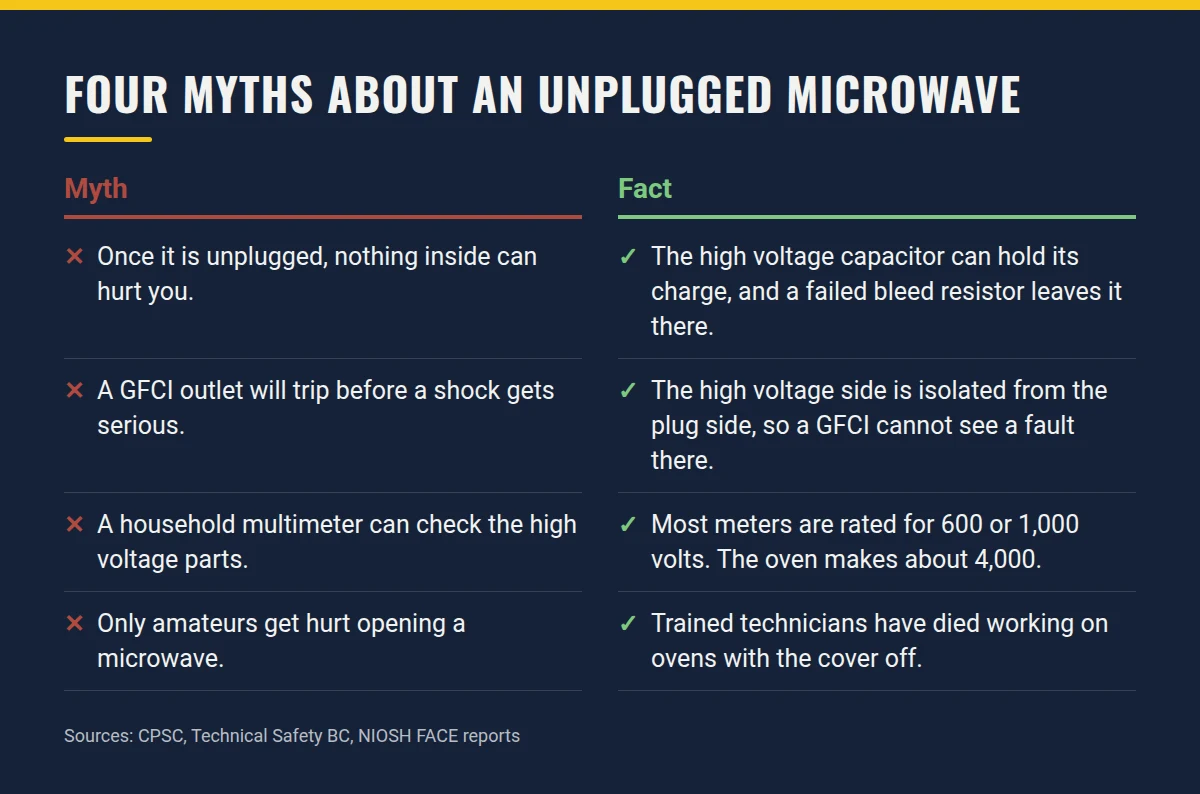
- A GFCI cannot see it. The transformer is an isolation transformer: its high voltage side has no direct electrical connection to the plug side. A ground-fault circuit interrupter (GFCI) protecting the outlet works on the plug side only, so it will not recognize a ground fault on the high voltage side, including one that runs through a person.
- The breaker and the fuse cannot see it either. Even the smallest household breaker, 15 amps, corresponds to about 1 amp of available current on the high voltage side, and the report notes that 1 amp is far more than it takes to kill. A person can be electrocuted long before the breaker or the oven’s fuse reacts.
- It is silent. There is little or no sound when the internal components are energized. Nothing hums to warn you.
- Your meter is not built for it. Most off-the-shelf multimeters are rated for 600 or 1,000 volts, and their insulation can break down at the voltages inside a microwave.
The heat is on a different scale too. Through a body with 10,500 ohms of resistance, the investigators calculated, a 120 volt shock dissipates about 1.4 watts, while a 4,000 volt shock dissipates about 1,500 watts. That is roughly what a space heater puts out on high, concentrated inside a human body.
The Capacitor: Why Unplugging Is Not the Same as Safe
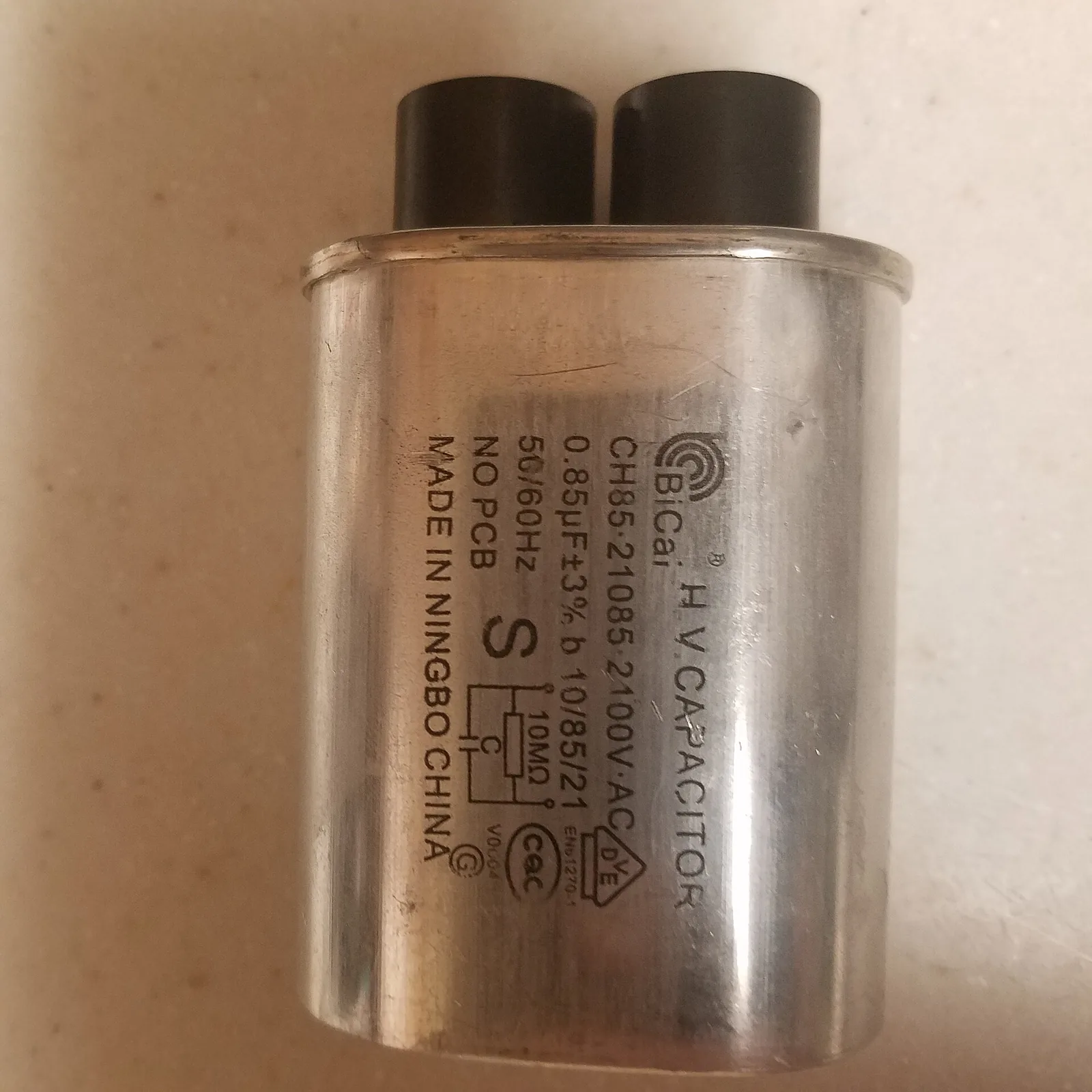
The part behind this article’s title is the high voltage capacitor, usually a metal can with two terminals on top, wired between the transformer and the magnetron. While the oven runs, it charges to about 2,000 volts. Unplugging the oven stops it from charging. It does not empty it.
Most microwave capacitors have a resistor built in, called a bleed resistor, that drains the charge once the power is cut. Technical Safety BC worked through an example oven with a 10 megohm bleed resistor. Ten seconds after shutoff, the capacitor still held about 735 volts. After 20 seconds it was down to about 270, after 30 seconds about 100, and after 40 seconds about 36. In its incident report, the agency says the internal resistor bleeds off the stored electricity “for up to one minute,” and that contact with the terminals during that time “could deliver a potentially lethal electric shock even after the power had been disconnected.”
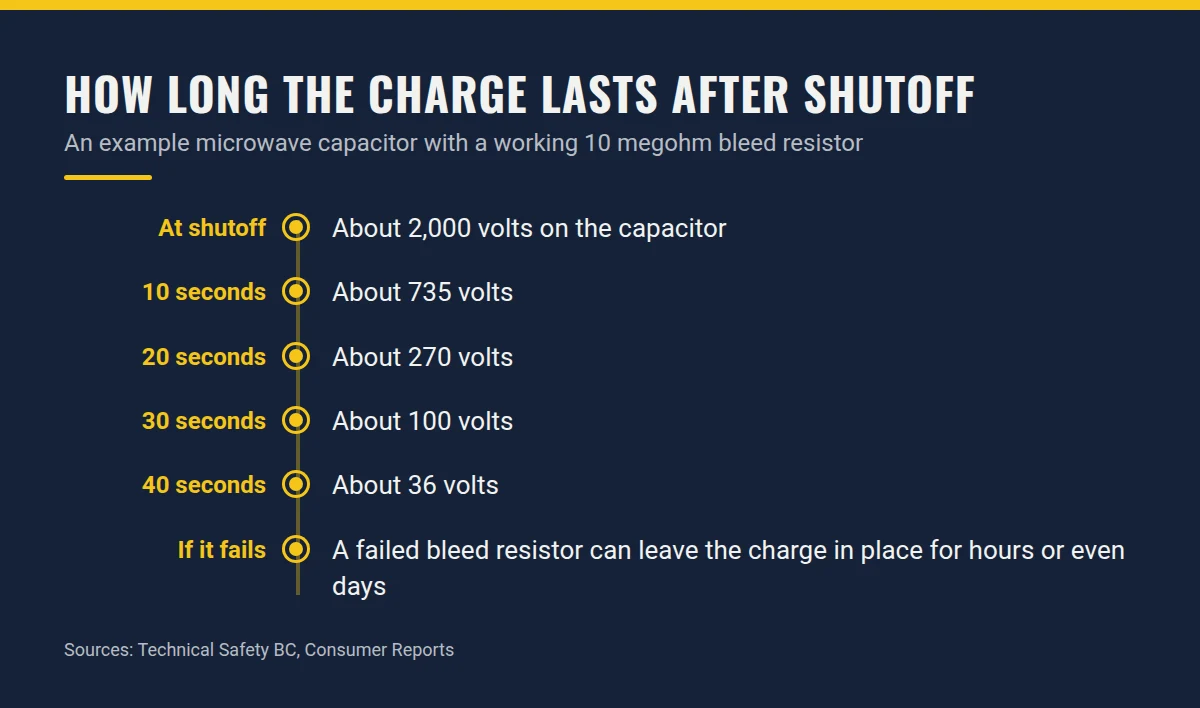
That timeline assumes the bleed resistor works. Resistors fail, and when this one does, the charge has nowhere to go. Consumer Reports warns that a microwave can hold thousands of volts in its capacitors “for hours or even days” after it has been unplugged. It is the scenario CPSC has in mind when it says that “should certain internal devices fail, even unplugged ovens can cause serious injury.” Technical Safety BC’s engineers draw the practical conclusion: a capacitor that size “must be treated as an energy source” until someone has confirmed the energy is gone.
There is a second wrinkle that surprises people who assume a quick short across the terminals settles things. Virginia Tech’s environmental health and safety office warns that capacitors “may build up a dangerous residual charge without an external source.” The safety manual at Princeton Plasma Physics Laboratory, a Department of Energy national laboratory, names the effect, dielectric absorption, and explains that a momentary short does not remove all of the charge: once the short is removed, a capacitor “can re-establish a percentage of its rated voltage sufficient to constitute a safety hazard.” Professionals handle that with shorting tools rated for the voltage and a meter rated to confirm the result. This article deliberately does not explain how to discharge a capacitor, because the honest instruction for a homeowner is not to be inside the cabinet at all.
How dangerous is the stored charge on its own? Precision helps here. By Technical Safety BC’s math, a typical microwave capacitor holds about 2 joules, two hundred times the energy of a static shock from a carpet. Princeton’s manual classes 10 joules or less as mainly an indirect hazard, “such as being startled,” while Technical Safety BC says a shock from a fully charged capacitor of this size “has potential to be fatal in the right conditions,” chiefly if it lands at a vulnerable moment in the heartbeat. A startle is not harmless when your hand is inside a cabinet of sharp sheet metal beside a transformer. But the bigger killer is the live high voltage circuit, and the investigations below show how people end up touching it: they open the oven, swap a part, and plug it back in to see whether the repair worked.
What the Investigations Found
Three deaths that public agencies investigated in detail show that experience is not the protection people assume it is.
New Jersey, 1991. A 42-year-old trained electronics technician who “reportedly knew the equipment well” was asked to check some microwave ovens that customers had returned. With the case open and the oven energized, he used small needle-nose pliers, the rubber insulation on their handles worn, to push a connector onto a terminal while wiring the transformer to the magnetron. He received roughly 2,500 volts. A coworker pulled him free, and he died about an hour later. The investigation, by New Jersey’s Fatality Assessment and Control Evaluation (FACE) program, which works with NIOSH, noted that the manufacturer’s service manuals for similar models said to remove the power plug when parts must be replaced. Its first recommendation was that equipment must be de-energized before repairs.
Maryland, 1994. A 43-year-old appliance repair person who had run his own repair business for at least five years stopped at a friend’s shop and asked to spend a few minutes diagnosing a microwave. He removed the cover and plugged the oven into a power strip on the bench, and with its fan running, put his hands into the circuitry. Witnesses heard a pop. He died an hour and 15 minutes later. Maryland’s FACE investigator wrote that unplugging a small appliance “should be a mandatory first step in any repair procedure,” followed by testing to make sure it is actually de-energized.
British Columbia, 2022. A maintenance worker at a commercial nursery, with no qualification as an electrician or an appliance service technician, took a break room microwave that had stopped working back to the maintenance shop. The worker was later found alone on the floor beside two partly disassembled ovens, with a digital multimeter on the bench set to measure resistance. A label on the back of the oven said it was to be serviced only by properly qualified service personnel, and the owner’s manual warned: “Touching some of the internal components can cause serious injury or death. Do not disassemble this appliance.” Technical Safety BC concluded that one oven had been plugged in and switched on with its cover off, that the worker grabbed two high voltage wires and was likely unable to let go, and that the contact continued without blowing the fuse or tripping the breaker. WorkSafeBC’s summary of the same death says the oven was likely unplugged and points to its charged capacitor, but Technical Safety BC’s engineers concluded that the energy left in a capacitor could not have caused burns that severe. The two agencies differ on the mechanism. Neither leaves any doubt that the repair should not have been attempted.
Two of those three people were professionals, and all three had the cover off. The danger is not that amateurs are clumsy. It is that the procedure that makes this work survivable (unplug, wait, discharge with rated tools, confirm with a rated meter, never power it up with the cover off) is exactly what a do-it-yourself repair skips.
Do Not Salvage the Transformer, Either
The same high voltage parts have found a second, deadlier use. Fractal wood burning, also called Lichtenberg burning, runs high voltage across a damp board so the current burns branching, fern-like patterns into the wood. Online tutorials show how to build the rig from a transformer pulled out of a microwave oven.
CPSC’s report on electrocutions associated with consumer products from 2011 through 2020, published in November 2023, estimates about 100 such deaths a year in 2018 through 2020. Fractal wood burning first appears in the agency’s death certificate files in 2016. By 2018 it was the most frequent product category in them, and it stayed on top in 2019 and 2020, with 65 deaths in those files over the decade. CPSC says the practice “often involved tampering with microwaves and other devices to produce the electricity the practice requires.”
Burn surgeons and forensic pathologists have been raising the same alarm. A team that included surgeons at the North Carolina Jaycee Burn Center reviewed news reports and found 25 people killed or injured by fractal wood burning between July 2016 and January 2020, 20 of whom died. Pathologists at the University of Wisconsin described two people found dead in a burned residential garage, a disassembled microwave nearby and its transformer beside the bodies; investigators had first suspected a double homicide. By their count, 33 deaths had been attributed to fractal wood burning since the first reported case in 2016. A University of Michigan team notes that some woodworking events have banned the practice outright.
Technical Safety BC’s report explains why these rigs are so dangerous. Outside the oven’s housing, the transformer’s 2,000 to 4,000 volts have nothing designed to contain them, and most ordinary wiring is rated for 600 volts or less, so a homemade setup invites arc flash, fire or electrocution. There is no safe homemade version. When a microwave dies, it goes to recycling in one piece.
Other Appliances That Hold a Charge or Keep Their Power
The microwave is the clearest example, not the only one. Virginia Tech’s safety office states the general rule plainly: capacitors “may store hazardous energy even after the equipment has been de-energized.” Several things in an ordinary house deserve the same respect.
- Central air conditioners and heat pumps. The outdoor unit has a run capacitor, a metal can that helps the compressor and fan motors start and run, in a cabinet fed by 240 volts. Pulling the disconnect beside the unit cuts the supply, not whatever charge the capacitor holds. Swapping that capacitor is often pitched online as an easy job. It is the microwave’s stored-energy problem inside a 240 volt cabinet, and it belongs with an HVAC technician.
- Old tube televisions and computer monitors. The picture tube in a CRT set holds a high voltage charge of its own, and the tube is a glass vacuum vessel that can implode if it cracks. Those sets belong at an electronics recycler, not on a garage workbench.
- Anything with a battery. A battery backup, also called an uninterruptible power supply, exists precisely to keep its outlets live after it is unplugged. Portable power stations, cordless tool packs and e-bike batteries are energized whether or not they are on a charger.
- Solar panels and home batteries. Panels produce voltage whenever light reaches them, and a home battery is stored energy by design. Our guide to shutting off power to a modern house covers the disconnects that matter.
- Hard-wired appliances. On a range, a dryer, a water heater or a dishwasher, the knobs and keypads control the heating elements and motors. They do not disconnect the supply, which stays live at the terminals until the breaker or a dedicated disconnect is turned off, and a technician still tests before touching anything.

What You Can Safely Check Yourself
Everything worth doing yourself happens on the outside of the appliance.
- Rule out the outlet first. Plug a lamp you know works into the same receptacle. If the lamp is dead too, look for a tripped GFCI (kitchen outlets are often protected by a GFCI elsewhere on the counter) or a tripped breaker, and reset it once.
- Notice what trips. If a breaker or GFCI trips every time the microwave starts while other appliances on that circuit run normally, treat the microwave as the suspect, unplug it and stop resetting. If the receptacle is warm, discolored or smells of burning, or the breaker trips with the microwave unplugged, the problem is in the wiring, and that is a call to a licensed electrician.
- Plug it straight into the wall. The National Fire Protection Association (NFPA) says to plug a microwave directly into a wall outlet and never to use an extension cord.
- Watch the door, not the insides. The Food and Drug Administration (FDA), which sets the federal safety standard for microwave ovens, requires two independent interlock systems that stop microwave production when the door opens, plus a monitoring system that stops the oven if they fail. FDA says to stop using an oven that keeps running with the door open, and to contact the manufacturer if the hinges, latches or seals are damaged, or if the door does not open or close properly.
- Check for a recall. Look up the model and serial number before paying for any repair. Our guide to checking CPSC recalls walks through the search, and NFPA advises returning the registration card on a new microwave so the manufacturer can reach you if a recall is issued.
- Stick to the owner’s manual. Some models list owner tasks, such as changing the cooktop light or the charcoal filter on an over-the-range unit. Do those exactly as the manual describes and nothing beyond them.
Then there is the list that matters most. Do not remove the outer cabinet. Do not run the oven with the cover off. Do not bypass or jumper a door switch. Do not try to measure anything on the high voltage side with a household meter. And do not try to discharge the capacitor yourself.
When It Sparks, Smokes, or Shocks Someone
If there is a fire inside the oven, NFPA’s advice is to leave the door closed, turn the oven off and unplug it from the wall. If the fire does not go out, get outside and call the fire department.
If it sparks, smells hot or misbehaves, stop using it. Sparks with nothing metal inside, a burning smell, smoke, a new loud buzz, a door that will not latch, an oven that runs with the door open, or a case that tingles when you touch it all mean the same thing: unplug it if you can reach the plug safely, and do not use it again until a qualified technician has checked it or it has been replaced.
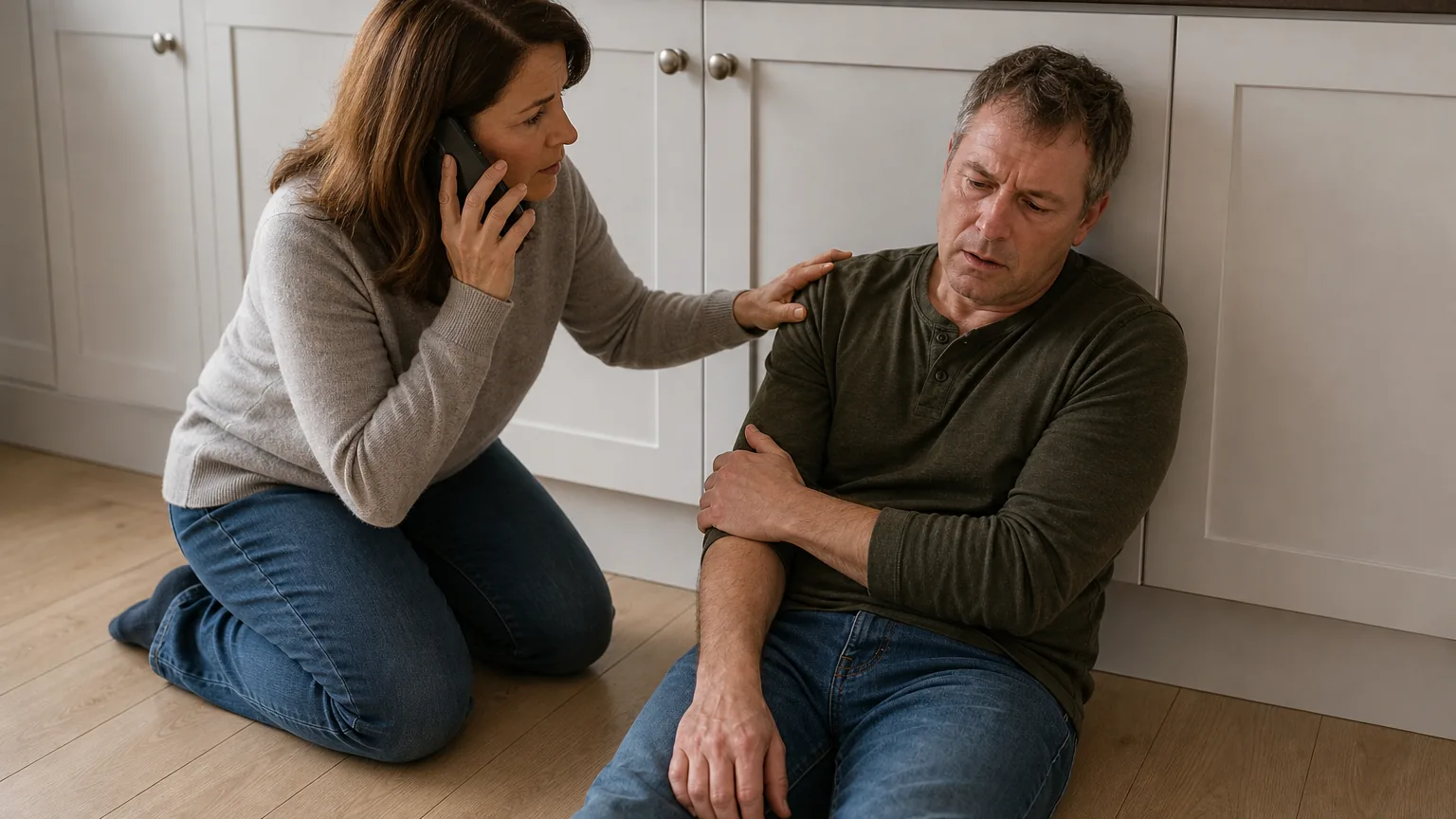
If someone is shocked, MedlinePlus, the National Library of Medicine’s consumer health service, sets out the order of operations:
- Do not touch the person with your bare hands while their body is still in contact with the source of electricity.
- If you can do it safely, cut the power at the plug or the breaker. As MedlinePlus puts it, “Simply turning off an appliance may not stop the flow of electricity.”
- Call 911.
- If the power cannot be cut, push the person away from the source with something dry that does not conduct, such as a broom, a chair, a rug or a rubber doormat.
- Once they are clear, check their breathing and pulse, and start CPR if they are unconscious and you cannot feel a pulse.
Anyone shocked by the inside of a microwave has met high voltage and should be seen in an emergency department even if they feel fine, for the reasons our guide to the hour after an electric shock explains. Some effects of an electrical injury surface months later, which we cover in the long-term effects of electric shock.
Repair or Replace?
The repair question is really two questions: who does the work, and whether it is worth paying for.
Who. An appliance service technician, not a handyman and not you. The federal performance standard for microwave ovens requires the radiation safety instructions supplied with every oven to say that it “should not be adjusted or repaired by anyone except properly qualified service personnel,” and requires manufacturers to give servicing dealers instructions for service procedures. FDA notes that radiation injuries from microwaves are very rare, and that the few on record trace to unusual circumstances or improper servicing. In British Columbia, appliance service technicians hold a trade qualification and train specifically on microwave high voltage circuits. Whoever you call, ask whether they are authorized by the oven’s manufacturer, which matters if it is still under warranty.
Check the warranty first. Consumer Reports notes that most manufacturers offer a one-year warranty, and in its member survey, nearly half of the over-the-range microwaves that were professionally repaired were covered by one.
Do the math on an over-the-range unit. Consumer Reports’ survey analysis suggests that a broken over-the-range microwave that cost $300 or less should be repaired if it is one to three years old and considered for repair at four to six years, and that the answer shifts if you paid more. Replacement carries its own costs: by the magazine’s estimate, a simple swap could cost $100 to $200 to install, and hundreds more if the new model needs electrical, venting or cabinet changes.
A countertop oven is usually an easy call. Any repair that means opening the cabinet means a technician’s visit, which rarely makes sense for an inexpensive countertop model. Replace it, and send the old one to recycling whole.
Know when the electrician comes in. Pulling out an over-the-range unit sometimes exposes a scorched or loose receptacle, or the new model needs a receptacle or circuit the old one did not. That is electrical work. Hire a licensed and insured electrician, expect a permit where your town requires one, and ask about GFCI protection, which the 2026 National Electrical Code requires for microwave ovens in new installations, hardwired or plugged in, as the kitchen section of our room-by-room safety walkthrough explains. Whether it applies to your job depends on the code edition your town has adopted.
The Bottom Line
Unplugging a microwave takes away the power from the wall. It does not take away what the oven has stored, and it does nothing about the step that has actually killed people: reaching into an oven that has been plugged back in with its cover off. The high voltage inside is invisible to a GFCI, draws too little on the plug side for a breaker or fuse to notice, makes no sound, and exceeds what a household meter is built to measure. The capacitor can keep a dangerous charge for up to a minute when everything works, and far longer when the bleed resistor fails.
Keep your checks on the outside of the appliance: the outlet, the breaker, the door, the recall list. Leave the cabinet to a qualified appliance service technician, leave the wiring to a licensed and insured electrician, and send a dead microwave to recycling in one piece rather than saving its transformer for a project. Electrical codes and permit rules vary by municipality, so confirm the specifics of any wiring work with your local building department and your electrician.
Further reading (sources)
- CPSC on the electrocution hazard of do-it-yourself microwave repair
- CPSC with its report on consumer product electrocutions from 2011 to 2020
- Technical Safety BC for an engineering report on microwave oven hazards and safe practices
- Technical Safety BC covering its investigation of the 2022 microwave repair death in Mission
- WorkSafeBC with its summary of the same death
- NIOSH FACE program on a New Jersey technician electrocuted while servicing a microwave in 1991
- NIOSH FACE program for a Maryland repair person electrocuted while diagnosing a microwave in 1994
- FDA on microwave oven interlocks, door damage and when to stop using an oven
- 21 CFR 1030.10 with the federal performance standard for microwave ovens
- OSHA on de-energizing equipment and discharging capacitors before work
- Virginia Tech Environmental Health and Safety covering capacitors that keep a hazardous charge
- Princeton Plasma Physics Laboratory (PPPL) from its safety directive on capacitors and dielectric absorption
- Campbell and colleagues on fractal wood burning deaths and injuries from 2016 to 2020
- Rohrer and Kallan with two deaths beside a dismantled microwave transformer
- Herb and colleagues for two fractal wood burning electrocutions and a review of the literature
- Consumer Reports on whether to repair or replace a broken over-the-range microwave
- NFPA with its microwave oven safety tip sheet
- MedlinePlus covering first aid for an electrical injury
Feature photo by Jstapko, CC BY-SA 3.0, via Wikimedia Commons.