Is Your Breaker, Outlet, or Power Strip Under Recall? Using CPSC's Tools to Find Out
Published on September 17, 2026

A recall notice is written for the person who bought the product. For a power strip, that was probably you. For the breaker in your panel or the receptacle behind the couch, it was an electrician or a builder, often years before you owned the house, buying from a supply house that never had your name. A recall can be announced, posted, and open for years while the household that actually has the part never hears about it.
The U.S. Consumer Product Safety Commission keeps its recalls and product safety warnings in one searchable database, and it runs other public tools most homeowners have never opened: a list of Notices of Violation, the SaferProducts.gov reporting site, and an injury clearinghouse that feeds it. This guide is the procedure rather than a list of recalls, because a list goes stale in a month. It covers where the model and date code hide on the devices in your house, how to search CPSC properly, what a Notice of Violation does and does not mean, what a remedy gets you when the part is inside a wall, and how to report a device that failed.
One thing outranks all of it. If an outlet, switch, breaker, or power strip is hot to the touch, buzzing, crackling, discolored, or smells like burning plastic, you are not researching tonight. Switch off that circuit at the panel if you can reach it without touching anything scorched or wet, and call an electrician. If there is smoke or flame, get everyone out and call 911.
Why Recalls Miss the Devices in Your Walls
A recall only protects you if it reaches the owner, and a wiring device is one of the hardest products there is to trace to an owner. Three things work against you.
You did not buy it. Breakers, panels, and receptacles are usually bought by whoever installs them. A 2010 recall of about 2.2 million breakers, load centers, and meter combos covered products sold through home centers, hardware and building supply stores, and numerous electrical distributors. A sale to a contractor rarely records which house the part went into.
You cannot see what decides it. Recalls of electrical gear are often defined by a range of date codes, not just a model, and the code can sit somewhere you cannot see. That same 2010 recall printed its breaker date codes on a side label, which faces the neighboring breaker once it is installed. A 2014 breaker recall covered only units built over six months.
It does not look broken. A breaker that fails to trip, or a connection overheating inside a panel, can give no outward sign until the day it matters. The 2014 recall involved breakers that would not trip during an overload. The 2022 recall discussed below involved load centers that could overheat.
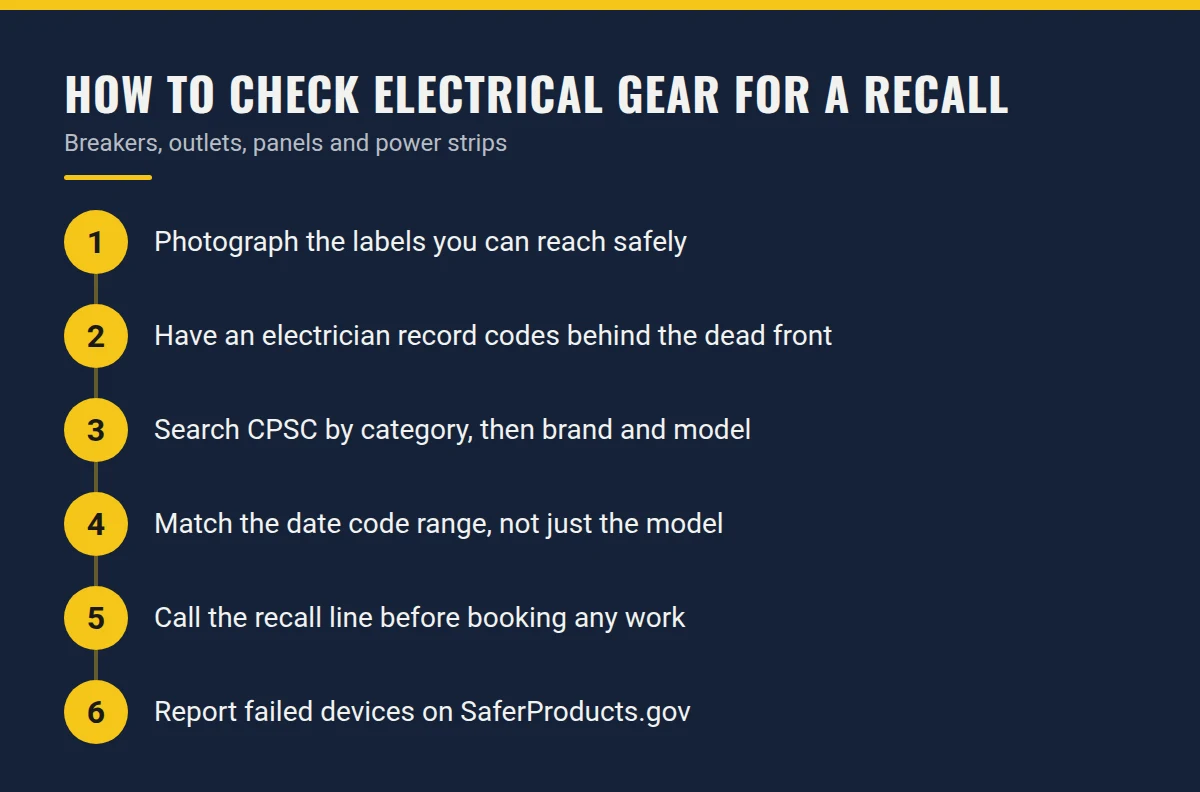
Step One: Read the Labels You Can Reach Without Opening Anything
For each device, photograph four things: the brand, the catalog or model number, any date code, and where the device sits in the house. Then match what you can see against what a notice asks for.
The panel. Open the panel door and look for the label on the inside of it. That label typically carries the manufacturer and catalog number, and sometimes a date code. The 2022 recall of about 1.4 million plug-on-neutral load centers told owners they could find the catalog number and date code inside the panel door on indoor units, and said a qualified electrician could locate the interior date codes that are not visible to the homeowner. That is the line to hold. The door is yours to open. The dead front, the inner metal cover that the breaker handles poke through, stays on.
Breakers. With the door open you can read the amperage on each handle, and often the brand on the breaker face. That is rarely enough to rule a breaker in or out, because the code a recall turns on may be printed on a side label, as it was in 2010. Reading it means removing the dead front and often pulling the breaker, which is an electrician’s job, not a flashlight job.
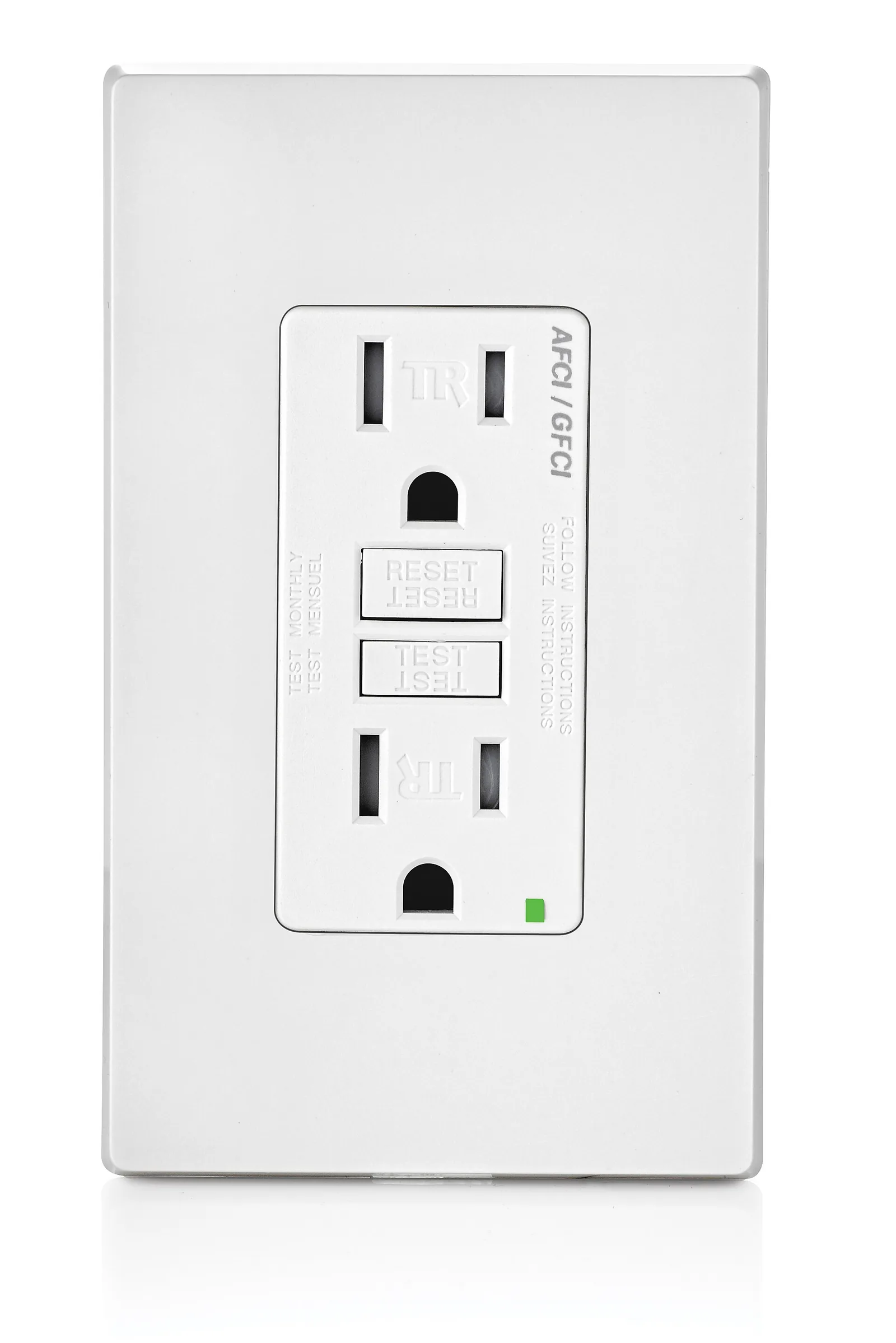
Receptacles and GFCIs. Removing a cover plate is one of the few steps here a homeowner can take, and it exposes the face of the device and its metal mounting strap, where the brand and ratings are commonly stamped. Date codes are another matter. A 2020 recall of commercial grade tamper resistant receptacles described date codes hot stamped on the back of the device, which you only see once it has been pulled out of the box. If the device or the plate is warm, cracked, or scorched, stop there and treat it as the emergency it is.
Power strips and surge protectors. These are the easy ones. Turn the strip over and read the label on the back or underside. In a 2026 case involving six outlet strips sold online, the identifying label on the back read “Relocatable Power Taps,” the formal name for a power strip.
Keep the photos with your house records. The next time an electrician has the dead front off for any reason, ask them to photograph the breaker labels and the panel interior before they close it up. Then any future recall can be checked from your couch. If you are in the middle of a remodel, ask for the brand and catalog number of the panel, breakers, and devices in writing; our guide to managing the electrical scope of a remodel covers what else to get before the walls close.
Step Two: Search CPSC by Category First, Then by Model
CPSC’s search lives at cpsc.gov/Recalls, under Recalls and Product Safety Warnings. It has a free text box, but the filters do the real work: a date range, hazard, category, where the product was manufactured, and remedy. Results can be exported as a spreadsheet file.
Start with the category rather than the brand. One manufacturer can sell the same device under more than one name (the 2010 recall covered breakers sold under two brand names), and the product name in a recall title is not always what is printed on the device. The categories that cover the electrical system are:
- Panelboards or Circuit Breakers or GFCIs or Fuses
- Electric Outlets or Receptacles
- Surge Suppressors or Power Strips
- Electrical Systems, and Electric Wire or Wiring Systems
- Extension Cords
Pair a category with a hazard such as Electrical Fire, Electrical Shock, or Electrical Overheating, and leave the date range wide. Stock can sit on a shelf before it goes into a wall, so a recall can predate your installation. Then open each plausible match and read three things: the description, the date code range, and the remedy.
The same search returns product safety warnings, and the difference matters. A recall is usually an agreement with a company, and it comes with a remedy. A warning is CPSC telling you directly to stop using something, often because the company has not agreed to an acceptable recall. In March 2026 CPSC warned consumers to stop using a line of six outlet power strips sold online that had no supplementary overcurrent protection, the small built-in breaker or fuse that cuts power when a strip is overloaded. The seller had not agreed to an acceptable recall. Three weeks later the warning became a recall with a refund. If your search turns up only a warning, there may be nothing to claim, and you should stop using the product anyway.
Last, check the manufacturer’s own safety notice page, because the two do not always match. For the 2022 load center recall, the manufacturer’s notice lists a wider span of date codes than the CPSC announcement does.
A Notice of Violation Is Not a Recall
CPSC’s Office of Compliance issues a Notice of Violation when it determines a company has violated a mandatory standard. The notice goes to the company, identifies the violation, and specifies the corrective action. CPSC publishes the sampled products that drew these notices as a downloadable spreadsheet, last updated in August 2026.
It is easy to read that spreadsheet as a recall list. It is not one. We sorted all of it, just under 40,000 entries, by the action CPSC requested:
- More than half asked the company to stop selling and correct future production.
- Nearly a quarter asked only that future production be corrected.
- Roughly one in eight involved seizure of the goods.
- Fewer than one in ten asked for a recall at the consumer level.
“Correct future production” means what it says. The company fixes what it makes next. Nothing in that request retrieves the units already sitting in homes.
For home electrical products the list is also narrow. The entries we found were mostly extension cords, holiday lighting, and portable generators with labeling violations. Extension cords and seasonal lighting are named in CPSC’s substantial product hazard rule: a cord that lacks the UL 817 requirements for minimum wire size, strain relief, polarization, or continuity qualifies, as does holiday lighting that lacks the UL 588 requirements for wire size, strain relief, or overcurrent protection. A batch of 23 extension cord notices in April 2021 all asked only for corrected future production. We found no circuit breakers, receptacles, or power strips in the spreadsheet at all.
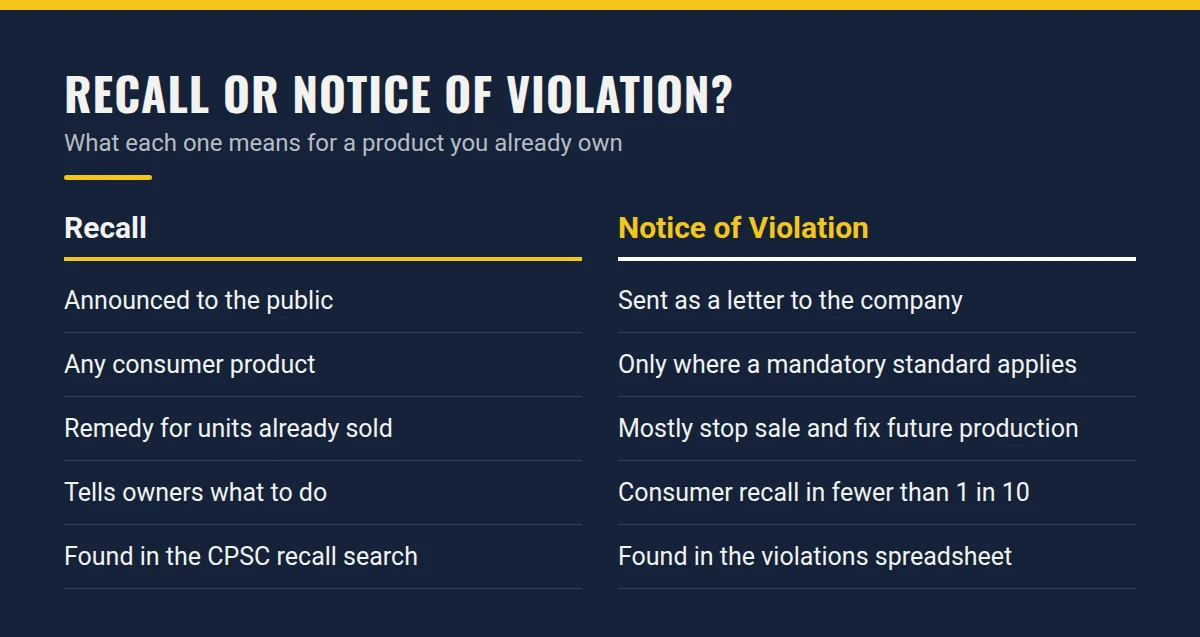
The practical takeaway: search the violations list if you own a no-name extension cord or holiday lighting, and if yours appears next to “correct future production,” nobody is coming for it, so retire it yourself. Our extension cord safety guide covers how to spot a cord that should already be in the trash. Do not expect this list to tell you anything about the devices inside your walls.
What a Remedy Gets You When the Part Is Inside a Wall
Every recall notice has a remedy line, usually refund, replace, or repair. For a plug-in product that line is the whole story: stop using it and follow the instructions. For a device that is wired in, the question that matters is who does the labor, and electrical recalls show how widely the answer varies.
The manufacturer sends the electrician. The 2010 breaker recall offered a free inspection by an electrician and a free replacement product. The 2022 load center recall arranged inspections by trained electricians and made the inspection and any resulting repair or replacement free of charge.
A part plus a capped labor credit. A 2014 recall of about 62,500 commercial breakers that would not trip during an overload offered a free replacement breaker and a credit of up to $300 per address toward installation by a certified electrician, or a handle update kit with a credit of up to $150.
A refund or a part in the mail. For a device that has to come out of a wall or panel, neither one covers the electrician. If that is what a notice for an installed device offers, raise the labor question before you book anyone.
Call the recall line before you call your own electrician. Programs can require approval before work starts: in the 2022 program, the manufacturer’s page told electricians not to begin any inspection or remediation until their service rate or quote had been approved. Work you arrange and pay for on your own may not be reimbursed. On that call, ask who performs the work, who pays if the inspection finds damage beyond the recalled part, and what you should do with that circuit in the meantime.
A recall notice cannot be unplugged. If the part in question is a breaker or a panel and you notice heat, buzzing, or scorching, that is an emergency call tonight, not a claim to file next week. Whoever arrives, check the license first; verifying an electrician’s license takes about five minutes.
When There Is No Recall to Find
An empty search result is not a clean bill of health, and one old panel story proves it. In 1983 CPSC closed its investigation of Federal Pacific Electric Stab-Lok breakers, saying the available data did not establish a serious risk of injury and that it would not commit further resources, and it made no determination about whether the breakers were safe. There was never a recall. We cover what that history means for an older house in our piece on grandfathered wiring, and what replacing a panel involves in our panel and service capacity guide.
Counterfeits are the other gap. At the end of 2007 a breaker supplier recalled about 50,000 counterfeit breakers made in China and labeled as a major brand, which had been sold through electrical distributors and retailers from 2003 to 2006 and could fail to trip when overloaded. That batch was caught. The defense against the next one sits upstream of any database: breakers bought through established electrical supply channels, installed by a licensed electrician, and matched to the breaker types listed on your panel’s label.
How to Report a Device That Failed
If a breaker, receptacle, or power strip fails in a way that could have hurt someone, report it on SaferProducts.gov. You do not need an injury. Congress defined harm to include the risk of injury, and reports that meet that definition can be published even when nobody was hurt. Consumers can file, and the definition of a consumer is broad enough to cover family members, friends, investigators, and professional engineers. Health care professionals and public safety agencies can file too.
To be published, a report needs eight things: a description of the product, the manufacturer or private labeler, a description of the harm or risk, the date or approximate date, your submitter category, your name and full mailing address, your verification that the report is accurate to the best of your knowledge, and your consent to publish. Your name and contact details never appear in the database, though you can choose to let CPSC share them with the manufacturer. CPSC sends the report to the manufacturer and publishes it no later than the tenth business day after that.
A few habits make a report worth more:
- Keep the failed device. If an electrician replaces it, ask them to hand it to you in a bag instead of tossing it.
- Photograph it before it moves, once the circuit is off, along with any label or markings.
- Include the model number and date code. Those are among the details a manufacturer may try to verify with you if you let CPSC share your contact information.
CPSC is candid that staff examine every report but cannot investigate each one individually. Reports still count. CPSC says every report matters to the analysis and product investigations it takes on where appropriate, and reports you allow it to publish join the incident data in the agency’s National Injury Information Clearinghouse, alongside death certificates, medical examiner reports, and news clippings. If you would rather talk to a person, the CPSC hotline is (800) 638-2772, weekdays from 8:00 a.m. to 5:30 p.m. Eastern.
The Bottom Line
A recall protects you only if you can connect it to the device in your house, and for wiring devices that connection is usually a date code you cannot see. Photograph what you can reach safely, have an electrician record the rest the next time the panel is open, and search CPSC by category before brand. Read a Notice of Violation as a letter to a company, not a promise about the unit you own. When a wired-in part is recalled, call the recall line before you book anyone and find out who does the labor. When something fails, keep it and report it.
Recall terms vary by manufacturer, and electrical codes and permit rules vary by municipality, so confirm the details with the recall contact and your local building department.
Further reading (sources)
- CPSC Office of Compliance on what a Notice of Violation is, with its spreadsheet of sampled violations
- CPSC with a 2022 load center recall that points owners to the label inside the panel door
- SaferProducts.gov for filing a complete report and keeping your name private
- 16 CFR 1102.10 on what a report of harm must contain before it can be published
- 16 CFR 1102.28 covering the ten business day deadline for publishing a report
- 16 CFR 1120.3 for the extension cord and holiday lighting defects treated as substantial product hazards