Is Your Old Wiring Really Grandfathered? What Existing vs. New Work Means for Homeowners
Published on September 13, 2026

You are three weeks into a kitchen remodel when the electrician tells you the number has gone up. The two-wire circuits feeding the counter have to be dealt with, the panel needs a surge device it never had, and a couple of outlets are moving, which apparently drags something else along with them. So you reach for the sentence every homeowner reaches for: the house was built in 1968 and the wiring is grandfathered.
It is the most misused word in residential electrical work, and it gets misused in both directions. Homeowners hear a permanent exemption. Some contractors use it to wave off work they would rather not do. Inspectors, who field it every week, mean something far narrower and far more conditional than either.
The code’s actual position is reasonable and worth knowing before you start a project, buy a house, or argue with anyone about a red tag. A new edition of the National Electrical Code does not make your house illegal overnight. Old work also does not earn a permanent pass just for having survived. What governs is a line between existing work and new work, and that line moves the moment somebody picks up a screwdriver.
One thing outranks all of it. If you are reading this because something in your house is sparking, smoking, buzzing, or smells like hot plastic, close the tab. Kill the circuit or the main if you can reach it safely, get everyone out if there is any sign of fire, and call 911. Nothing below is an argument you need to win tonight.
The Code Does Not Actually Contain the Word
Search the NEC for “grandfather” and you will not find it. It is trade shorthand, not a legal term, and that is a large part of why two people can use it in the same conversation and mean opposite things.
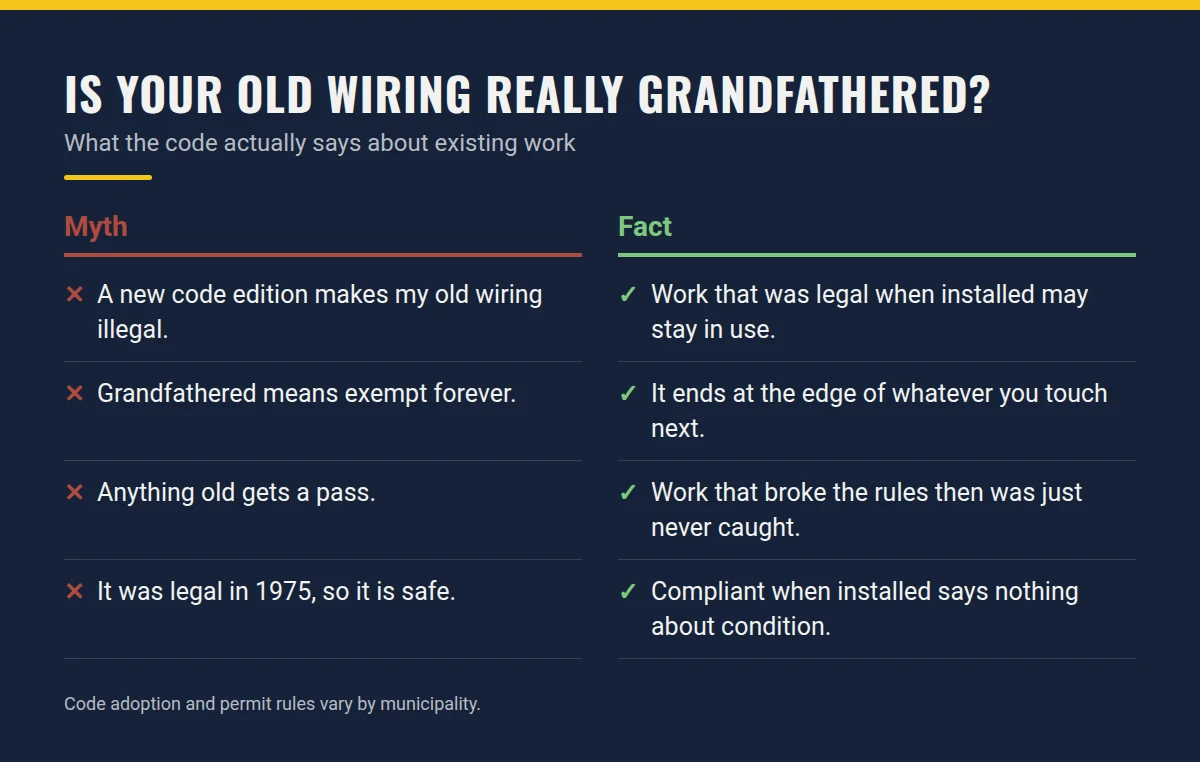
What does exist is the administration and enforcement language that jurisdictions adopt alongside the code, reproduced in the NEC as Informative Annex H. The operative sentence is short: existing electrical installations that do not comply with the current code are permitted to be continued in use, unless the authority having jurisdiction determines that the lack of conformity presents an imminent danger to occupants. Where corrections are ordered, a reasonable amount of time is allowed, scaled to how bad the hazard is.
Two conditions hide in that sentence and homeowners usually register only the first.
The installation has to have been legal when it went in. Something that violated the code in 1968 is not grandfathered, it was simply never caught. Age does not launder a violation, it only conceals one. A great deal of what inspectors find in older homes is not old compliant work at all, it is old noncompliant work that no one ever opened a wall to see.
And the inspector keeps a veto. “Imminent danger” is a high bar that nobody invokes over a missing arc-fault breaker, but it is real, and it is why a service that is visibly failing can be ordered corrected no matter what year it was installed.
Then comes the other half of the provision, the half that costs money. Additions, alterations, and repairs have to conform to what would be required of a new installation. The untouched rest of the building does not have to be brought along. The part you touch does.
Existing Work and New Work: The Line That Actually Governs
Paul Abernathy, an NEC consultant who has worked as a licensed electrician, an electrical inspector, a plans examiner, and a member of two NEC code-making panels, has made the case that “grandfathered” should be dropped from the conversation entirely, because the distinction that does the real work is existing versus new.
Existing work is an installation that was legal under the code in force when it was installed, has not been altered since, and is not unsafe. It stays.
New work is whatever you do now. It answers to the code edition your jurisdiction currently enforces, regardless of how old the house is or how old the circuit you are tapping into happens to be.
The trade says it more bluntly: you touch it, you own it.
Worth knowing, because it surprises people: the edition in force is not automatically the newest one. The NEC is a model standard with no legal force anywhere until a state or a city adopts it, and adoption lags publication by anywhere from a year to five. As of late 2026 most of the country is enforcing the 2023 edition, a handful of states have moved to 2026, several are still on 2020, and one or two are further back than that. Cities amend on top of the state, and a few large ones run their own electrical code outright. This is the same patchwork that makes electrician licensing a state-by-state affair, and it means the only authoritative answer to “what code applies to my job” comes from your local building department.
The Events That End It
Here is the practical list, ordered roughly by how small a thing can set it off.
Replacing a single receptacle. This is the smallest trigger in the book and the one that catches people out. Section 406.4(D) sets out a list of requirements for any receptacle that gets replaced. If an equipment grounding conductor is present in the box, the replacement has to be a grounding type and it has to be connected. If the location is one where GFCI protection is now required, the replacement has to be GFCI protected. If the location is one where AFCI protection is now required, the replacement has to be one of the listed arc-fault options. Tamper-resistant where tamper resistance is required, weather-resistant where the location is wet or damp. Swapping a tired beige outlet for a white one in a 1972 kitchen quietly pulls that one outlet forward five decades of code.
There is a defined answer for the common case where the box has no ground at all, and it is worth knowing before someone tells you the whole house needs rewiring. Our piece on what happens when a box loses its ground walks through the three replacements the code permits there.
Extending or modifying a branch circuit. Since the 2011 edition, where branch-circuit wiring is modified, replaced, or extended in one of the dwelling areas that requires arc-fault protection, the circuit has to be given that protection, either with a breaker at the panel or a listed outlet branch-circuit AFCI at the first receptacle on the circuit. There is a narrow exception for extensions of six feet or less that add no outlets or devices. Moving a receptacle eight inches to clear a new backsplash is a modification. So is adding an outlet to a bedroom wall. Our comparison of what AFCI and GFCI devices each actually catch covers why the code keeps pushing both further into older homes.
Replacing the panel or the service. This is the big one, and it is where quotes blow up. New service equipment has to satisfy current rules in full: working space and clearance in front of the panel, a compliant grounding electrode system, circuit directory labeling, conductor sizing. Two more recent requirements catch homeowners who budgeted from a neighbor’s ten-year-old invoice. Surge protection at dwelling unit services became a requirement in the 2020 NEC, and an outdoor emergency disconnect for one and two family dwellings arrived around the same time. Both are written so that they apply when existing service equipment is replaced, not only on new construction. Our panel and service capacity guide covers what a service change involves and what it tends to run.
Additions and remodels. New square footage gets new circuits to the current code, and the new load has to be justified against the existing service with a calculation. That calculation is frequently where a project discovers it needs a service upgrade it had not planned for.
Damage repair. Fire, flood, storm, rodents, a car through the garage wall. Repair is new work. Flooding is the least negotiable version, because submerged breakers, panels, and devices are not restorable no matter how dry and normal they look afterward, and our post-flood sequence explains why the replacement list is as long as it is.
An inspector deciding it is unsafe. The imminent danger clause. Rare, real, and not something you argue your way out of with a build date.
What Was Not Required When Your House Was Built
Grandfathering is a statement about paperwork. It says nothing whatsoever about protection. Here is roughly what a house did not have to have, by era. The dates are NEC editions, and your city may well have picked each one up years later.
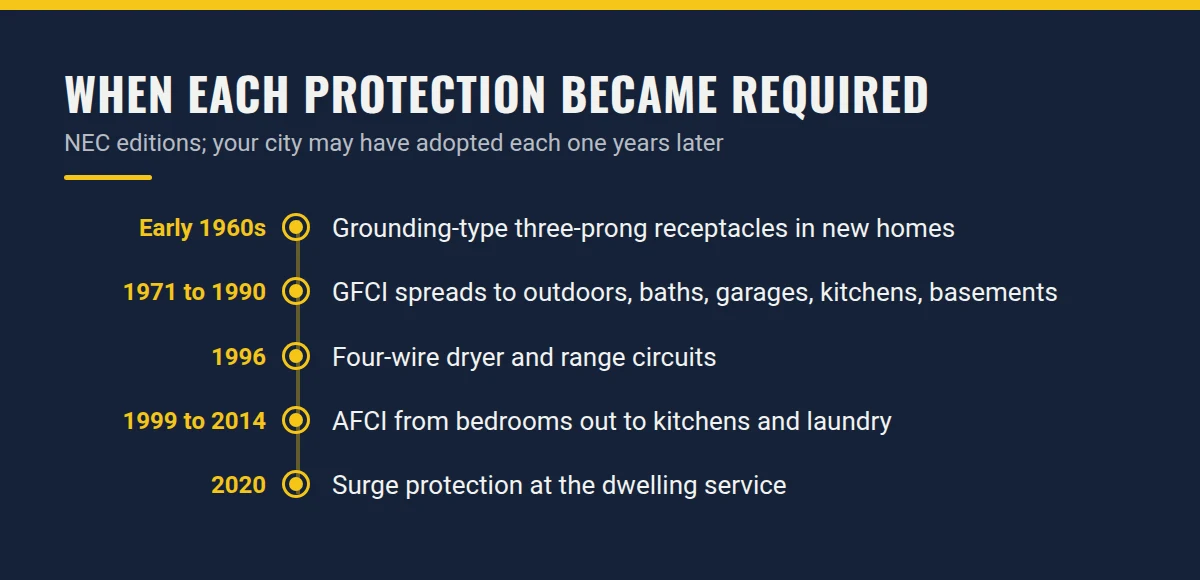
Grounding-type three-prong receptacles became the general requirement for new residential branch circuits in the early 1960s. Before that, two wires and no ground, which is why two-prong outlets are still in service by the millions.
GFCI protection arrived one location at a time rather than all at once: pools and outdoor receptacles around 1971, bathrooms in 1975, garages in 1978, kitchen counters near the sink in 1987, unfinished basements and crawl spaces in 1990, then a steady expansion through the 2020 and 2023 editions that now reaches nearly every damp, grounded, or outdoor location including the receptacle serving an air conditioner.
Four-wire dryer and range circuits were not required until the 1996 NEC. Before that the appliance frame was bonded to the neutral, and Section 250.140 still permits an existing three-wire circuit to stay in service where no equipment grounding conductor is present. That is textbook legal grandfathering, and it is also why a lost neutral can energize the case of an old dryer. Our guide to 240 volt circuits covers that failure in detail.
Arc-fault protection first appeared for bedroom circuits in the 1999 NEC with a 2002 effective date, expanded to most living areas in 2008, and picked up kitchens and laundry areas in 2014. Surge protection at the service is newer still.
None of that is retroactive. All of it is on the table the moment someone touches the circuit.
Legal Then, Dangerous Now
The code is a floor, and it gets raised because installations that met the old floor turned out to burn houses down.
Aluminum branch-circuit wiring is the cleanest example. It went into roughly two million American homes during the copper shortage of the mid 1960s through the mid 1970s, fully listed and fully legal. Research conducted for the Consumer Product Safety Commission found that homes built before 1972 and wired with aluminum are 55 times more likely to have one or more connections at outlets reach what the study defined as fire hazard conditions, meaning cover plate screws at 300 degrees Fahrenheit, sparks from the receptacle, or charred material around it. The fix is a specific listed repair at every connection, not a service call to go around tightening screws.
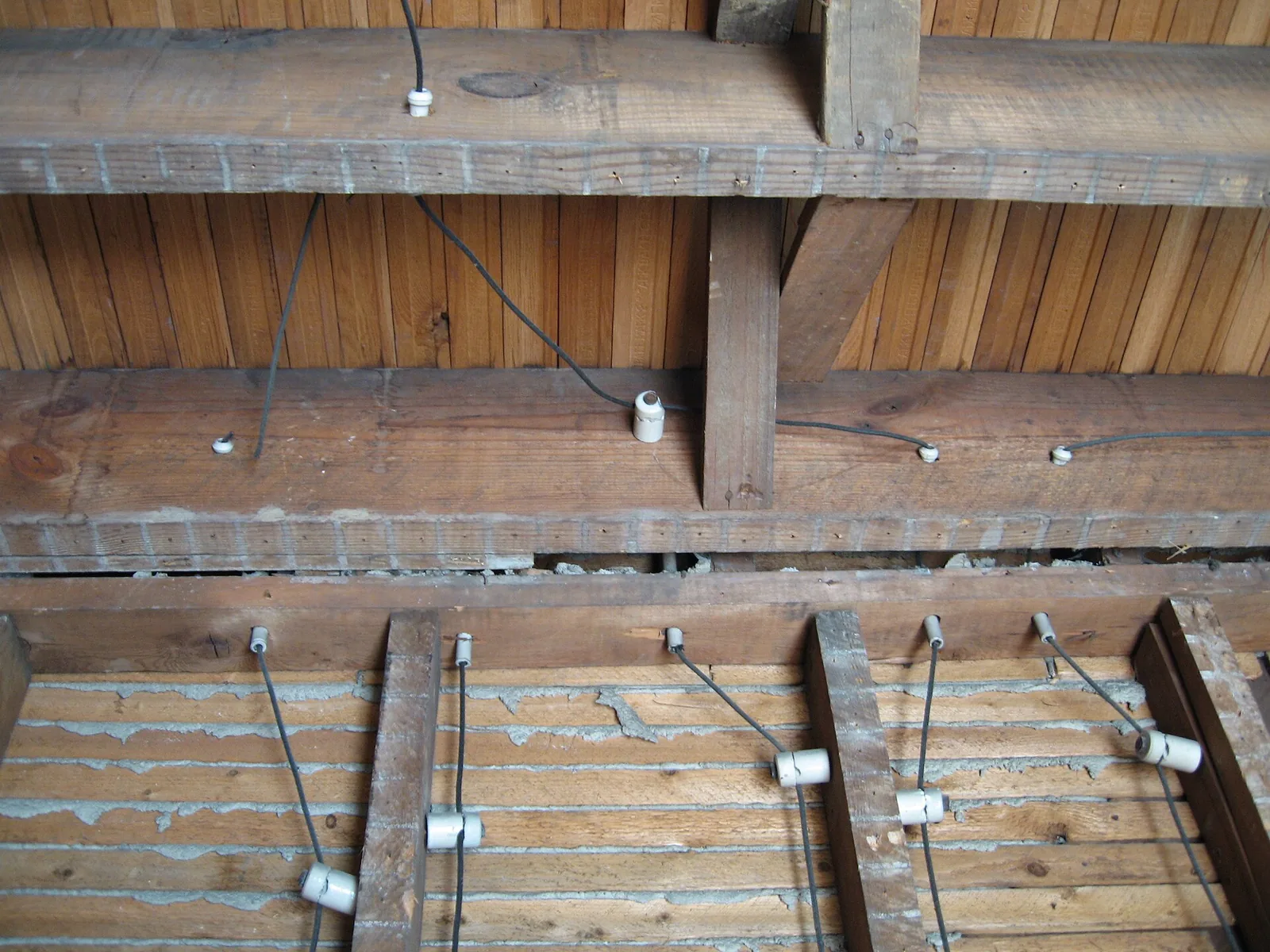
Knob and tube wiring was competent work for its era and is still sitting in a lot of attics. It has no equipment ground, its rubber and cloth insulation embrittles after several decades, and the code now prohibits it in spaces filled with thermal insulation, which is precisely what gets blown into an attic during an energy retrofit. A great many knob and tube problems were created by an insulation contractor, not an electrician.
Federal Pacific Stab-Lok and Zinsco panels were listed and legal when they were installed, then developed a reputation for breakers that fail to trip on a fault. A CPSC investigation in the early 1980s closed without a recall, which is not at all the same thing as a clean bill of health. Both are still energized in houses today, entirely grandfathered.
The pattern is the point. “Compliant when installed” is a filing status. It tells you nothing about the current condition of a fifty-year-old aluminum connection behind a receptacle, and only one of those two things can hurt you. If any circuit in your house trips repeatedly, runs warm, or smells hot, the age of the installation is irrelevant to how urgent it is.
The People Who Do Not Care About Your Grandfather Clause
Even if the code is entirely on your side, two other parties get a vote, and neither is bound by the NEC.
Insurers are first. Carriers have grown steadily less willing to write or renew policies on homes with active knob and tube, unremediated aluminum branch circuits, or Federal Pacific and Zinsco panels, and where they do write them the premium often makes the point for them. An insurer does not need to find a code violation. It needs a loss history, and it has one. Non-renewal letters citing the panel have become common enough in some states that electricians now quote panel replacements against an insurance deadline rather than a remodel schedule.
Buyers are second. A home inspector will flag every item above, the buyer will ask for remediation or a credit, and in some municipalities a point-of-sale inspection ordinance requires a certificate before the property can transfer at all. None of that is the building department enforcing the NEC against you. It is a private transaction where the other side has leverage.
So it is entirely possible to be legally grandfathered, fully compliant, uninsurable, and unable to close a sale, all at once. Those are four separate systems with four separate standards, and only one of them is the electrical code.
How to Use Any of This Before You Start
Ask what the work triggers, and ask before you sign. The question that gets a useful answer is this one: what does this job require you to bring up to current code, and is all of that in the quote? A good electrician has already worked it out. A vague answer now becomes a change order later.

Pull the permit. The trigger applies whether or not anyone files paperwork, so skipping the permit does not avoid the obligation, it just removes the inspection that would have caught a mistake. What it leaves you with is an unpermitted alteration that surfaces during a sale or an insurance claim at the worst possible moment. Confirm as well that the person doing the work is licensed and insured in your jurisdiction and that the contractor, not you, is the one pulling the permit.
Do not accept “it’s grandfathered” as a description of work happening today. It is a legitimate answer about the circuits nobody is touching. It is not an answer about the receptacle currently in someone’s hand.
And keep two budgets separate in your head: what the code obliges you to do, and what you ought to do anyway. An electrician who is already inside an open wall can run a ground, add a circuit, or replace a run of aluminum for a fraction of what the same work costs after the drywall goes back up. The remodel is the cheapest chance you will ever get.
The Bottom Line
Grandfathering is real, it is narrower than its reputation, and it is conditional on two things at once: the work was legal when it was installed, and it is not dangerous now.
It covers the parts of your house nobody is touching. It ends at the edge of the work, and the edge can be as small as one receptacle. It never applied to anything that was noncompliant to begin with. And it makes no claim at all about safety, which is a separate question your insurer, your buyer, and eventually your wiring will each answer on their own terms.
If your house predates the mid 1970s and you have never had the electrical system looked at by someone qualified, the useful move is not to research whether you are obligated to upgrade. It is to have a licensed electrician tell you what is actually behind your walls, so that the decision is yours rather than a claims adjuster’s. Code adoption, permit requirements, and point-of-sale rules all vary by municipality, so confirm the specifics with your local building department and a licensed electrician in your area.
Further reading (sources)
- EC&M on why the word grandfathered muddies existing versus new work
- EC&M for the replacement rules that apply every time a receptacle comes off the wall
- e-Hazard with the case that you cannot grandfather a code violation
- Consumer Product Safety Commission from its findings on aluminum branch wiring and how it has to be repaired
- Electrical Contractor on the outdoor emergency disconnect and when replacing service equipment invokes it
- Consumer Product Safety Commission on the home wiring hazards behind 40,000 fires a year