Apprentice to Master: Electrician Licensing and How to Verify a License
Published on September 12, 2026
It is 11:40 at night. Something behind the wall smells like hot plastic, the number you found is answering, and a van is twenty minutes out. In a few minutes a stranger you have never met will pull the dead front off your panel and put their hands inside the one part of your house that can kill them.
The whole American licensing system exists to make that moment survivable. It is a ladder of supervised hours, exams, and paperwork, and almost none of it is visible from your doorstep. What is visible, if you know where to look, is a number. This guide covers what the tiers actually mean, what a contractor license and bond cover that an individual license does not, and how to check that number against the state’s own records before you unlock the door.
One thing first, because it outranks all of this. If you can see flame, if the panel is arcing or smoking, or if there is scorching spreading across a wall, you are not vetting a contractor tonight. Get everyone out and call 911. If a service conductor is down in the yard or the meter base is damaged, that is the utility’s line and their emergency number, not an electrician’s.
The Three Tiers, and Why They Exist
There is no national electrician’s license in the United States. Every rung of the ladder below is defined by a state, and in some states by a city, which is why the same title can mean different things four hours’ drive apart.
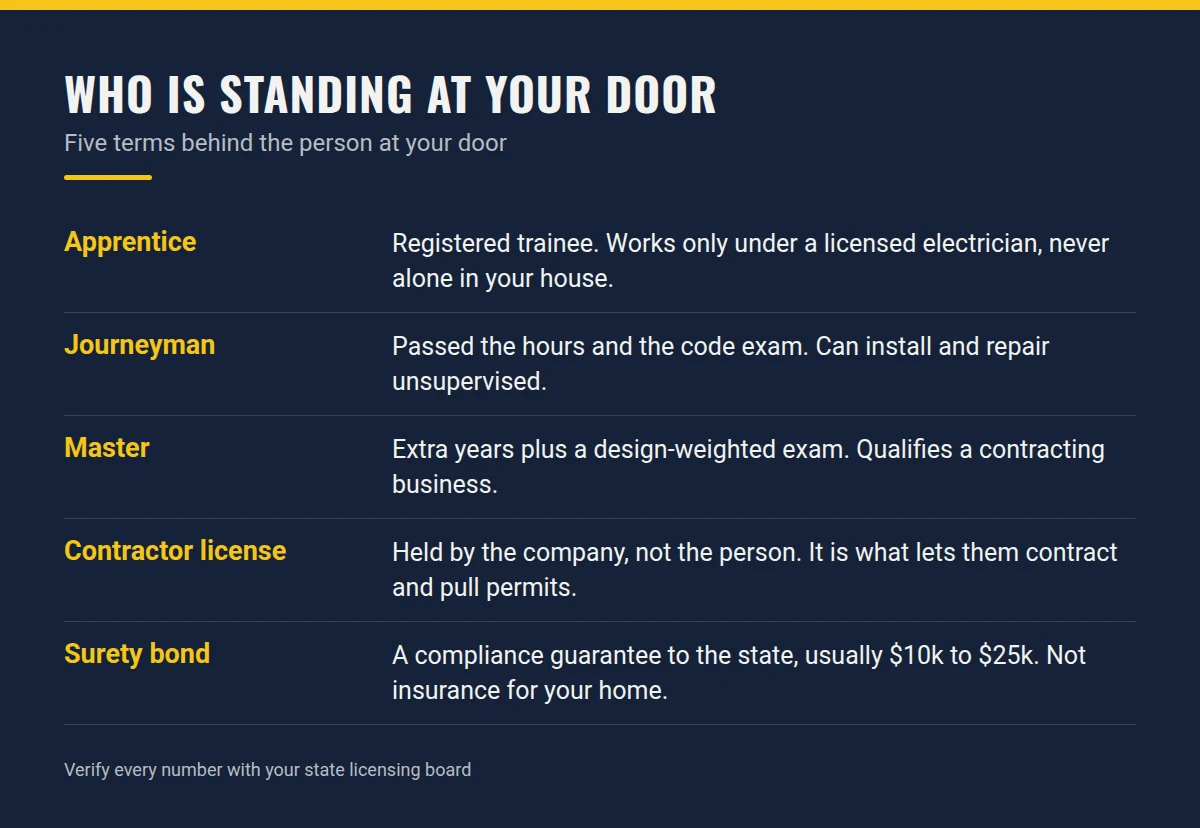
Apprentice. A registered apprentice is a paid employee who works only under the supervision of a licensed electrician, at a ratio the state sets, often one apprentice per journeyman on site. Registration is not a formality. It puts the apprentice in a program tracked by the US Department of Labor or a state apprenticeship agency, which means the hours they log are documented well enough to count toward a license years later. An apprentice may be perfectly competent at the task in front of them. They are not licensed to be in your house alone.
Journeyman. The journeyman license says a person has finished the hours, passed the exam, and can install and repair electrical systems without anyone watching. This is the license the person actually doing the work at your panel should hold. In most states a journeyman cannot pull a permit or contract for the job in their own name, which surprises homeowners.
Master. A master electrician has worked as a journeyman for an additional stretch, usually two more years, and passed a harder exam weighted toward design, load calculation, and code application rather than installation practice. Masters design systems, supervise, and in most states are the only individuals who can serve as the qualifying party for a contracting business.
The Hours and the Exam
The apprenticeship is the long part. The common shape is four to five years combining roughly 8,000 hours of on the job training, about 2,000 a year, with several hundred hours of classroom instruction, typically around 144 hours per year. Union programs run through the Electrical Training Alliance with IBEW and NECA use that structure; merit shop programs through the Independent Electrical Contractors and Associated Builders and Contractors run parallel versions of it. State minimums vary widely, from around 4,000 hours in the lightest jurisdictions to 10,000 in the heaviest, and some states let a two year technical degree substitute for a defined block of hours.
The classroom half is not optional padding. It is where conductor sizing, voltage drop, box fill, grounding theory, and motor calculations get taught, and it is what separates an electrician from someone who has watched a lot of installations.

The journeyman exam is typically open book with the National Electrical Code permitted at the desk, runs about four hours, and asks 80 to 100 questions with a passing mark usually set between 70 and 75 percent. Open book is not the concession it sounds like. The questions are written so you cannot pass by reading; you have to already know where a rule lives and how it interacts with three others. Many states add a section on their own amendments to the NEC, and some add a business and law paper.
That last point matters more than it looks. States adopt NEC editions on their own timetable, so one state may be enforcing the 2023 code while its neighbor is still on 2020, and cities amend on top of that. A licensed electrician is licensed against a specific code as adopted in a specific place. This is the same reason permit requirements differ so much when you add a large 240 volt circuit or a new appliance feed.
The License You Actually Hire: Contractor, Bond, and Insurance
Here is the distinction that trips up almost everyone. An individual license certifies a person’s competence. A contractor license authorizes a business to sell you work.
An electrical contractor license is issued to a company, and to get one the company generally has to name a qualifying party, a master electrician who is genuinely employed there and answerable for the work, then post a surety bond and carry insurance. The contractor is the entity that signs your contract, pulls the permit, and carries the liability.
The bond is not insurance for you. A surety bond, commonly $10,000 to $25,000 depending on the state, is a guarantee to the state and the public that the contractor will follow the licensing law. If a claim is paid out of it, the contractor has to repay the surety in full. It is a compliance instrument with a small ceiling, and it will not come close to covering a house fire.
General liability insurance is the one that covers your property. Look for at least $500,000, and $1 million is common on residential work. This is what pays if a mistake damages your home.
Workers’ compensation is the one nobody asks about and everybody should. If an uninsured worker is injured in your basement, the claim can land on your homeowner’s policy, or on you. Ask whether the person coming out is a W-2 employee covered by the company’s policy or a subcontractor with their own.
Beyond the paperwork, none of this tells you what the visit will cost. Our breakdown of what emergency electrical work actually runs covers call out fees and after hours rates, and our five questions to ask before hiring covers the rest of the phone call.
Reciprocity: Why a License From the Next State May Not Count
Reciprocity is an agreement between two states to accept each other’s licenses without making the holder retake the exam. It is real, it is common, and it is narrower than people assume.
Reciprocity is usually granted at the journeyman level, sometimes at master, and it typically requires that the license was earned by passing a comparable exam rather than grandfathered in, that it is currently active and in good standing, and that the holder has worked under it for some minimum period. States publish their reciprocity lists, and they change.
Two things reciprocity almost never covers. It does not transfer a contractor license, and it does not transfer the bond. Both are tied to the state where the work happens. So an out of state crew that shows up after a regional storm may hold entirely legitimate individual licenses and still have no authority to contract for work or pull a permit in your jurisdiction. That is the exact gap storm chasers operate in.
How to Verify a License in Five Minutes
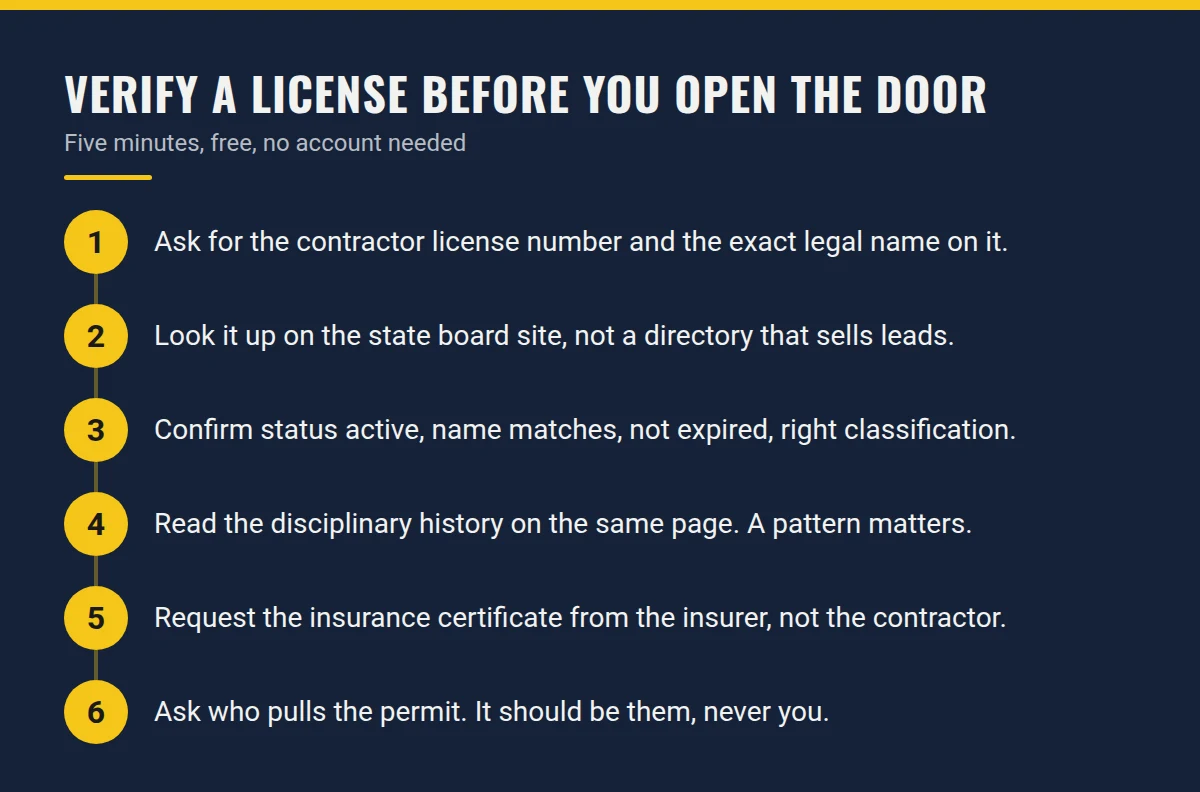
Every state that licenses electricians runs a free public lookup, usually through a board of electrical examiners, a contractors’ licensing board, or a department of labor and industry. You do not need an account and you do not need to explain why you are asking.
Get the number, not the reassurance. On the phone, ask for the contractor’s license number and the exact legal name it is issued under, which is often not the trading name on the truck. Ask separately for the name and license number of the electrician who will actually be dispatched.
Look the number up on the board’s own site. Go to the state board directly, rather than a lead generation directory that also sells leads to the company. Confirm four things: the status reads active, the name matches the business you called, the expiry date has not passed, and the classification covers electrical work. California, for example, issues electrical contractors a C-10 classification, and a general contractor’s license is not the same thing.
Read the disciplinary history. Most boards publish citations, suspensions, and complaint outcomes on the same page. An old resolved complaint is not damning. A pattern is.
Get the insurance certificate from the insurer. Ask the contractor for their agent’s contact details and request the certificate of insurance directly, with your name listed as certificate holder. A PDF forwarded by the contractor proves nothing about whether the policy is still in force this week.
Ask who pulls the permit. For panel work, service changes, or new circuits, the contractor pulls it. If they ask you to pull an owner-builder permit instead, that shifts the liability onto you and is often a sign they cannot pull one themselves. Permits and inspections are the whole point of the process when you are upgrading a panel or service or installing a Level 2 EV charger.
What an Expired or Borrowed License Looks Like
The failures cluster into a few recognizable shapes.
The expired card. Licenses renew on a cycle, usually every one to three years, and renewal normally requires continuing education on the current code. A card that lapsed eighteen months ago means the holder has missed a code cycle and is working outside the law.
The borrowed qualifier. This is the serious one. A master electrician is paid to attach their name to a company they do not really work for, so the business can hold a contractor license without anyone qualified running the jobs. It is illegal in every state that licenses contractors. The tell is that the qualifying party’s name on the state record matches nobody who has ever been to your house or answered the phone.
The number that belongs to somebody else. Ask whose name is on the license and compare it against the board record. A number that comes back registered to a different business, or to a person who is not present, is not your contractor’s license.
No number at all. Many states require the license number to appear on contracts, estimates, invoices, and advertising. An estimate with no license number in a state that requires one is itself a violation, before you have looked up anything.
The behavioral flags. Cash only, no written estimate, an unmarked vehicle, a refusal to pull a permit, pressure to authorize work immediately, or door to door solicitation in the days after a storm. Any single one might have an innocent explanation. Two together is a pattern.

At midnight the compressed version is this. Get the license number on the phone before they arrive, look it up on your phone while you wait, and photograph the ID and the license card at the door. If the number does not check out and the situation is not immediately dangerous, kill the affected circuit at the breaker and wait for morning. A dead circuit is an inconvenience. A bad repair inside your panel is a fire that starts three months later.
Why This Is Getting Harder
The vetting matters more now than it did a decade ago, because the supply of qualified electricians is genuinely tight. Construction had 298,000 job openings at the end of May 2026 according to an Associated Builders and Contractors analysis of federal JOLTS data, up 76,000 year over year, while the industry’s hiring rate fell to 3.5 percent, matching an all time low. ABC’s chief economist attributed the gap specifically to demand for electricians driven by data center construction rather than broad industry growth.
The trade is responding. The National Technical Institute opened an 8,000 square foot campus in Reno-Sparks, Nevada, its fifth, built to train 400 people a year in electrical, HVAC, and plumbing. Wells Fargo committed $1 million to skilled trades development in Pennsylvania through the mikeroweWORKS Foundation. Industry programs profiling electricians under thirty describe a deliberate push to replace a retiring generation.
None of that fills the gap tonight. When licensed capacity is scarce and demand is urgent, unlicensed operators fill the space, and they concentrate exactly where judgment is worst: after storms, after floods, and at 2 a.m.
The Bottom Line
The ladder from apprentice to master is roughly four to five years of supervised hours and a code exam to reach journeyman, and a few more years plus a harder exam to reach master. The business you hire needs its own license, a bond, liability coverage, and workers’ compensation, and none of those transfer across state lines the way an individual license sometimes does.
Verification is a five minute task and the only part of this system a homeowner controls. Ask for the number, check it against the state board’s own record, get the insurance certificate from the insurer, and confirm who is pulling the permit. Do it before the emergency if you can, so the number you call at midnight is one you already checked.
Licensing rules, adopted code editions, and permit requirements vary by state and municipality, so confirm the specifics with your state licensing board and local building department.
Further reading (sources)
- EC&M on why demand for electricians is outrunning construction hiring overall
- EC&M for a new trade campus built to train 400 students a year
- Bureau of Labor Statistics on electrician licensing, apprenticeship and the job outlook
- Apprenticeship.gov for finding a registered electrical apprenticeship