How to Shut Off Power to a Modern House: Breakers, Meters, Solar Rapid Shutdown, and Battery Disconnects
Published on September 23, 2026

Nearly every piece of emergency electrical advice, including plenty on this site, starts with the same instruction: shut the power off. For most of the last century that meant one switch. You found the panel, threw the big breaker at the top, and the house went dead, because the utility was the only thing feeding it.
That assumption no longer holds for a lot of houses. A home built or upgraded in the last decade may have panels on the roof, a battery in the garage, a standby generator beside the air conditioner, and an EV that can push power into the house as easily as it pulls power out. Several of those exist precisely to keep the lights on when the utility disappears, and they cannot tell a storm from you reaching for the main. This guide covers where the code puts each shutoff, what it leaves live, which ones are yours to operate, and how to rehearse the sequence before you need it.
One rule outranks everything below. If there is fire or smoke at the panel, the battery, or the generator, if reaching a switch means stepping into water, or if you smell gas, do not go looking for switches at all. A breaker opening can spark. Get everyone out, call 911 from outside, and tell the dispatcher the house has solar, a battery, or a generator, because that changes how firefighters approach it.
What the Main Breaker Actually Turns Off
The main breaker separates the utility from everything downstream of it. That is a lot, but it is not everything. The conductors between the meter and the main stay live at full utility current with every breaker in the house switched off, which is why the panel cover is never homeowner territory. Our map of how power reaches your outlet walks through that line side in detail.
The bigger gap in a modern house is that the main only handles one source. Count the others before you trust it:
- Rooftop solar makes voltage whenever light hits the modules, grid or no grid, main on or off.
- A home battery with backup is built to take over the moment the utility disappears. Switching off the utility is, from the battery’s point of view, an outage.
- A standby generator has a transfer switch watching the utility supply. When that supply vanishes, the switch starts the engine and moves the house onto it.
- A portable generator on an interlock kit runs the house with the main off. That is the whole point of the interlock: the main has to be OFF before the generator breaker can go ON.
- A bidirectional EV on a vehicle to home charger is a battery on wheels, and it behaves like one.
The Los Angeles Firemen’s Relief Association spelled out the consequence in its guidance for firefighters: pulling the meter kills only the power coming in from the grid, and circuits can stay live if the home has battery backup, an automatic start generator, or sun on the panels. The same logic applies to your main breaker.
Start at the Meter: The Placards Are Your Map
A house with more than one source is supposed to say so, at the meter and service equipment where a firefighter looks first. The code requires signs that tell a stranger what the house has and where each shutoff lives. Minnesota’s Department of Labor and Industry publishes a one page guide to the solar labels, and California permit checklists cover the rest. Look for these:
- A plaque reading “CAUTION: MULTIPLE SOURCES OF POWER.” It belongs at the service equipment and has to show where the disconnect for each power source is located. This is your map. Read it before you need it.
- A yellow and white label reading “SOLAR PV SYSTEM IS EQUIPPED WITH RAPID SHUTDOWN,” with a simple drawing of the building and its roof, placed at the service equipment and pointing to the rapid shutdown switch.
- A red reflective label reading “RAPID SHUTDOWN SWITCH FOR SOLAR PV SYSTEM” on that switch or within 3 feet of it.
- “PV SYSTEM DISCONNECT” and “ENERGY STORAGE SYSTEM DISCONNECT” on the solar and battery disconnects, each of which has to show plainly whether it is on or off.
- A generator sign at the service equipment giving the type and location of each standby source on the property.
- “EMERGENCY DISCONNECT” on the outdoor service disconnect of newer services, covered in the next section.
If your house has panels or a battery and you cannot find any of these, either something was missed at inspection or the labels have weathered off. Ask the installer or an electrician to replace them. They cost little, and they are the first thing a fire crew will look for.
Switch One: The Main Breaker or the Outdoor Emergency Disconnect
In most older houses the main is the large double breaker at the top of the indoor panel, or it sits outside in a combined meter and breaker enclosure. Since the 2020 edition, the National Electrical Code has required new services on houses and duplexes to include an emergency disconnect at a readily accessible spot outdoors, and current editions apply the rule when an existing house has its service equipment replaced. IAEI Magazine, published by the electrical inspectors’ association, explains that the rule exists first and foremost to give first responders a quick, safe way to isolate power, and to reduce the temptation to pull meters. It usually sits right beside the meter. The 2026 edition folded the rule into its general service disconnect section and spells out the marking: “EMERGENCY DISCONNECT” in white letters at least half an inch high on a red background, as EC&M’s review of the 2026 changes describes.
Whether your house has one depends on when the service was installed or last replaced and which code edition your town had adopted at the time. A house with an older panel that has never been touched will not.
Either way, the switch works the same. Stand on a dry surface, leave the panel’s inner cover in place, and move the handle firmly to OFF. Ready.gov’s household guidance is to switch off the individual circuits before the main, which means the main opens with almost no load on it. When seconds matter, skip straight to the main.
Water changes the rules. The CDC’s advice for flooded homes is to turn off the main only if you can reach it from a dry location, and to call an electrician rather than step into standing water to reach it. Never operate a switch while you are standing in water. The utility can also cut the power at the meter, which our guide to electrical safety after a flood walks through.
The Meter Is Not a Switch, and It Is Not Yours to Pull
For decades the surest way to kill a house was to have a utility worker pull the meter, and IAEI describes that as the historical standard. It is not a homeowner move, for three reasons.
First, the meter and the seal on its ring belong to the utility. Utilities treat a broken seal as tampering, and in many places tampering is a crime. If an electrician needs the meter out to repair your service, that gets arranged with the utility.
Second, a meter socket is not a disconnecting means. Pulling a meter under load can draw an arc across the jaws, and the terminals it leaves exposed are on the line side, where nothing in your house limits the current.
Third, in a house with other sources it does not finish the job. With a battery the house may not even go dark, because the battery reads the missing meter as a grid outage and takes over.
The emergency disconnect exists largely so that firefighters no longer need to pull meters, and your utility will cut service at the meter or the pole when that is genuinely required. Our outage triage guide covers which calls go to the utility and which go to an electrician.
Solar: What Rapid Shutdown Does, and What It Leaves Live
Rooftop solar puts wiring exactly where firefighters work: on the roof, through the attic, and down the wall. Rapid shutdown is the code’s answer. It first appeared in the 2014 NEC, and the 2017 edition set the version most modern systems follow. Once it is triggered, wiring more than a foot outside the edge of the array has to fall to 30 volts within 30 seconds, and wiring inside that boundary to 80 volts, according to IAEI’s summary of the rule and the Berkeley permit checklist that quotes it.
The trigger has to be at a readily accessible spot outside the house. It can be the service disconnect itself, the solar system’s own disconnect, or a dedicated switch that plainly shows on and off, which is why the yellow placard matters: it tells you which one your house uses. On many systems without a battery, switching off the main or the outdoor emergency disconnect is the trigger, because the rooftop electronics shut down when they lose the grid. Add a battery and that shortcut can stop working, since a battery holding up the house wiring can keep the solar producing along with it. The placard should point you to a separate switch in that case.
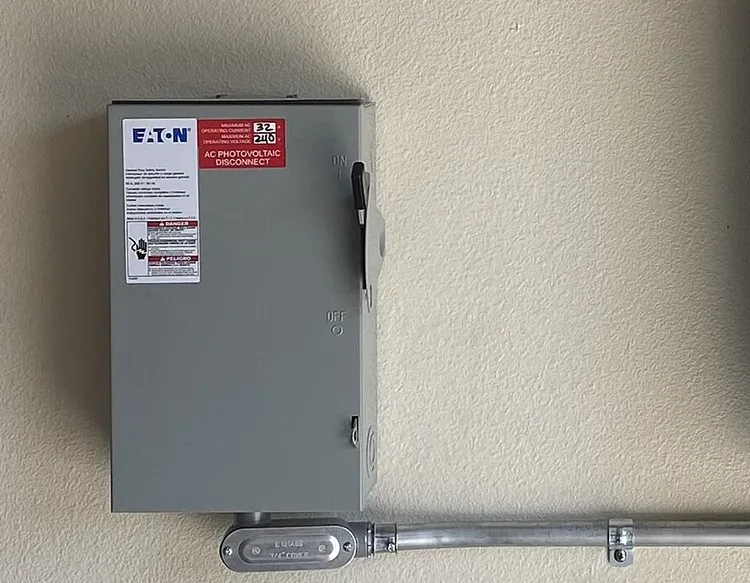
What rapid shutdown does not do is make the roof safe. The modules themselves produce voltage whenever the sun is on them, and 80 volts inside the array is lower, not zero. Systems installed before rapid shutdown was required keep full voltage on the wiring between the roof and the inverter whenever it is light out. The Minnesota label guide notes that a building with a mix of system types needs a roof plan showing a dotted line around every area that stays energized after the switch is thrown.
Your part is the switch and nothing else. Stay off the roof, and never pull apart the connectors between modules, because separating a DC connector under load can draw an arc. A grid-tied system without a battery also stops sending power into the house within seconds of losing the grid, which our guide to solar and bidirectional EV backup explains.
Batteries: The Source Built to Ignore Your Main Breaker
A home battery set up for backup has one job in an outage: keep the backed up circuits alive. Its transfer equipment separates the house from the grid and the battery picks up the load, and on many systems the lights barely flicker. The battery cannot tell you switching off the utility from a storm taking down the line.
Current code gives you two controls. The battery must have a disconnect marked “ENERGY STORAGE SYSTEM DISCONNECT” that plainly shows on or off, located in the battery, within sight of it and no more than 10 feet away, or lockable if it is out of sight. And at a house or duplex, the battery must have an emergency shutdown function that stops it from exporting power into the house wiring, triggered from a readily accessible spot outside and plainly marked on and off. Berkeley’s storage permit checklist quotes both rules.
Read that second rule closely, because its wording is exact: the shutdown stops export. It does not drain the battery. The cells stay charged after the switch is off, and the EPA warns that lithium battery fires are extremely difficult to put out and can reignite hours or days later.
That is also why the switch is outside. If the battery itself is the problem, with hissing, popping, smoke, a sharp chemical smell, or a swollen case, do not go into the garage to find its switch and do not open the garage door to look. In fire service testing of a residential battery in a mock two car garage, the timing and severity of a battery gas explosion proved unpredictable, and the U.S. Fire Administration notes that firefighters face the greatest explosion risk in the driveway and at doors and windows. Get out and call 911. The code also reserves installing and maintaining these systems for qualified people, so everything behind the battery’s cover belongs to your installer or electrician.
Generators: The Source That Restarts Itself
A standby generator’s transfer switch watches the utility supply around the clock. When that supply disappears, it starts the engine and moves the backed up circuits onto the generator, usually within seconds. It cannot tell a downed line from you switching off the utility ahead of it, so a generator left in automatic can start and energize the house again moments after you thought you had finished.
The fix is to take it out of automatic first. Every standby unit has an OFF setting on its controller, and current code also requires a permanently installed generator at a home to have an emergency shutdown device outside the house at a readily accessible location, as EC&M’s code column quotes the rule. The generator sign at your service equipment tells you where the generator itself is, so you know where to look.
Portable generators work differently. Connected through an inlet and an interlock, the generator runs the house with the main off, so switching the main does nothing to it. Shut it down at the source: switch off the generator’s own breaker, stop the engine, and unplug the cord from the inlet. If anyone in the house has ever fed a generator into a dryer outlet or a wall receptacle, now is the moment to stop for good. The CDC points out that connecting a generator to house circuits without approved isolating equipment is against the law and endangers line workers restoring power. Our guide to preparing your electrical system for an outage covers transfer switches and interlocks in more depth.
EV Chargers: A Load, Unless the Charger Runs Both Ways
An ordinary Level 2 charger is just a big appliance. Its breaker, or the main, takes it out, and the car’s battery stays sealed inside the car.
A bidirectional setup is different. The Department of Energy describes bidirectional vehicles as able to provide backup power to buildings, and at home that means the car behaves like a stationary battery: when the grid disappears, the charging equipment isolates the house and the car starts feeding it. Stop the export in the charger’s controls, then unplug the connector. The vehicle’s own pack stays charged, so anything wrong with the car itself is a call for the fire department.
Who Is Allowed to Touch What
In an emergency most homeowners either do too little or far too much. The line between the two is simpler than it looks.
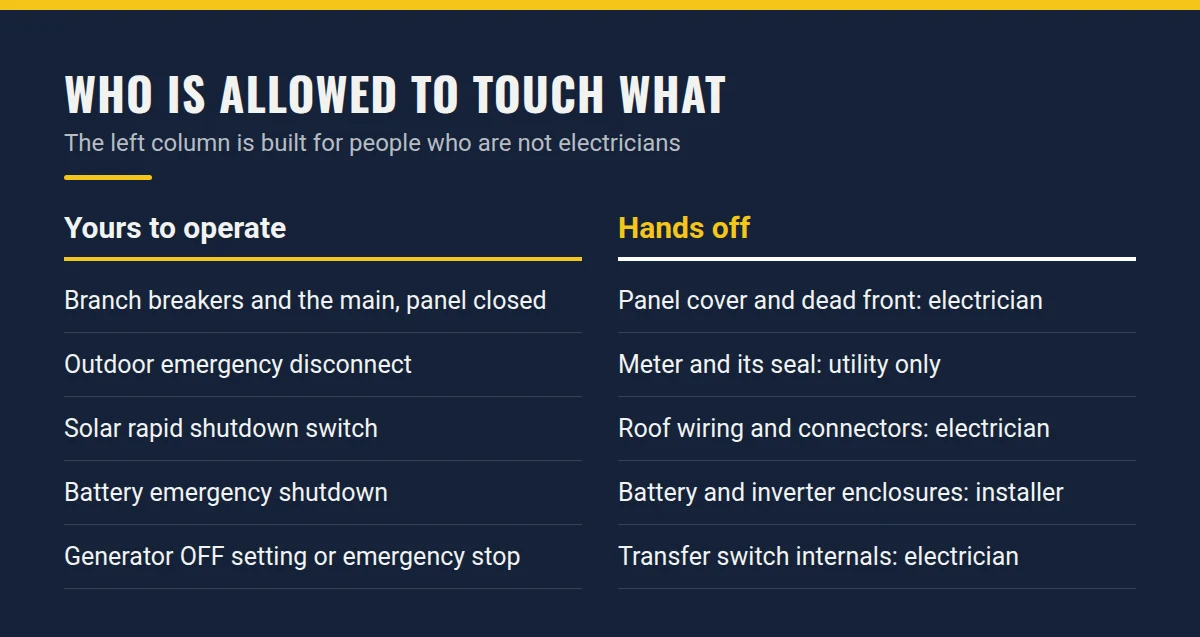
You may operate: branch breakers and the main from the front of a closed panel while standing somewhere dry, the outdoor emergency disconnect, the rapid shutdown switch, the battery’s emergency shutdown, a standby generator’s OFF setting or emergency stop, a portable generator’s breaker, engine switch and cord, and an EV charger’s controls and plug. Every one of those is designed to be operated by someone who is not an electrician.
Your electrician handles: anything behind a cover, including the panel’s inner dead front, the inverter, the battery enclosure and the transfer switch, plus all of the rooftop wiring. An electrician is also the one who confirms with a meter that a circuit is actually dead before anyone works on it.
The utility handles: the meter and its seal, the service drop or underground lateral, and the transformer.
The fire department handles: everything else during a fire, starting with the same outdoor switches you would use and bringing in the utility for the rest.
The Shutdown Sequence, in Order
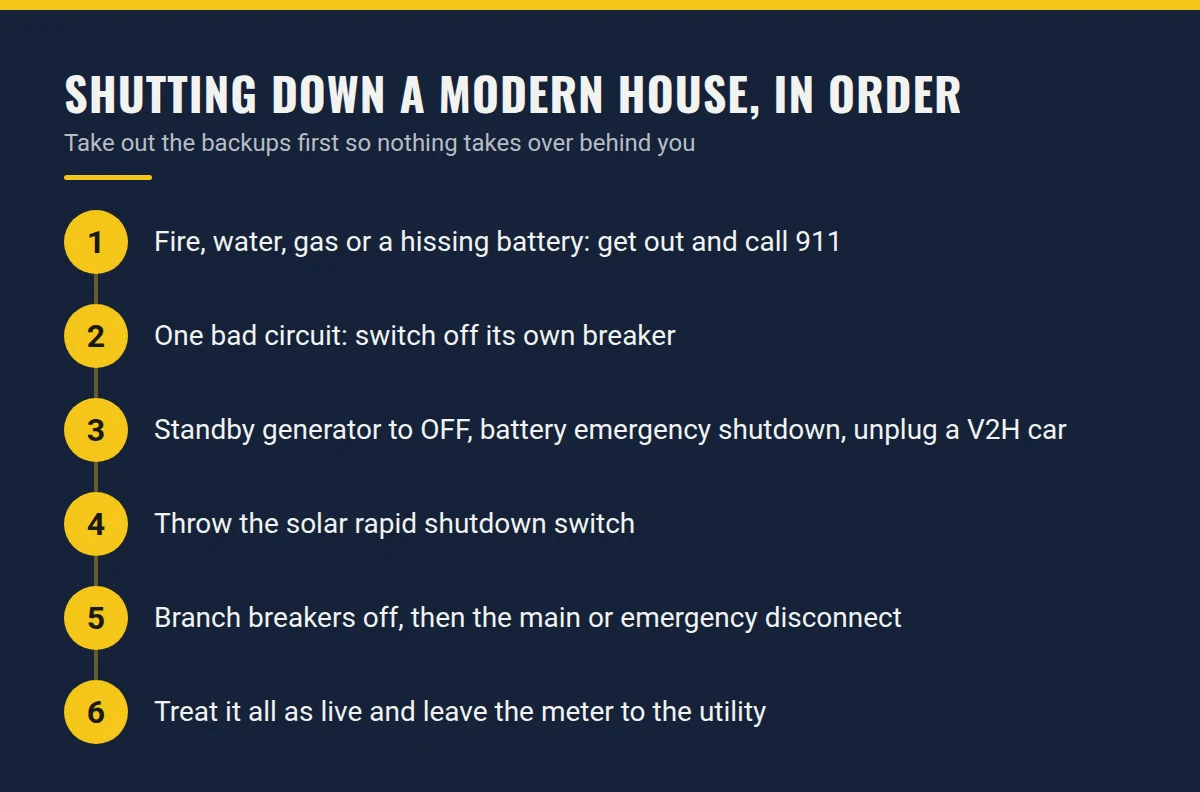
Here is the order that works in a house with every source described above. Skip the steps that do not apply to yours.
- Decide whether to go at all. Fire or smoke at any equipment, water between you and a switch, a smell of gas, or a battery making noise means you leave and call 911 from outside.
- If the problem is one circuit, use its breaker. A sparking outlet or a faulty appliance is handled fastest at its own breaker, and a branch breaker cuts its circuit no matter which source is feeding the panel. If someone is being shocked, do not touch them. Cut the circuit or pull the plug, then call 911.
- Take out the sources that restart themselves. Put a standby generator in OFF or press its emergency stop, trigger the battery’s emergency shutdown, and stop and unplug a bidirectional EV. Shut a portable generator down at its own breaker and engine, then unplug its cord. Doing these first keeps anything from taking over behind you.
- Trigger rapid shutdown, if your solar has its own switch.
- Cut the utility. Switch off the branch breakers if you have time, then the main or the outdoor emergency disconnect.
- Treat the house as live anyway. The wiring ahead of the main, the modules on the roof, the cells in the battery and the generator itself all still hold energy. Do not open covers or test anything by touch. Call your electrician, and tell the fire crew or the utility exactly which switches you operated.
Rehearse It Once, in Daylight
The worst time to discover that your emergency disconnect sits behind a locked gate, or that nobody in the house knows what the yellow sign means, is the night you need it. Do a walkthrough on a calm afternoon with every adult in the house. Ready.gov’s advice is to teach all responsible household members how to shut off the electricity, and in a house with several sources that means every switch, not just the panel.

- Walk the plaque. Stand at the meter, read the directory, and find every switch it names. If a switch is not where the plaque says, or a label is missing, call the installer.
- Check that each one is reachable. These switches are meant to be readily accessible, which in code terms means you can reach them quickly without tools, ladders, or moving things out of the way. A new fence, a woodpile or an overgrown hedge quietly undoes that.
- Learn how each one comes back on. Ask your installer or electrician to show you, because a generator left in OFF or a battery left shut down after a practice run is a backup that will not be there in the next outage.
- Write it down. Put the order, your utility’s emergency number, and a photo of each switch on a single page. Keep it by the panel and on your phone, with a flashlight that lives there too.
- Redo it when anything changes. A new battery, generator or EV charger means a new switch and a new step.
The Bottom Line
“Shut off the power” is still the right first move in most electrical emergencies, but in a house with solar, a battery, a generator or a bidirectional EV it is a sequence rather than a switch. The main or the outdoor emergency disconnect takes out the utility and nothing else. The battery and standby generator are built to take over the moment the utility goes, so they come off first, at their own outdoor controls. Rapid shutdown lowers the voltage on the roof without making it dead. The meter belongs to the utility, and everything behind a cover belongs to an electrician. Find the placard at your meter this week and walk the switches it names with everyone who lives with you.
Further reading (sources)
- Tim Bush in IAEI Magazine on why the 2020 code moved an emergency disconnect outdoors for first responders
- Joseph Kraft in IAEI Magazine for the array boundary and the 30 and 80 volt rapid shutdown limits
- EC&M with the 2026 code’s marking and location rules for dwelling service disconnects
- EC&M quoting the outdoor emergency shutdown rule for generators at dwellings
- Minnesota Department of Labor and Industry on the required solar, rapid shutdown and multiple source labels
- City of Berkeley from its solar permit checklist quoting the rapid shutdown rule
- City of Berkeley with its energy storage checklist covering the battery disconnect and emergency shutdown
- City of Auburn, California for the generator sign required at the service equipment
- Los Angeles Firemen’s Relief Association on what pulling the meter leaves live in a house with solar, batteries or a generator
- U.S. Fire Administration covering fire service testing of a residential battery system in a garage
- U.S. Environmental Protection Agency on why lithium battery fires can reignite hours or days later
- CDC for turning off the power from a dry location before reentering a flooded home
- Ready.gov with shutting off individual circuits before the main and teaching the household
- U.S. Department of Energy on bidirectional vehicles as backup power for buildings