Manufactured and Mobile Home Electrical Safety: Feeders, Pedestals, and Who Is Responsible
Published on September 2, 2026
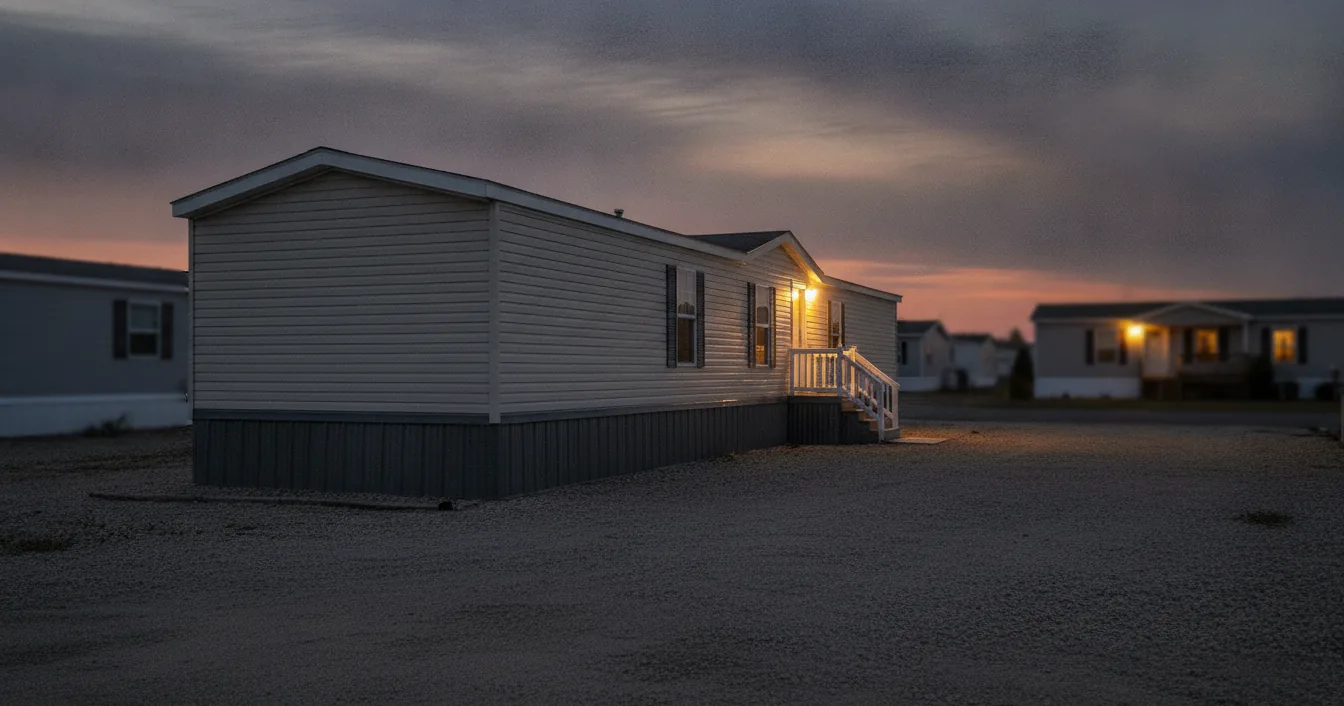
In August 2026, the Arizona Attorney General’s office asked a court to sanction the owners of a Tucson mobile home park for allegedly ignoring a court order to test the park’s underground wiring. Set the litigation aside for a moment and look at what the order was actually about. Nobody was arguing that the homes themselves were unsafe. The dispute was over buried conductors feeding those homes, equipment that no resident owns, cannot inspect, and in most cases has never seen.
That is what makes electrical safety different in a manufactured home community. In a site-built house on its own lot, one owner is responsible for everything from the weatherhead to the last outlet. In a park, the system is cut in half. The home is yours. The pedestal it connects to, the feeder buried in the yard, and the transformer down the row belong to somebody else. Both halves can hurt you, and the half you do not own is the half you can do least about.
One override before anything else. If you feel a tingle or a shock from any metal part of the home, the skirting, the siding, a handrail, a door frame, a faucet, treat the entire structure as energized. Stop touching it, keep everyone away from it, and call 911 and the utility. Same answer for smoke, a burning smell, buzzing, or a service pedestal that is hot to the touch. Those are not maintenance requests you leave at the office in the morning.
Two Systems, Two Owners, One Home
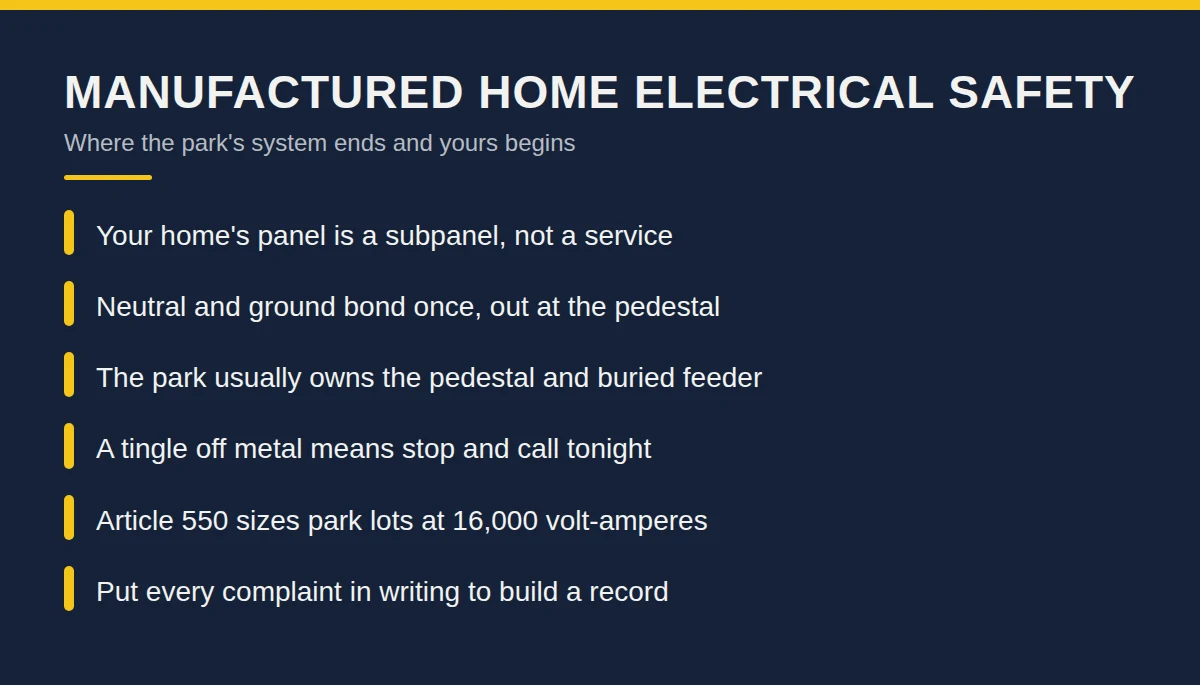
Electricity reaches a manufactured home in a park through a chain with a clear break in the middle.
On the park side there is a utility transformer, distribution running down the rows overhead or underground, and a service pedestal standing at each lot. Article 550 of the National Electrical Code calls this the park electrical wiring system, requires it to be 120/240 volt single phase, and makes operators size it against a minimum calculated load of 16,000 volt-amperes per lot before demand factors are applied. A 25 lot park, even after Table 550.31 knocks the demand down to 24 percent, still needs a 400 amp service. The pedestal at your lot is the end of that chain, and it is service equipment in the full sense: it holds the meter, the main disconnect, and the overcurrent protection for the feeder running to your home.
On the home side there is that feeder, the home’s distribution panel, and the branch circuits inside the walls. Article 550 wants the service equipment located adjacent to the home rather than mounted on it, generally within 30 feet of an exterior wall, and it sets a floor of 100 amps for the equipment serving a single home.
Where those two halves meet decides who fixes what, who pays for it, and who you should be calling at eleven at night.
Why HUD Wiring Is Not Site-Built NEC Work
A manufactured home built after June 15, 1976 was wired to a federal standard rather than a local one. HUD’s Manufactured Home Construction and Safety Standards, 24 CFR Part 3280, include a full electrical subpart covering wiring methods, grounding, branch circuits, and the disconnecting means. That work is inspected in the factory by a HUD-approved agency, and the certification label on the exterior is the proof of it. Your city inspector never signed off on the wiring inside those walls and generally has no authority to.
Four consequences matter if you live in one.
The home’s panel is a subpanel, not a service. This is the single most important electrical fact about a manufactured home. The neutral-to-ground bond is made once, outside, at the pedestal. Inside the home, the neutral bar must stay isolated from the enclosure and from the equipment grounding conductors, and the feeder between the two carries four conductors: two hots, a neutral, and a separate equipment ground.
The steel frame is part of the safety system. The chassis is bonded to that equipment grounding conductor. It is the reason a fault inside the home is supposed to trip a breaker instead of making the siding live.
The factory standard is frozen in time. HUD’s electrical subpart tracks an older edition of the NEC, so a home built in 1998 reflects 1990s practice. That is legal, and it is also not what a new site-built house would get today.
Nobody re-inspects it. Site-built work gets looked at whenever a permit is pulled. Factory wiring is inspected once, then the home travels down a highway, gets set on piers, and gets crossed over on site by an installer working to a different standard entirely. Crossover connections between the two halves of a double wide are field work, made underneath the home, in a crawl space that sometimes floods.
The Pedestal, the Feeder, and the Bond
Three failure points account for most of what an emergency electrician actually finds on a park call.
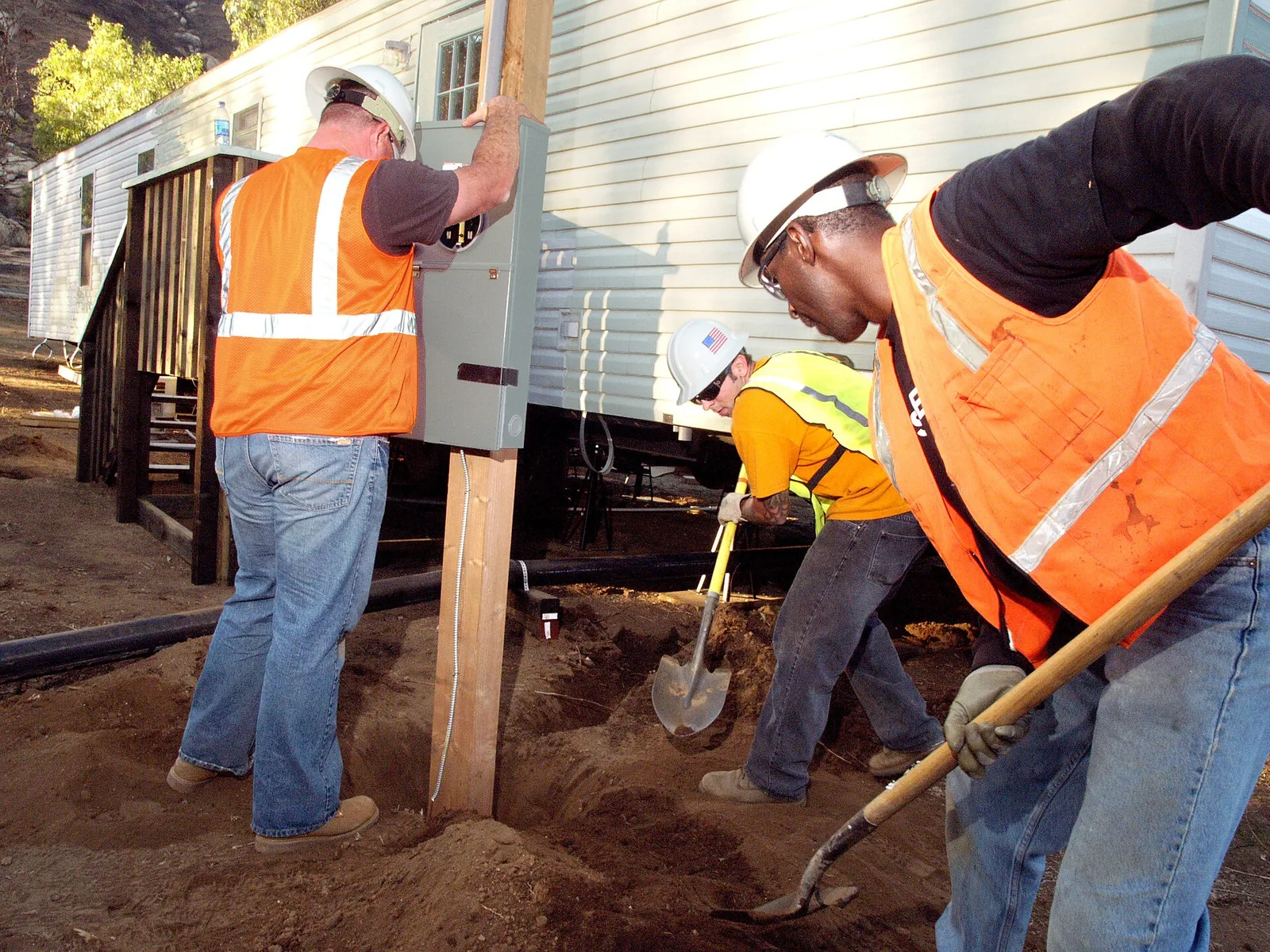
The pedestal. It stands outdoors, at ground level, in weather, for thirty or forty years. Water gets in at the top or wicks up through the base. The lugs where the feeder lands loosen through thermal cycling and begin to heat. Galvanized enclosures rust from the inside out. A pedestal that is warm, humming, discolored around the breaker, scorched, or holding standing water in its base is not in slow decline. It is a fire and shock source with a meter attached.
The buried feeder. This is what the Tucson order was about. Direct-buried conductors installed decades ago degrade in ways nothing above ground reveals. Insulation absorbs moisture, jackets crack, irrigation and soil chemistry accelerate corrosion, rodents chew, and a shovel sunk for a fence post nicks a conductor that then takes years to fail. When it does fail, it often fails as a high-resistance connection rather than a clean short, which means it heats steadily without tripping anything.
The bond. The neutral and ground separation described above gets violated constantly. An older three-wire feeder left in service, a neutral bonded to the enclosure during a repair inside the home, a green bonding screw driven into a subpanel, a corroded or missing grounding electrode at the pedestal. Any one of them can put current on the chassis. In a site-built house that mistake is dangerous. In a manufactured home, where a steel frame sits under everyone’s feet and metal skirting is at child height, it is worse.
Warning Signs That Mean Stop and Call Tonight
Some symptoms are a maintenance ticket. These are not.
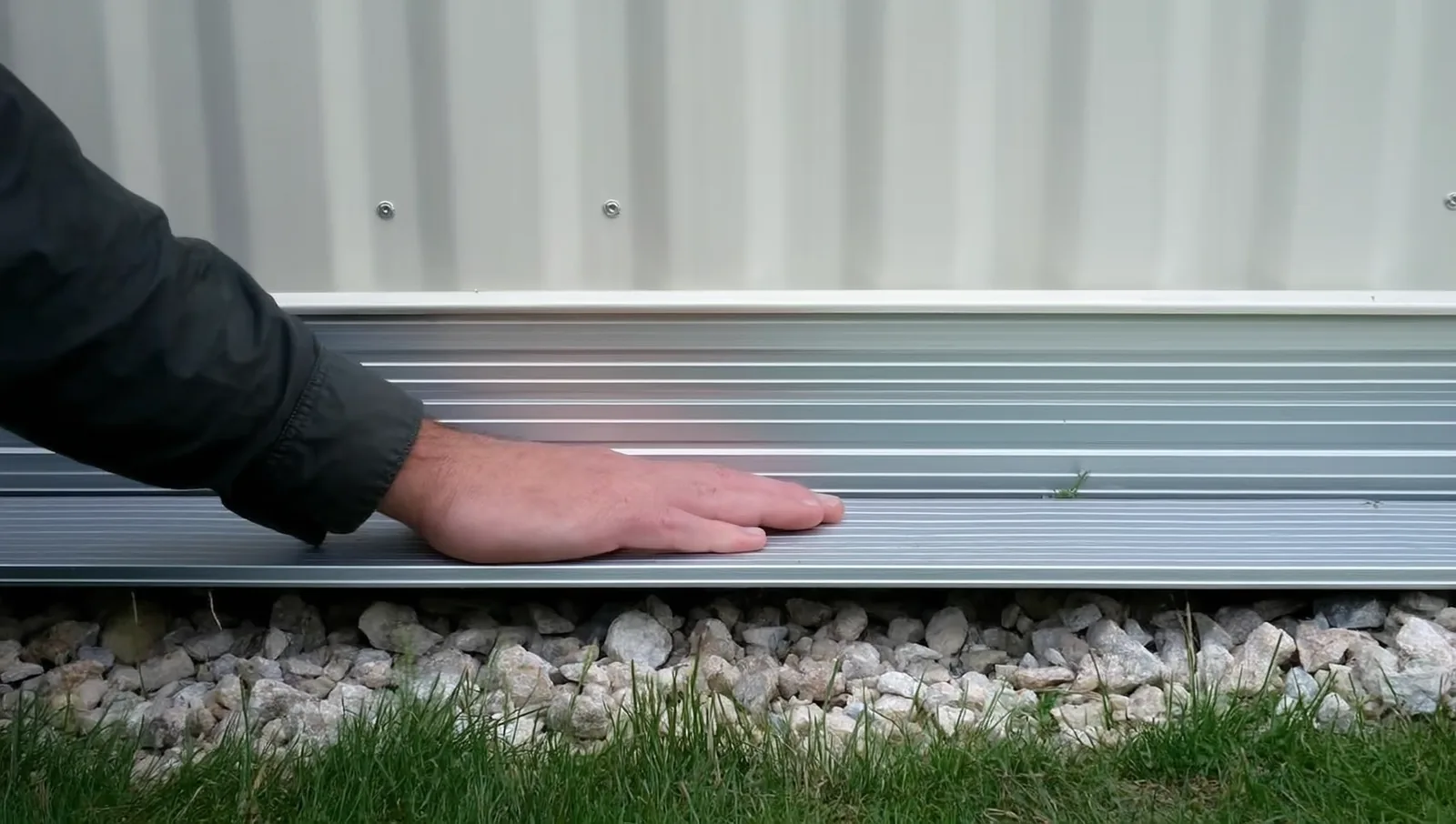
A tingle or shock from any metal part. Skirting, siding, a handrail, the frame, a faucet, the washer. That is stray current on parts that should be sitting at zero volts, and it means the grounding or bonding path has failed somewhere between the pedestal and the home. Anyone who takes a jolt should be checked out even if they feel fine, because low voltage shocks can cause delayed cardiac problems.
Lights that brighten in one room while dimming in another, shifting every time the air conditioner or dryer cycles. That is the signature of an open neutral, and on a park lot the break may well be on the park’s side of the line. It overvolts half your circuits and cooks electronics while no breaker trips at all. Our guide to telling your fault from the utility’s covers how that pattern reads at the panel.
A hot, buzzing, or scorched pedestal. Do not open it, and do not reset anything in it more than once.
Repeated trips at the pedestal rather than inside the home, or a main disconnect that will not hold. The problem is upstream of your panel.
Burning smell, smoke, or visible arcing. Everyone outside first, then call.
What you can legitimately do yourself is short: get people away from the metal, switch off the pedestal main if and only if you can reach the handle on a closed, dry, cool enclosure without touching anything else, and then call. Opening a pedestal is not homeowner territory under any circumstances. The line side of that disconnect stays energized at full utility current with nothing between it and the transformer.
Who Is Legally on the Hook
The default split, which most leases follow, puts the distribution, the transformers, the buried service lines, and the pedestal on the park owner up to the point of connection. The resident owns the home, its feeder, its panel, and everything inside it.
That default is not universal, and the exception gets expensive. Several states write it into statute. Colorado makes the landlord responsible for maintaining and repairing the utility service lines and connections it provides up to the pedestal, and makes that landlord pay for damage to a home caused by failing to do it. Illinois requires park owners to keep electrical systems in good condition and make repairs within a reasonable time. Ohio requires them to maintain the electrical systems and fixtures they supply. Florida runs the other direction and treats the outside electrical box as the homeowner’s problem.
So before you argue with anybody, read two documents: your lot lease, which usually names the point of demarcation, and your state’s mobile home park act, which in most states overrides a lease term trying to hand a landlord’s duty to a resident. If your state runs a manufactured housing division or office, that is generally the agency with jurisdiction over the community and the installation.
How to Escalate When the Park Ignores It
Tucson is a reminder that a park owner may ignore a judge, never mind a maintenance slip. Build a record from day one.

- Report it in writing and keep a copy. Email or certified letter, dated, describing the symptom in plain physical terms. A verbal complaint to an on-site manager leaves no trace.
- Document the evidence. Photographs of the pedestal, dates and times the symptom appears, appliances that died, and any electrician’s written findings. A licensed electrician’s inspection report converts a complaint into a technical finding, which is much harder to file away.
- Call local code enforcement or the building department. Park site wiring falls under the local authority having jurisdiction even though the home’s factory wiring does not. Some states route mobile home communities through the health department instead, so ask.
- Go to the state manufactured housing agency, then to the attorney general’s consumer protection division. The AG route is what produced the Tucson order in the first place.
- Call the utility. They own the transformer and the meter, they can red-tag or disconnect unsafe equipment on their side, and they have no reason to wait for a court.
- Call the fire department for anything imminent. They will respond to arcing, smoke, or an energized structure, and their report becomes part of your record.
What a Real Inspection Tests
If you are arranging an inspection, whether as a resident, a buyer, or an operator trying to get ahead of this, here is what testing the wiring actually means.
- Insulation resistance testing with a megohmmeter on the buried feeders. This is the test that finds degraded direct-burial cable before it faults, and it is the test at the center of the Tucson order.
- Infrared thermography of pedestals and distribution equipment under load, which finds loose and corroded connections by the heat they give off.
- Ground resistance and continuity testing on the grounding electrode at the pedestal and the equipment grounding conductor through to the home’s frame.
- Verification of neutral and ground separation in the home’s panel, plus continuity on all four feeder conductors.
- Polarity, GFCI, and AFCI testing at the receptacles. Retrofitting the two kinds of protection a modern home gets is one of the few upgrades sitting squarely on the resident’s side of the line, and it is worth doing.
One capacity note, because it comes up constantly now. A lot pedestal sized decades ago against a 16,000 volt-ampere assumption was never planned around a car in the driveway. Adding Level 2 charging at a park lot is a park distribution question before it is a home question, and a park that says yes without a load study is setting up the next failure. Whoever you bring in for any of this, vet the license and the insurance yourself rather than taking a card’s word for it.
The Bottom Line
The electrical system serving a manufactured home has a seam in it, and almost every hard question comes down to which side of that seam a fault is on. Learn where your pedestal is, know that it is service equipment and not a junction box, and understand that the bond making your home safe lives out there rather than in your panel. A tingle off metal, a hot pedestal, or lights swinging against each other are all the same instruction: stop, get people clear, and call tonight. Then write it down, because in a park the fix often depends less on the electrician than on the paper trail that makes somebody else pay for it.
Codes, park regulations, and landlord duties vary by state and municipality, so confirm the specifics with your local building department, your state’s manufactured housing office, and a licensed electrician in your area before relying on any of this.

Further reading (sources)
- EC&M on the Arizona action over skipped underground wiring tests at a Tucson park
- EC&M for how Article 550 sizes park distribution and feeders
- eCFR with the federal electrical standard every manufactured home is built to
- Illinois Legal Aid Online covering what a park owner is obliged to maintain and repair
- Indiana Department of Health from its interpretive guidelines for mobile home community electrical service