A Shock From a Cover Plate: The Missing Ground Pigtail Inside Your Metal Boxes
Published on September 8, 2026

You reach for the hall light with damp hands and something bites you. Not the light, the metal screw in the middle of the plate. It is a quick buzz up the fingertips, gone before you can decide whether it really happened. Everybody in the house has felt it at some point, and everybody has filed it under the same heading: static, dry air, the carpet.
Sometimes that is exactly what it is. But there is a second explanation, and it is the one that puts an electrician in a truck at nine at night. The plate can be sitting at 120 volts because the metal box behind it lost its connection to ground, and the thing that makes this so dangerous is precisely what makes it so easy to dismiss. No breaker tripped. No lights flickered. Nothing smells hot. The house behaves perfectly while one small piece of steel in your wall waits for someone to complete a circuit.
Static Snaps. A Fault Hums.
The two feel different once you know what to compare.
A static discharge is a single sharp snap, over instantly. It happens in dry weather, usually after you have walked across carpet in socks, and it will jump to a doorknob or a car door just as happily as to a switch plate. It does not repeat if you touch the same thing again right away, because you have already dumped the charge.
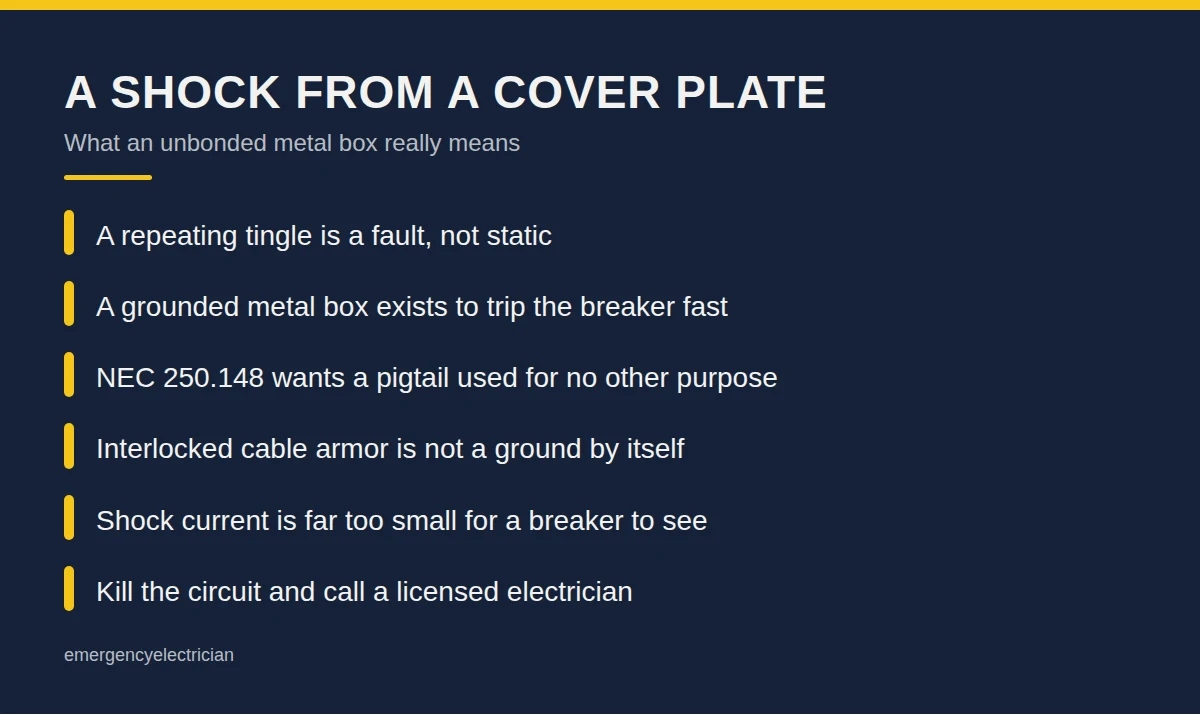
A fault shock is a sustained tingle or a low buzz rather than a snap, and the tell is that it repeats. Touch the plate again and it is still there. It gets noticeably worse when your hands are wet, when you are barefoot on a tile or concrete floor, or when you are touching a faucet or an appliance with the other hand, because all of those lower the resistance of the path through you. It is often tied to one specific plate, one appliance, or one circuit, and it may come and go with whatever is switched on.
If what you felt was a repeating tingle rather than a one-time snap, stop touching it and read on. If anyone in the house took more than a tingle, our guide to the first hour after an electric shock covers why a person who feels fine can still need an ECG.
What a Metal Box Is Supposed to Do
Every splice and every device in your house lives inside a box. In a lot of homes, especially those wired with armored or metal-clad cable or anything in conduit, those boxes are steel.
Steel boxes are not just containers. They are part of the safety system, and the job they do is counterintuitive. A properly grounded metal box is designed to be a deliberate short circuit waiting to happen. If a hot conductor works loose, or a screw terminal backs out, or a staple bites through insulation and energizes the box, the code wants that fault to have a fat, low resistance road straight back to the panel. Hundreds of amps rush through it, the breaker sees a massive overcurrent, and the circuit is dead in a fraction of a second.
The code calls that road an effective ground-fault current path, and it is the reason a bare copper or green wire runs alongside the black and white ones in every modern cable. That conductor carries nothing at all on an ordinary day. It exists purely so that on the one bad day, the fault is loud enough for the breaker to hear.
Take the box out of that path and the physics change completely. The box still gets energized. The fault current simply has nowhere to go. Our map of how power actually reaches your outlet walks the whole chain from transformer to device, and the box is the last stop before the part you touch.
The Pigtail Nobody Sees
Here is where installations go wrong, and it is a violation that gets photographed in the trade press constantly.
An installer opens a metal box with three cables landing in it, twists all the green and bare equipment grounding conductors together under a wire connector, and moves on. The grounds are spliced. They are continuous from cable to cable. Everything downstream is fine. What never happened is the short jumper from that splice over to the box itself.
That jumper is the pigtail, and Section 250.148 of the National Electrical Code requires it in language that is unusually specific: where circuit conductors are spliced or terminated inside a metal box, a connection used for no other purpose has to be made between the box and the equipment grounding conductors.
The “no other purpose” clause is the part that matters, and it exists because of what happens later. The connection cannot be a screw that also holds the box to a stud. It cannot be a cable clamp screw. It cannot be the screw securing a plaster ring, and it certainly cannot be a drywall screw. Every one of those is a fastener that somebody will eventually remove to work on something else, and the moment it comes out the box quietly loses its ground with no symptom whatsoever. The rule demands a dedicated connection, typically a green 10-32 screw in a tapped hole or a listed grounding clip, so that pulling a device out of the wall cannot break the bond.
That last detail is why this article exists. The failure mode is not usually the original electrician. It is the next person, the handyman swapping a builder-grade receptacle for a nicer one or adding a dimmer, who unscrews the device, sees a green wire attached to something, decides it is the ground, and reassembles the box with the box itself no longer bonded to anything.
Why the Metal Cable Jacket Is Not a Ground
There is a specific version of this mistake that even trained installers make, and it is worth understanding because it produces a box that looks obviously grounded and is not.
Modern MC cable has a spiral, interlocked metal tape armor. It is metal, it runs continuously back toward the panel, and it screws into the box through a metal connector, so it seems self evident that the box must be grounded through it. It is not. Interlocked metal tape armor by itself is not recognized as an equipment grounding conductor, because a spiral strip is a long helical path with much higher impedance than a straight copper wire, and it may not clear a fault fast enough or at all. Standard MC cable qualifies only when it includes a bare aluminum bonding conductor running in direct contact with the armor, which is a specific listed product and not simply whatever metal cable is on the truck.
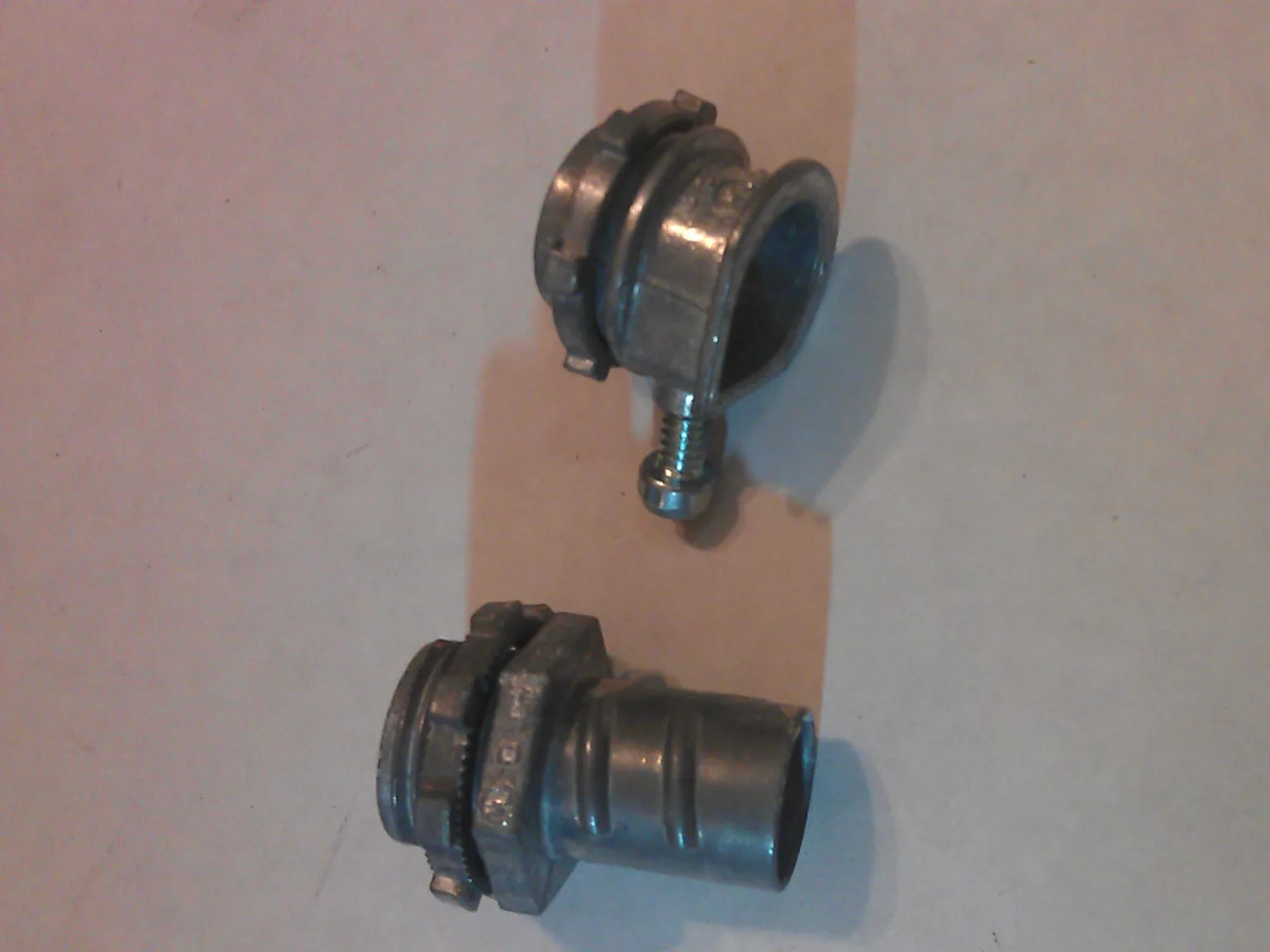
Older armored cable, the stuff most people call BX, has a thin aluminum bonding strip inside the armor for the same reason. In houses of a certain age that strip is the entire equipment grounding system, and it fails in predictable ways: corrosion at the fittings, a strip that was cut off during a remodel, a connector that was never tightened. This is one of the more common reasons an older home develops an energized box with no other symptom.
The Device Is Not the Backup You Think
A reasonable person assumes the receptacle bridges the gap. Its green terminal is grounded, the receptacle is screwed to the box with metal screws, so the box gets grounded through the device. The code does allow a version of that, but the exceptions are narrower than most people realize.
Section 250.146 requires an equipment bonding jumper between a receptacle’s grounding terminal and the box, and then carves out specific cases where you can skip it: surface-mounted boxes where the device yoke makes direct metal to metal contact with the box, devices with yokes specifically designed and listed as self-grounding, listed floor boxes, and isolated ground receptacles installed to reduce electrical noise.
Notice what is not on that list: an ordinary flush box in drywall with an ordinary receptacle screwed to it. Those mounting screws pass through insulating retention washers, the yoke sits proud of the box on plaster ears, and there is often a painted plaster ring in between. The metal to metal contact people are counting on frequently does not exist, and even where it does, it depends on two screws staying tight in a wall that gets bumped, painted, and reworked for decades. That is exactly the fragile arrangement Section 250.148 was written to prevent you from relying on.
Why the Breaker Never Notices
This is the part that makes an ungrounded box genuinely dangerous rather than merely non-compliant.
When a hot conductor contacts an unbonded metal box, the box rises to 120 volts and simply sits there. No current flows, because there is no path back to the source. The circuit is, in the electrical sense, perfectly happy. The breaker is doing its job correctly and has nothing to trip on.
Then a person touches it. Now there is a path: through the hand, through the body, out the feet or the other hand into a grounded floor, a faucet, an appliance. Human resistance varies enormously with skin moisture and contact area, but the current that results is typically somewhere in the tens of milliamps.
Line those numbers up against the protection you have and the problem is obvious. A GFCI is built to open at roughly 5 milliamps. Around 10 milliamps is where most people can no longer let go of what they are holding, because the current makes their own muscles clamp. Somewhere in the range of 100 milliamps, current across the chest can send the heart into fibrillation. A 15 amp breaker trips at 15,000 milliamps. The entire span between “annoying” and “fatal” happens two orders of magnitude below anything your breaker is capable of detecting.
So “nothing tripped” is not reassurance. In this specific failure it is the diagnosis. If you want the flip side, our guide to why a breaker keeps tripping covers the faults that overcurrent protection does catch, and the contrast is the point: a breaker protects wiring from burning, and a grounded box is what turns a shock hazard into something the breaker can see.
What To Do Tonight
If a plate, a screw, an appliance case, or a metal light fixture has given you a repeating tingle, treat it as live until an electrician proves otherwise.
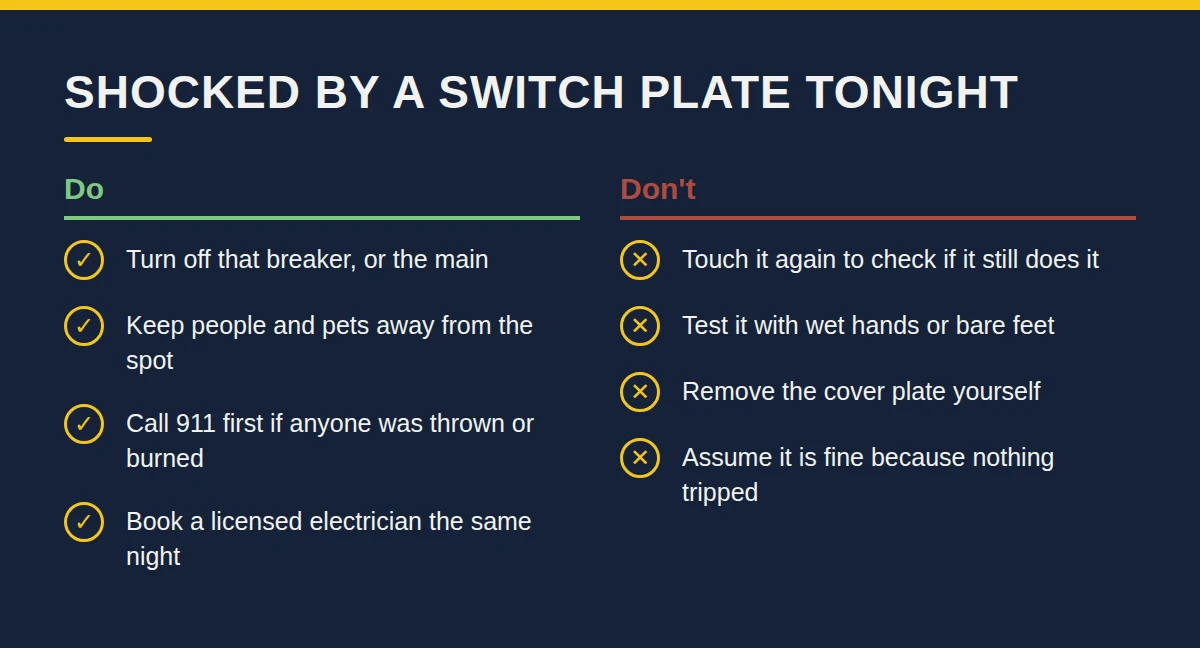
Turn off the breaker for that circuit if you can identify it, and if you cannot, turn off the main. Keep people and pets away from the spot. Do not test it again to see if it is still doing it, and above all do not test it with a wet hand, bare feet, or while touching a faucet or appliance, because those are the conditions that turn a tingle into an injury.
Do not take the cover plate off. The plate is doing the one useful thing it can, which is standing between you and everything else in that box, and the failure that energized the box may well be a loose conductor sitting right behind it.
Call for help the same night. Escalate past the electrician if there is any smoke, burning smell, buzzing, or scorching around the box, or if anyone was shocked hard enough to lose their grip, be thrown, or feel chest symptoms. In those cases call 911 first and worry about the wiring afterward.

One more scenario deserves its own line. If you feel a tingle on plumbing fixtures, appliance cases, or metal surfaces in more than one room, that is a different and more serious pattern that can point to a lost neutral or a bonding failure at the service rather than one bad box. That one is an emergency call to both an electrician and your utility.
What the Electrician Will Actually Do
The repair itself is usually small, which is the frustrating part. Diagnosis is what takes the time.
An electrician kills the circuit, verifies it is dead with a meter rather than assuming, pulls the device out of the box, and looks for the connection that should be there and is not. From there the fix is a green equipment bonding jumper landed on a dedicated screw or clip in the box, sized from Table 250.122 against the largest overcurrent device protecting conductors in that box. On an ordinary 15 or 20 amp residential circuit that is 14 gauge copper, and it costs a few cents in material.
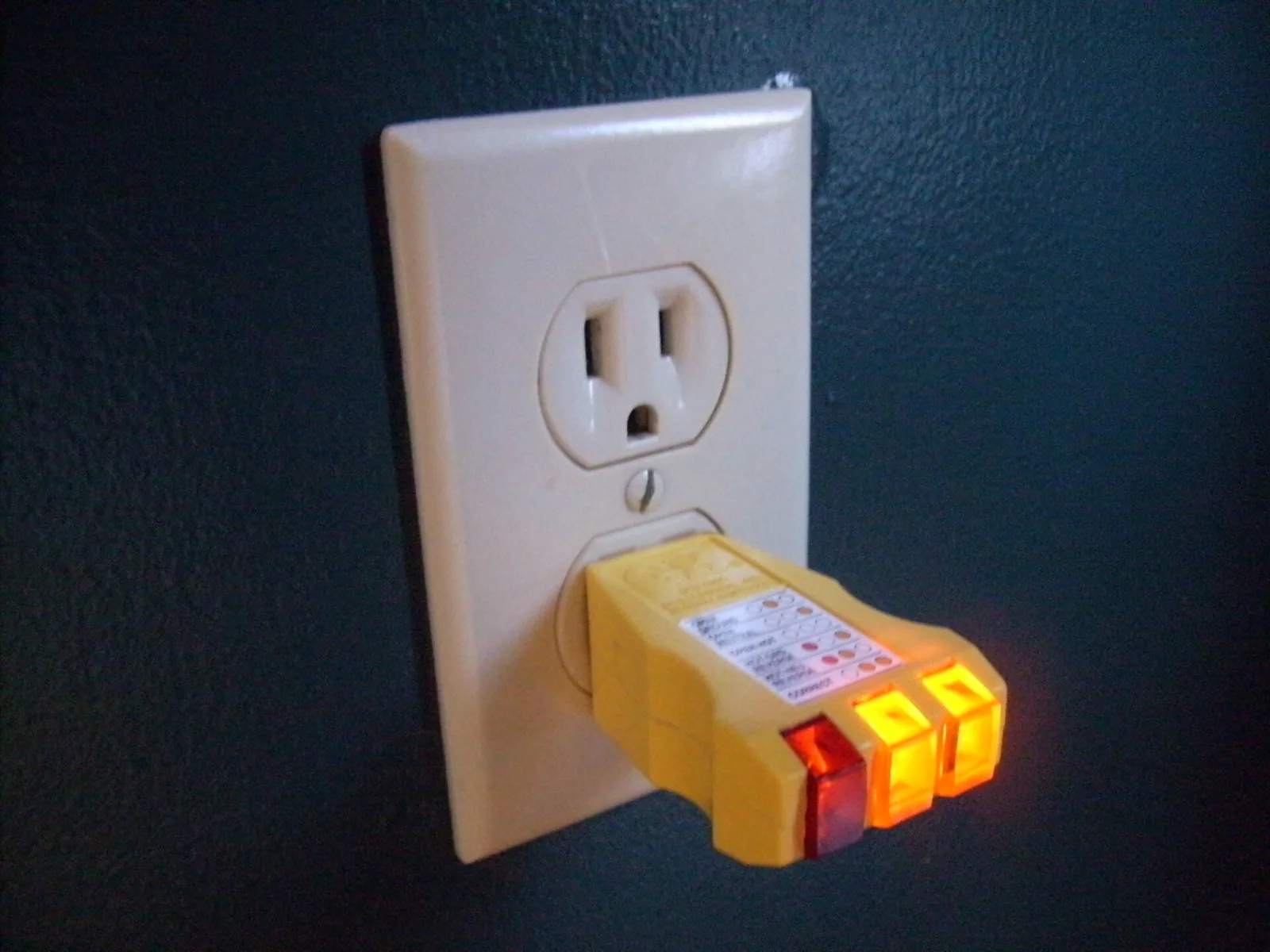
They will also check continuity properly, which matters more than it sounds. A plug-in three-light tester is a useful screening tool and it is genuinely worth owning, but it cannot measure the quality of a ground path and it cannot tell a real equipment grounding conductor from a fake one. The classic fake is a bootleg ground: a short jumper installed between the neutral and ground screws of a receptacle so the tester lights up correctly. It reads as properly wired, and it works right up until the neutral opens somewhere upstream, at which point it energizes the receptacle’s ground pin and everything bonded to it.
Because the visit is diagnostic rather than parts-heavy, expect to pay for the electrician’s time and the after-hours premium rather than for materials. Our breakdown of what emergency electricians actually charge covers the usual call-out structure, and it is worth asking whether they will check the other boxes on the same circuit while they are there. A missing pigtail is rarely a one-off. It is a habit, and whoever left one out generally left out several.
When There Is No Ground to Find
Sometimes the electrician opens the box and there is no equipment grounding conductor at all, because the house was wired before anyone ran one. That is a different conversation, and the code has a defined answer rather than leaving you stuck.
Where no equipment grounding conductor exists in the box, Section 406.4(D)(2) permits three things: replacing like with like using another non-grounding receptacle, installing a GFCI receptacle marked “No Equipment Ground”, or installing a grounding-type receptacle downstream of GFCI protection, marked both “GFCI Protected” and “No Equipment Ground”.
That works because a GFCI does not use the equipment grounding conductor to do its job. It compares the current going out on the hot against the current coming back on the neutral, and opens when enough of it is going somewhere else, which is to say through a person. It will protect you from a shock on a two-wire circuit perfectly well.
What it will not do is give you a real ground. Surge protectors need one to function. Some electronics rely on it. And a GFCI does not create the low impedance fault path that clears a fault instantly at the breaker. It is a legitimate, code-recognized fix for the shock hazard rather than a full substitute for rewiring. Our comparison of what AFCI and GFCI protection each actually catch goes into where the code now requires each one.
The Bottom Line
The most dangerous electrical faults in a house are not the dramatic ones. A sparking outlet gets attention. A box that has quietly lost its ground gives you one small tingle, waits for the weather to change, and gives you another.
The rule at the center of it is one sentence long: a metal box needs its own dedicated connection to the equipment grounding conductors, made for no other purpose, so that nothing anyone does later can take it away. Cable armor does not count on its own. A device screwed to the box is not a reliable substitute. And a breaker will never tell you the connection is missing, because the current that hurts a person is far too small for it to see.
If a cover plate has ever bitten you, that is not static. Kill the circuit and get a licensed electrician to open the box. Electrical codes, permit requirements, and inspection rules vary by municipality, so confirm the specifics with your local building department and a licensed electrician in your area.
Further reading (sources)
- EC&M on the spliced grounds that never got a pigtail to the box
- IAEI Magazine for what “no other purpose” means in the metal box bonding rule
- EC&M covering which wiring methods the code accepts as equipment grounding conductors
- IAEI Magazine on how proper grounding technique prevents shocks in the first place
- OSHA with why the equipment grounding path must be permanent and continuous