Portable Space Heater Safety: Outlets, Cords, Clearances, and the Heaters Behind Winter Fires
Published on October 12, 2026
Every fall the same appliance comes out of the closet in millions of American homes. It is about the size of a toaster oven, it turns 1,500 watts of electricity into heat, and it is expected to do that for hours on end, on the floor, a few feet from the couch or the bed. Most nights nothing goes wrong. But when NFPA tallied the home fires caused by heating equipment from 2016 to 2020, space heaters were behind a third of those fires and 88 percent of the deaths. No furnace, boiler, water heater or fireplace comes close.
This guide is about the plug-in electric heater and the parts of the house it leans on: the outlet it goes into, the cord and power strip it should never go through, the three feet of floor around it, the marks on the box, and the point where a room that needs a heater every night actually needs a circuit or permanent heat. Heat that is wired into the walls is a different job with different rules, and our guide to wired-in baseboard, wall heater, and heat pump circuits covers it.
First, the part that cannot wait. If a heater’s plug, its cord, or the outlet it is plugged into is hot to the touch, smells like burning plastic, or shows browning or melted plastic, switch the heater off and leave that outlet unused until an electrician has looked at it. If there is smoke or flame, get everyone out, close the door behind you, and call 911 from outside.
Why Space Heaters Cause So Many of the Deadly Heating Fires
NFPA’s estimates for 2016 through 2020 put heating equipment behind an average of 44,210 home structure fires a year, which killed about 480 people annually and injured 1,370. Within that total, the fixed and portable space heater category (NFPA counts electric and fuel-burning units together) accounted for about 14,600 fires a year, 420 deaths, and 1,100 injuries. Central heating systems, by comparison, started 4 percent of heating fires and essentially none of the fatal ones.
The electric plug-in heater on its own is a large share of that. CPSC staff attribute an annual average of 1,700 fires from 2018 to 2020 to portable electric heaters alone.
Where and when those fires start explains why they kill. Nearly half of all home heating fires (46 percent) happen from December through February. Fires that began in a living room or family room were only 11 percent of heating fires but caused 46 percent of the deaths, and bedrooms, the origin of just 4 percent of the fires, accounted for 22 percent of the deaths. Fires between midnight and 6 a.m. were 13 percent of the total and roughly two in five of the deaths. NFPA’s explanation is the obvious one: people asleep have less time to react and are farther from a way out.
Put those numbers together and the typical fatal heater fire draws itself. A heater runs in the room where someone is relaxing or sleeping, close to upholstered furniture, bedding or curtains, and the fire starts after everyone has stopped paying attention.
There is good news in the long trend. Heating fires have fallen from more than 70,000 a year in the early 2000s to about 42,000 in 2020, and NFPA suggests that safety standards requiring automatic shutoffs on heaters that tip over, and better guards around heating coils, likely helped. The equipment is safer than it was. The habits around it are what this guide is about.
Three Feet in Every Direction, and Off Before Bed
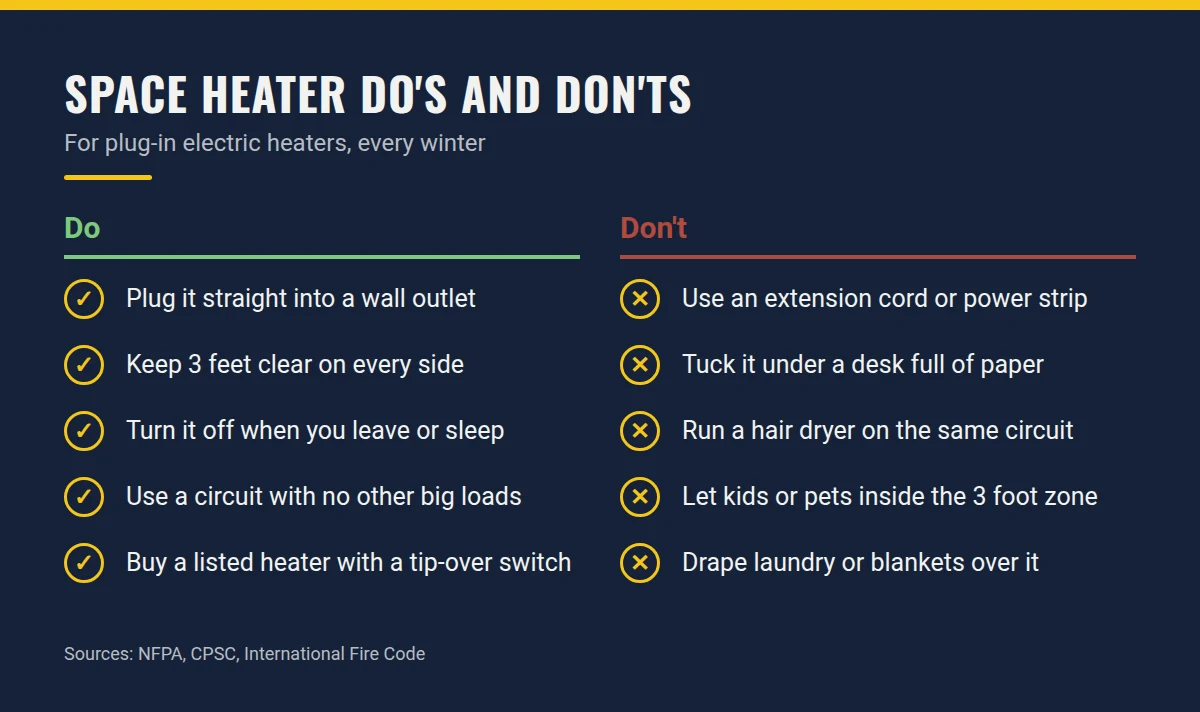
The rule every authority agrees on is three feet. NFPA’s guidance is to keep anything that can burn at least three feet from heating equipment, and the International Fire Code, as cities like Columbus, Ohio, enforce it, bars operating a portable electric heater within three feet of any combustible material.
Three feet sounds generous until you look at what drifts into that circle over a winter evening:
- Bedding that slides off the side of the bed overnight, or a bed skirt that already reaches the floor.
- Curtains that sway in the heater’s own airflow.
- A throw blanket draped over the arm of the sofa, or the sofa itself after someone drags the heater closer.
- The space under a desk, which is often a wastebasket, a box of paper and a pair of legs, with a heater squeezed in among them.
- Laundry, shoes, and dog beds, along with the cat that curls up against the warm side of the heater.
Set the heater on a stable, level floor, out of walkways, where nobody will kick it or trip over the cord. Never put it on a bed, a chair, or a sofa cushion, and never run its cord under a rug, where foot traffic can crush the cord without anyone seeing the damage.
NFPA also asks for a three foot “kid-free zone” around space heaters, and the injury data shows why. Brooks and McGwin, analyzing CPSC’s national emergency room sample, estimated about 53,600 burn injuries from portable heaters treated in US emergency departments from 2003 to 2013. Young children and older adults had the highest injury rates, injuries peaked in winter, and the hand was the body part burned most often, a third of the cases. A toddler’s first instinct with a glowing grille is to touch it. Our guide to childproofing a home’s electrical system covers the cords and outlets that draw small children in the same way.
Then there is the overnight problem. NFPA’s advice is to turn portable heaters off when you leave the room or go to bed. Warm the bedroom before you turn in, then switch the heater off and let the blankets do the rest. A heater that runs all night in a room where everyone is asleep is the exact scenario behind those overnight death figures, and a working smoke alarm outside every sleeping area is the backstop when something goes wrong anyway.

One Heater Can Fill Most of a Circuit
The typical plug-in heater sold in the US is rated 1,500 watts on its high setting. Divide by 120 volts and it draws 12.5 amps, steadily, for as long as it runs.
Now look at what it is plugged into. Bedrooms and living rooms are often on 15 amp circuits, and on paper a 15 amp circuit delivers 1,800 watts. But the National Electrical Code’s receptacle table, which OSHA reprints in its workplace wiring rules, caps the plug-in load on an ordinary 15 amp receptacle at 12 amps whenever the circuit serves more than one outlet. A 1,500 watt heater on high is over that line by itself. Everything else on the circuit (the lamp, the television, the phone charger) comes on top of it.
That circuit rarely stops at one outlet. A typical bedroom circuit feeds every receptacle in the room and often the ceiling light, and in older houses it may carry part of the room next door. Plug in a hair dryer, a vacuum, or a second heater anywhere on it, and the breaker trips. That trip is the system working, and our guide to why a breaker keeps tripping explains how to tell an honest overload from a fault.
The more dangerous case is the circuit that does not trip. A 15 amp breaker will carry a 12.5 amp heater plus a lamp indefinitely, so the breaker stays quiet while that current flows for hours through every connection between the panel and the heater: the breaker terminal, the splices in each box along the way, the screws or push-in terminals on the receptacle, the contacts that grip the plug, and the plug itself. A sound connection handles it. A loose, worn or corroded one turns current into heat right at that spot, and a breaker cannot tell. Breakers respond to too much current, and a failing connection carries perfectly normal current.
A few habits keep a heater inside what the circuit can take:
- Give it a circuit of its own, or the next best thing. Pick an outlet on a circuit that is not also running a refrigerator, a microwave, a window air conditioner, or another heater. If you do not know which outlets share a breaker, switch one breaker off and walk the house.
- One heater per circuit, always.
- Use the low setting when it is enough. Many heaters drop to around 750 or 900 watts on low, which cuts the current by roughly 40 to 50 percent.
- Let the thermostat cycle it. A heater set to a sensible temperature switches itself off part of the time. One set to maximum in a cold room never rests.
Straight Into the Wall: No Extension Cords, No Power Strips
Every safety authority gives the same instruction, and the fire code makes it law where it applies. The International Fire Code section on portable electric space heaters, as the Columbus Fire Prevention Bureau quotes it, requires that only listed and labeled heaters be used, that they be plugged directly into an approved receptacle, and that they never be plugged into extension cords.
The reasons are physical, not bureaucratic. An extension cord adds two more connections, one at each end, plus a length of conductor that may be thinner than the heater’s own cord. A light 16 gauge household cord is built for roughly 13 amps, and a heater keeps it near that limit for hours, coiled behind furniture or flattened under a rug. Our guide to extension cord fire safety explains gauge and why cords fail where they do.
A power strip is worse in a way people do not expect. It is a row of extra spring contacts and thin internal metal strips, often built to a price, and the heater’s full current runs through the strip’s plug, its switch, its breaker, and the contacts gripping the heater’s plug. The strip’s own 15 amp breaker will not trip at 12.5 amps, so it cannot warn you that the contacts are cooking. A surge protector does not help either. It guards electronics against brief voltage spikes and does nothing about a heavy load that lasts all evening.
People do it anyway, and a study CPSC commissioned shows why. In focus groups that EurekaFacts ran for the agency in 2023, almost half of the 43 participants said they used an extension cord with their heater at least sometimes, and in a smaller group 14 of 19 said they used power strips. Their reasons were practical: an older house without enough outlets, and heater cords too short to reach where they wanted heat, especially on cheaper models. Two participants believed a power strip was “more efficient than straight into the walls.” The groups deliberately recruited higher-risk households and were not a national sample, but the reasoning will sound familiar to anyone who has walked through a house in January.
“Directly” means nothing in between: no power strip, no cube tap, no outlet multiplier, no plug-in timer. If the heater cannot reach a wall outlet from a spot that also keeps three feet clear, the cord is a symptom. The room needs an outlet where the heat is needed, and adding one is ordinary electrician work.
The Warm Plug and the Melted Outlet
This is the failure that sends an electrician out on a winter night, and it usually gives warning first.
After an hour on high, a heater’s plug may feel faintly warm in a sound outlet. These are the signs that something has gone past that:
- A plug or cover plate too hot to hold comfortably, or noticeably warmer than it used to get.
- Browning around the outlet slots, or a glossy, melted edge on the plug or faceplate.
- A plug that wobbles in the outlet or slides partway out under its own weight.
- A crackle, a buzz, or a smell of hot plastic near the outlet.
- Lights on the same circuit that flicker when the heater cycles on.
Often the receptacle is the weak link. The spring contacts inside an outlet lose their grip after years of plugs going in and out, and a loose grip means less metal touching metal, which means heat. Push-in “backstab” connections on the back of inexpensive receptacles, and terminal screws that were never tightened properly, fail the same way. An outlet can sit behind a nightstand for twenty years feeding a lamp and a charger without trouble, then meet a 12.5 amp heater for three months straight, with every thermostat cycle heating and cooling the bad joint again.
Sometimes it is the heater’s side. In a 2022 letter to UL, CPSC staff reported that while investigating heaters with thermally damaged plugs from different manufacturers, they found inconsistent crimping, welding and soldering where the plug blades join the cord’s wires. Those plugs came from certified heaters with listed power cords. X-rays and CT scans showed the defects, and in testing at an 11.5 amp load the plugs from incident heaters ran 5.5 to 19.8 degrees Celsius (roughly 10 to 36 degrees Fahrenheit) hotter than exemplar plugs. You cannot see inside a molded plug, so a hot one tells you something is wrong without telling you which side failed. Treat both as suspect.
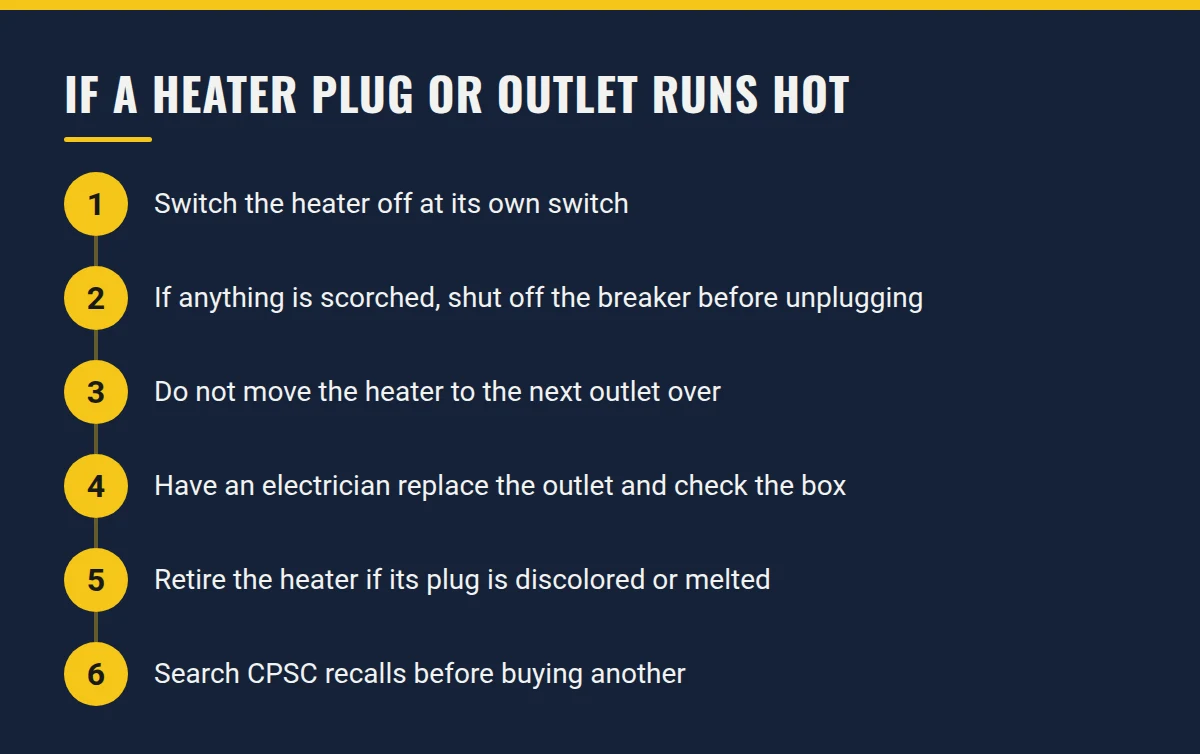
If the plug or the cover plate is scorched or melted, switch the heater off and turn off that circuit’s breaker before you pull the plug. Otherwise, unplug it by the plug body, never by the cord. The fix on the house side is a new receptacle, and an electrician should check the box behind it, because heat that melts plastic on the face often reaches the conductors and the terminals in the back. Do not move the heater to the next outlet over and carry on, since that outlet is often on the same circuit and may be wired through the damaged one. If the heater’s own plug is discolored or deformed, retire the heater rather than splicing on a new plug. Before you buy another, our guide to checking whether a product is under recall walks through searching CPSC’s database by product type.
What the Box Should Tell You: Listing, Overheat Cutoffs, and Tip-Over Switches
Start with the listing mark. A heater should carry the mark of a nationally recognized testing laboratory. UL, Intertek’s ETL and CSA are the familiar ones, and OSHA keeps the full list. Where the fire code applies, it is not optional, because the code allows only listed and labeled portable heaters. A heater with no mark at all has not been tested against anything you can check, however it is marketed.
The standard behind the mark is UL 1278, which covers movable and wall or ceiling hung electric room heaters. Two protections matter most.
Overheat protection. As an IAEI Magazine article on heater fires puts it, all electric space heaters are currently required to have overtemperature protection, which shuts the heater off if it is covered or crowded and starts to run too hot. Treat that cutoff as a last line of defense. It responds to the heater’s own temperature, not to the curtain or cushion beside it.
Tip-over protection. UL’s Code Authority newsletter explains that listed portable heaters must pass a tip-over test, in which the heater is tipped over onto terry cloth and fails if it throws embers, flame or molten metal, or if the cloth glows or flames. But manufacturers have been allowed to pass that test with temperature-limiting controls instead of a switch. So today a listing mark alone does not promise that a heater switches itself off the moment it falls over. If you want that, look for “tip-over switch” or “tip-over shutoff” printed on the box.
That is about to change. UL 1278 was revised in May 2025, and according to a notice that Intertek, one of the certifying labs, sent to manufacturers, products certified to it must meet the revision by December 12, 2028. The revision requires every movable 120 volt heater to have a tip-over switch that cuts power to all of its heating elements and keeps them off until the heater is set upright again. It also tightens the rules for the plug, which generally must be rated for at least 125 percent of the heater’s current, requires the connections where the cord meets the heater’s internal wiring to be both mechanically secured and soldered, and bans twist-on wire connectors on the heater’s internal power connections. Those changes go after the same kind of weakness CPSC staff described in their plug investigation: crimped connections that run hot when they are not made consistently. For the next few winters, store shelves will carry heaters built both ways, so read the box.
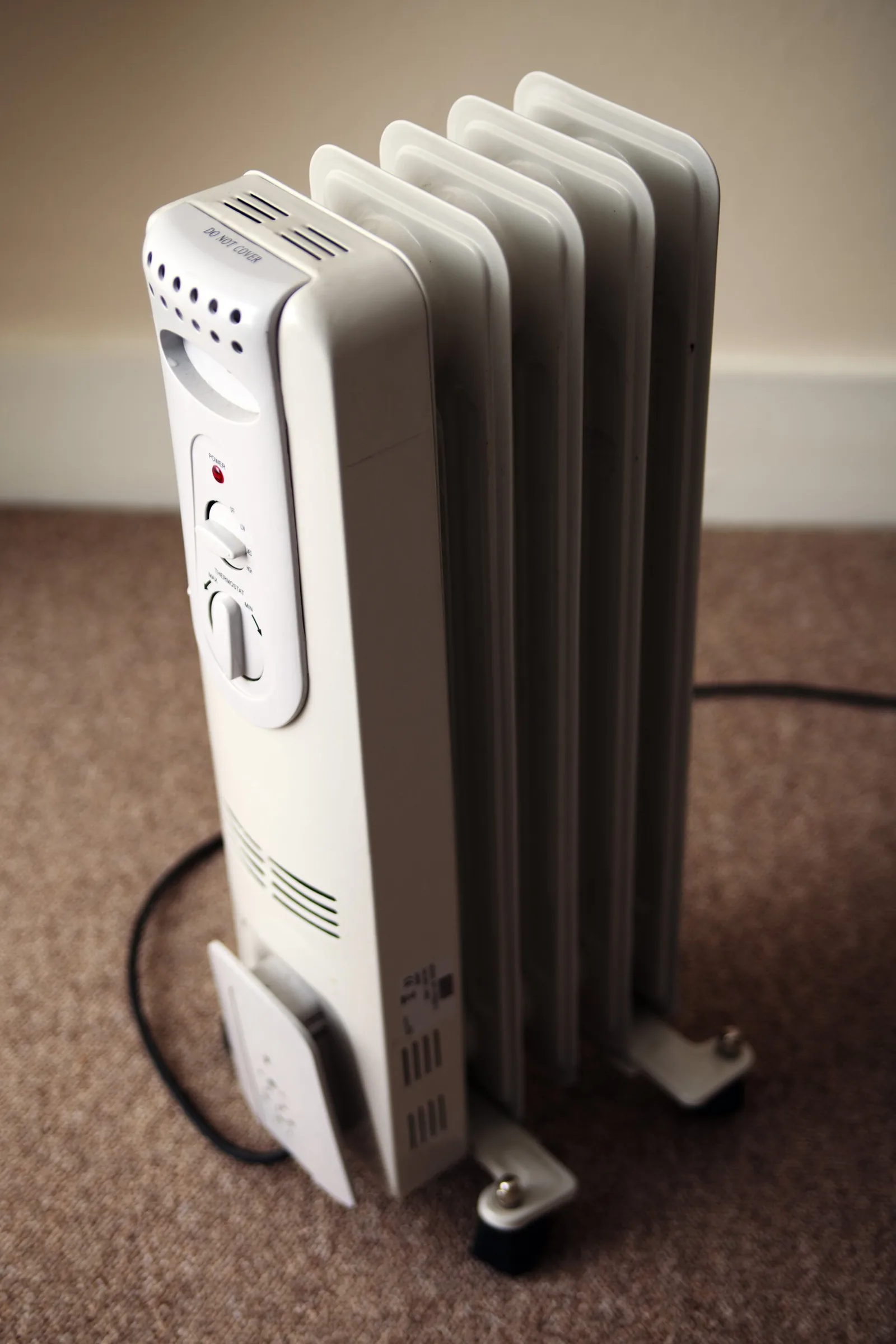
Heater design changes how the heat comes out, not the rules around it:
- Radiant heaters (quartz, halogen, and exposed coil types with a visible glow) heat whatever sits in front of them, so the zone straight ahead matters most.
- Fan-forced ceramic heaters push a stream of hot air and have a hot grille, and a blocked air intake or grille is what trips their overheat cutoff.
- Oil-filled radiators warm slowly and evenly, and their fins stay hot for a long while after you switch them off.
None of the three changes the three foot rule or the wall outlet rule. Beyond protection, look for a built-in thermostat, a timer that shuts the heater off on its own, and a cord long enough to reach a wall outlet from where the heater will actually sit.
Fuel-burning space heaters, the kerosene and propane kind, sit in the same NFPA category but bring carbon monoxide and refueling hazards that a plug-in heater does not. If you use one, follow the manufacturer’s ventilation instructions and keep working carbon monoxide alarms on every level of the house.
When the Room Needs a Circuit, Not a Heater
A space heater is meant for occasional, supplemental heat. When it becomes the only thing keeping a room livable, the house is telling you something. These are the usual signs:
- The heater runs every evening from November to March.
- The breaker trips whenever the heater and anything else run together.
- The lights dim or flicker each time the heater cycles on.
- The only outlet within reach of a safe spot means a cord or a strip.
- The room is a converted garage, a finished basement, a sunroom, or an addition that never got real heat.
- The heater lives in a bathroom, where it usually shares the bathroom’s 20 amp receptacle circuit with a 1,875 watt hair dryer. That is about 28 amps on a 20 amp circuit, around water.

There are four good fixes, and they can be combined.
A dedicated circuit. An electrician can run a 20 amp circuit that ends in a 20 amp receptacle placed exactly where the heater sits. The same code table that caps a 15 amp receptacle at 12 amps allows 16 amps on a 20 amp receptacle, so a 12.5 amp heater has real headroom, nothing else shares the circuit, and no cord is needed. It is one of the more modest jobs an electrician does, though permit rules vary by municipality.
Permanent heat. A baseboard unit or a wall heater on its own correctly sized circuit is designed for the long, steady load a space heater only puts up with, and our guide to wired-in electric heat explains how those circuits are sized.
A ductless heat pump. A heat pump moves heat rather than making it, so it delivers more heat per kilowatt-hour than any resistance heater, portable or wired in.
Fixing why the room is cold. Missing insulation, air leaks, and a duct run that barely reaches the room are common culprits, and a heating contractor or an energy audit can find them.
The running cost is worth working out before deciding. A 1,500 watt heater on high for eight hours uses 12 kilowatt-hours a night. Multiply that by the rate on your electric bill and by the nights in a winter, and a permanent fix often looks less expensive than it did. Whoever does the work, verify their license and insurance with your state board before the walls open.
The Bottom Line
A plug-in heater is a small appliance with a large load, and nearly every way it starts a fire comes down to that. Give it a wall outlet on a circuit it is not sharing with anything heavy, keep three feet of floor clear around it, switch it off when you leave the room or go to bed, and touch the plug once in a while. A plug or outlet that runs hot is a reason to stop, not to move the heater one outlet over. When you buy, look for a listing mark and the words “tip-over switch” on the box. And when the heater has become the room’s real heat, call an electrician about a dedicated circuit or a permanent heat source. Codes and permit requirements vary by municipality, so confirm the details with your local building department and a licensed electrician.
Further reading (sources)
- NFPA Research on how home heating fires, deaths, and injuries break down by equipment, month, and room
- NFPA’s supporting tables for the space heater fire, death, and injury estimates by equipment type
- CPSC staff in a 2022 letter to UL about thermally damaged heater plugs
- CPSC with a 2023 focus group study of how people plug in and place portable heaters
- OSHA on the 12 amp plug-in limit for a standard receptacle in Table S-4
- OSHA for the current list of nationally recognized testing laboratories
- Columbus Fire Prevention Bureau quoting the fire code rules for portable electric space heaters
- IAEI Magazine from an inspector’s look at electric space heater fires and listed equipment
- UL’s Code Authority newsletter covering how listed heaters pass the tip-over test
- Intertek on the 2025 UL 1278 revision and its December 2028 effective date
- Brooks and McGwin with emergency room burn injuries from portable heaters, 2003 to 2013
Feature photo by Tony Webster from Minneapolis, Minnesota, United States, CC BY 2.0, via Wikimedia Commons.