Wildfire Season and Your Home's Electrical System: Power Shutoffs, Undergrounding, and Hardening Your Service
Published on September 7, 2026
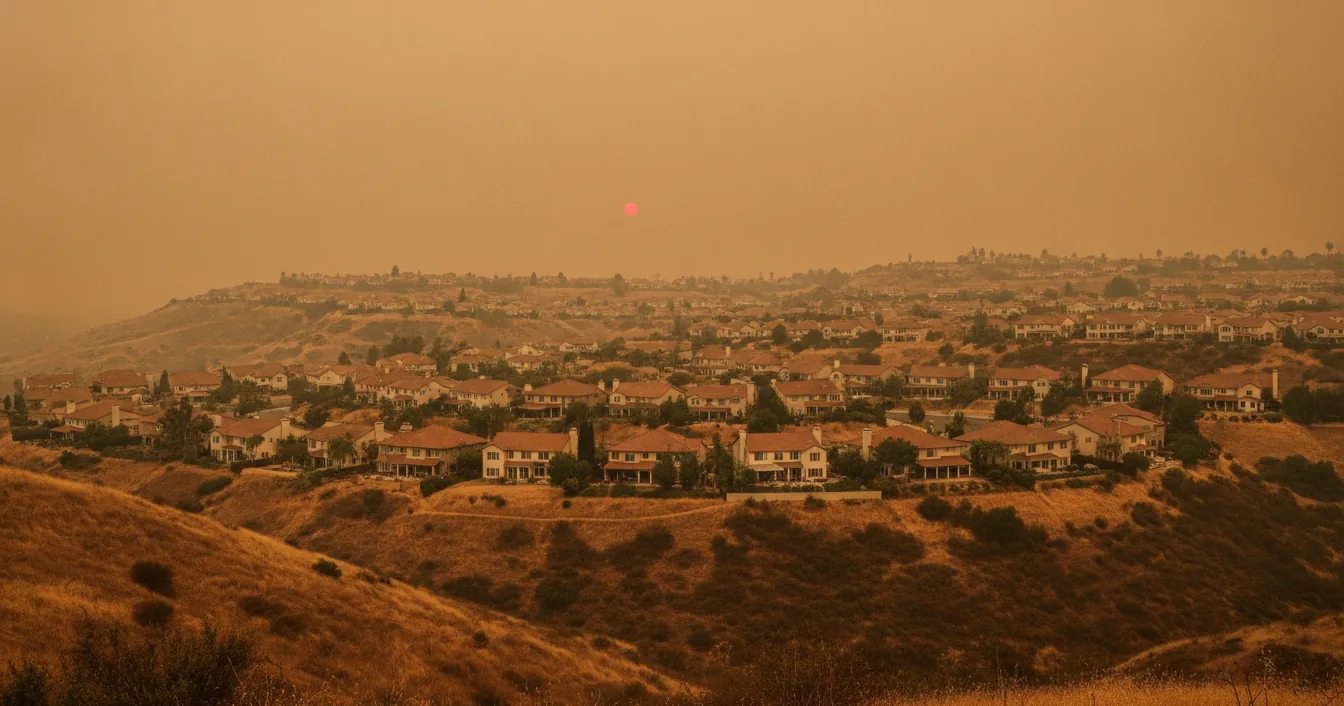
Every other weather emergency on this site arrives and takes your power with it. Wildfire is the one where the utility takes it first, on a clear afternoon, with two days of warning, because leaving the lines energized in a 60 mph wind blowing through cured brush is the more dangerous option.
That single difference reshapes the whole problem. A hurricane outage is a failure you ride out. A Public Safety Power Shutoff is a decision you plan around, and it lands in exactly the conditions where the reflexive backup answer, a gasoline generator running in the side yard, is itself an ignition source. Meanwhile your service equipment, the mast and meter and panel bolted to the outside of your house, sits directly in the ember stream that actually burns most homes down.
If you live anywhere the wildland urban interface has crept up to your fence line, fire season asks three things of your electrical system: survive a deliberate multi-day outage, avoid being an ignition source, and avoid catching one. Our hurricane and severe storm preparedness guide covers the wind and water version of this problem. Fire is a different animal.
Public Safety Power Shutoffs: When the Grid Is Cut on Purpose
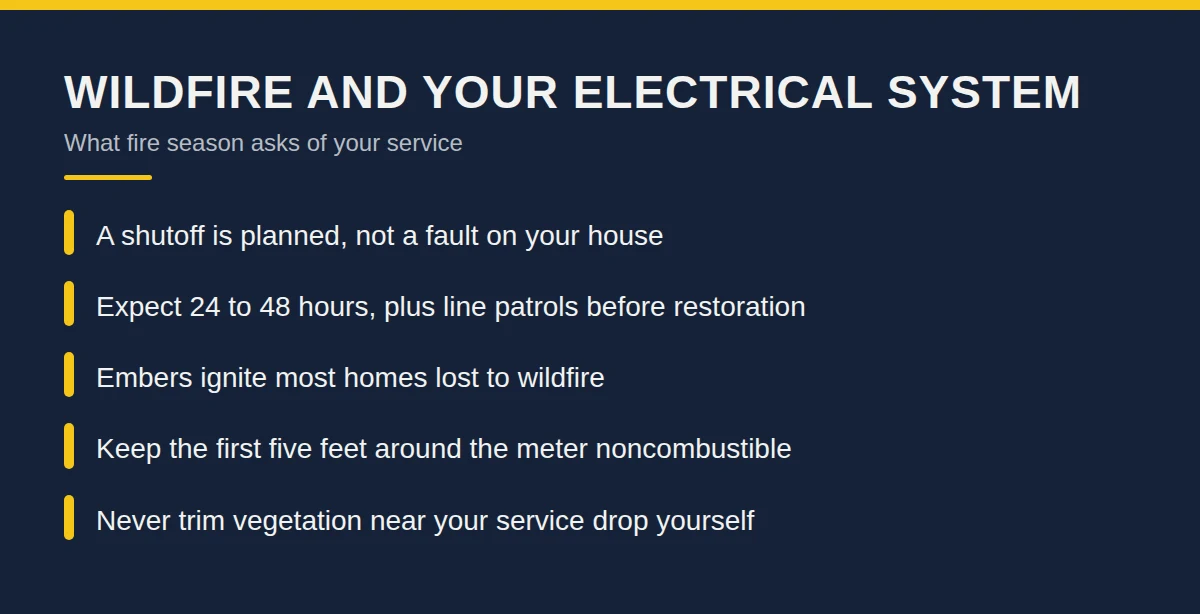
A Public Safety Power Shutoff, PSPS for short, is a utility deliberately de-energizing distribution lines when fire weather gets bad enough that a downed conductor or a branch slapping a wire would probably start a fire. The trigger is a combination rather than a single number: sustained wind and gusts, very low humidity, and fuel moisture low enough that anything landing in the grass takes hold. California utilities formalized the practice after the 2017 and 2018 fire seasons, and it has since spread to utilities across the interior West.
The thing to understand as a homeowner is that a shutoff is scheduled, not sprung. The notification cadence most utilities follow runs roughly two days out for the first customer notice, one day out with refined timing, and a final warning one to four hours before the lines actually open. When conditions pass, you get a separate all clear notice.
What catches people off guard is the back end. Power does not come back when the wind stops. Crews have to patrol every de-energized mile looking for damage before anything is re-energized, on foot, by truck, and by air. Utilities generally budget up to about eight hours for that inspection, and it stretches when the patrols need daylight. Add it up and a typical event runs 24 to 48 hours from shutoff to restoration, with longer events entirely normal when the wind event itself is long.
Two practical consequences follow. First, register. Utilities notify against the contact information on the account, so an old cell number means no warning at all. If anyone in the house depends on powered medical equipment, get on the utility’s medical baseline list, and treat that as a courtesy notification rather than a promise of power. Second, when the lights go out during a red flag warning, do not go hunting through your panel and do not call an electrician. It is not your equipment. Check the utility’s outage map by address first.
Planning for a Deliberate Multi-Day Outage
The runway is the gift here. Once a shutoff is announced you have a day or more to charge everything, fill water containers, get cash, refill prescriptions, and eat down the refrigerator. Four things catch households out, and none of them are the lights.
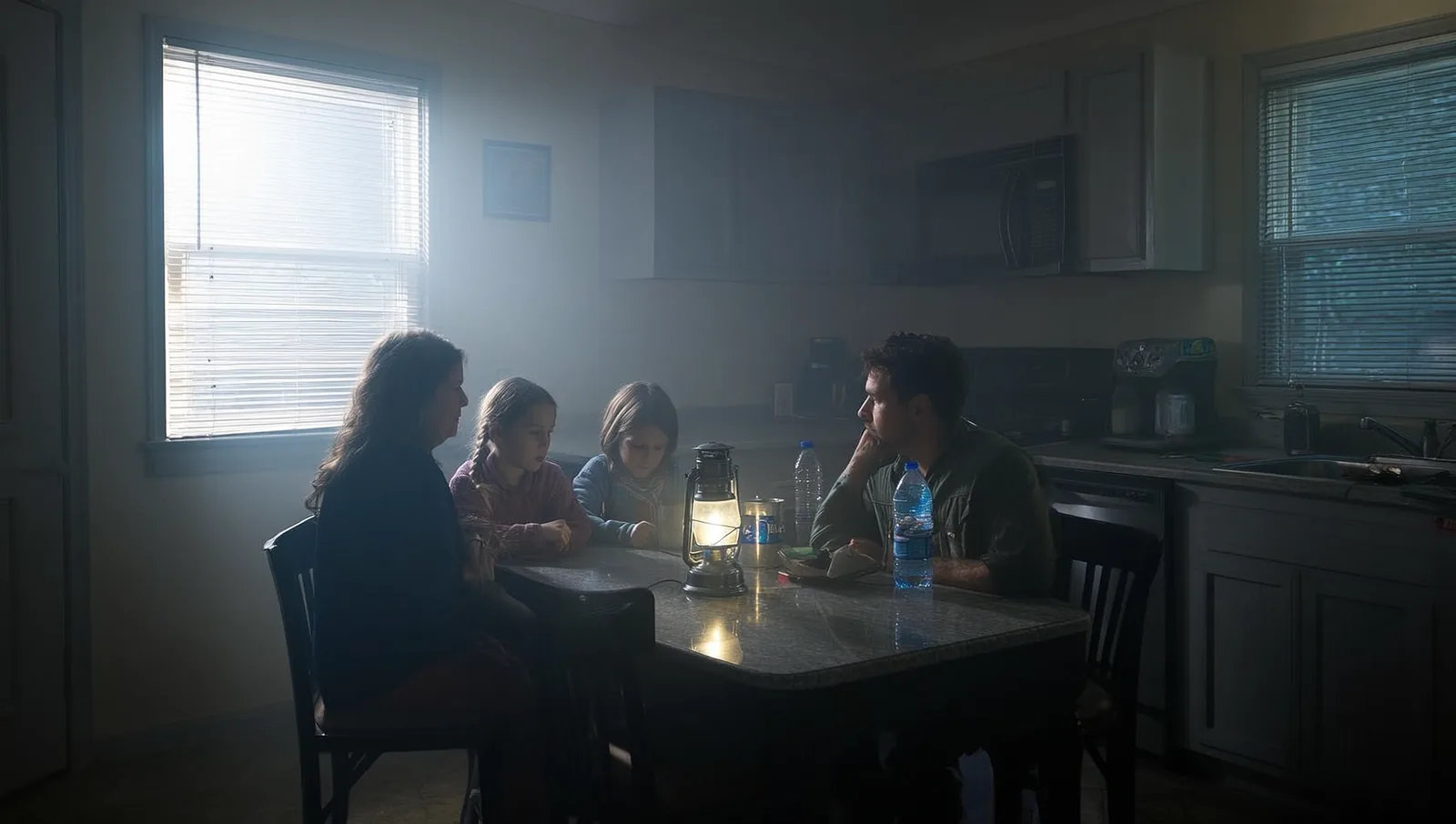
Water. A private well is an electric well. When the pump stops you have no drinking water, no toilets, and nothing to wet down a roof or a fence line. In fire country that is a safety problem, not an inconvenience. Fill storage before the shutoff, and if you are on a well, putting the pump on backup power belongs at the top of your list rather than the bottom.
Getting out. Electric driveway gates and garage doors fail closed. Every one of them has a manual release, and the time to find yours is not while smoke is visible on the ridge. Show everyone in the house where it is and let them pull it once.
Medical equipment. Oxygen concentrators, CPAP machines, powered wheelchairs, and refrigerated medications all need a plan that does not assume the grid, because the grid is the thing being switched off.
Communication. Cell sites have their own limited batteries and often sit inside the same de-energized footprint. A car charger, a battery bank, and a plain radio matter more here than they do in a storm outage.
Backup Power in Fire Weather
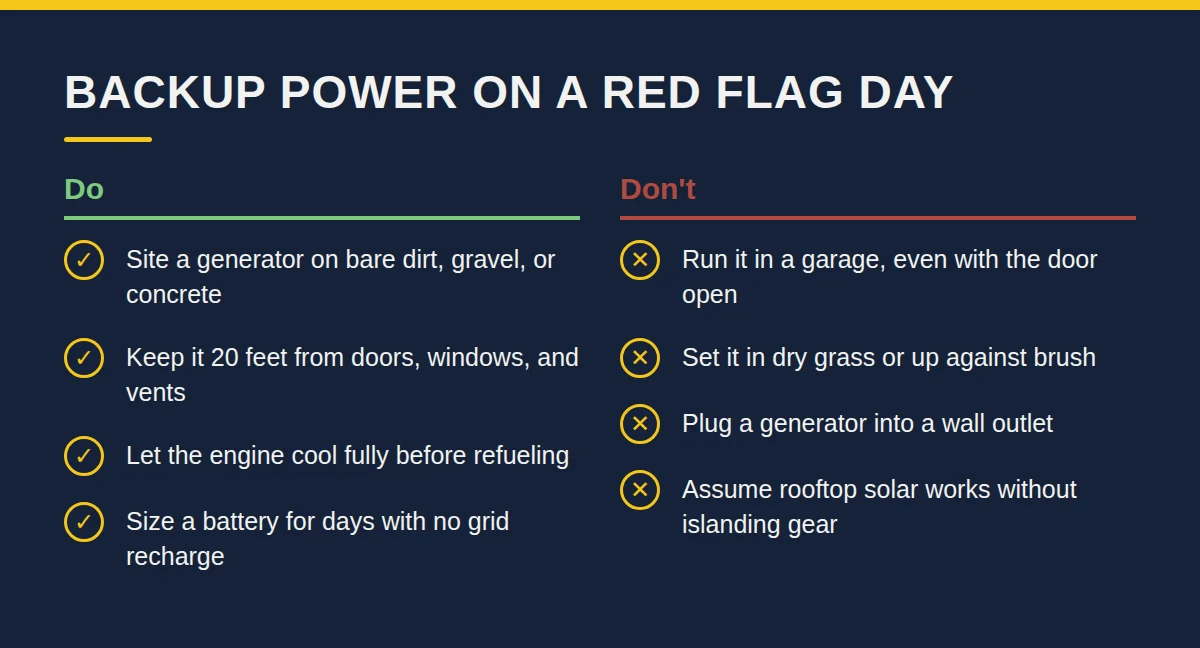
Here is the tension nobody raises in the generator aisle. A shutoff happens on the worst possible day to run a small engine outdoors: single digit humidity, cured fuels, and wind. A hot muffler resting near dry grass is a documented ignition source, and there are few worse outcomes than burning your own house down running a generator during an outage called to prevent fires.
If a portable generator is your answer, the fire weather rules stack on top of the usual ones. Set it on bare dirt, gravel, or concrete with a clear radius around it, never in grass or up against brush. Keep the fuel cans well away. Never refuel a hot engine, and give it real cooling time instead of a token couple of minutes. Confirm the spark arrestor is intact if your unit has one.
None of that displaces the rule that kills the most people. Carbon monoxide from a portable generator can be lethal in under an hour, and a garage with the door open is not outdoors. Keep the unit at least 20 feet from any door, window, or vent, with the exhaust pointed away from the house. Our full breakdown of generator carbon monoxide poisoning covers why post-event CO deaths routinely outnumber deaths from the outage itself.
This is the scenario where batteries genuinely beat engines. A home battery or a large power station has no exhaust, no fuel, no hot surfaces, and makes no noise, which means it can live indoors, it keeps working while you are evacuated, and nobody has to stand over it. The catch is sizing. In a storm outage you expect a recharge within a day. In a shutoff the grid is gone by design and may be gone for three days, so you size for the whole window or pair the battery with solar that can actually island. Ordinary grid-tied rooftop solar shuts down the instant the grid does, and only keeps producing with the right inverter and transfer equipment behind it. Our backup power buyer’s guide compares the real options.
Whatever you connect, connect it properly. A generator or battery feeding house circuits needs a transfer switch or an interlock kit installed by a licensed electrician. Plugging a generator into a wall outlet backfeeds the utility line and can kill a lineworker patrolling to restore your service.
Hardening the Service Against Embers
Fire rarely arrives as a wall of flame. It arrives as a blizzard of embers that can travel more than a mile ahead of the front, and post-fire investigations keep reaching the same conclusion: those embers, landing in the wrong place, ignite most of the homes lost in a wildfire. Research from the Insurance Institute for Business and Home Safety found that clearing the first five feet around a structure cuts the odds of ignition roughly in half.
Your electrical service lives in that first five feet. The meter enclosure, the mast running up the wall, an exterior panel, the AC disconnect, and the EV charger are all bolted to the exact band that needs to stay noncombustible. Walk it with fresh eyes and look for:
- Bark mulch, dry groundcover, or a wood chip bed against the wall beneath the meter
- Stacked firewood, cardboard, paint cans, or plastic bins beside the panel
- A wood fence that lands on the wall next to the service, which is a fuse running straight to the house
- Open knockouts, missing plugs, or gaps around conduit penetrations, every one of them an ember path into the enclosure and the wall cavity
- Cracked or missing sealant where the service conduit passes through the siding
- Unscreened soffit or crawlspace vents near the service run
The sealing work is electrician work, not caulk gun work. Closing an unused knockout takes a listed plug rather than tape, and firestopping a penetration takes a listed material. While you are back there, keep the code-required working space in front of the panel clear anyway (the NEC wants roughly three feet of depth), which conveniently doubles as the room a fire crew needs to reach your main disconnect.
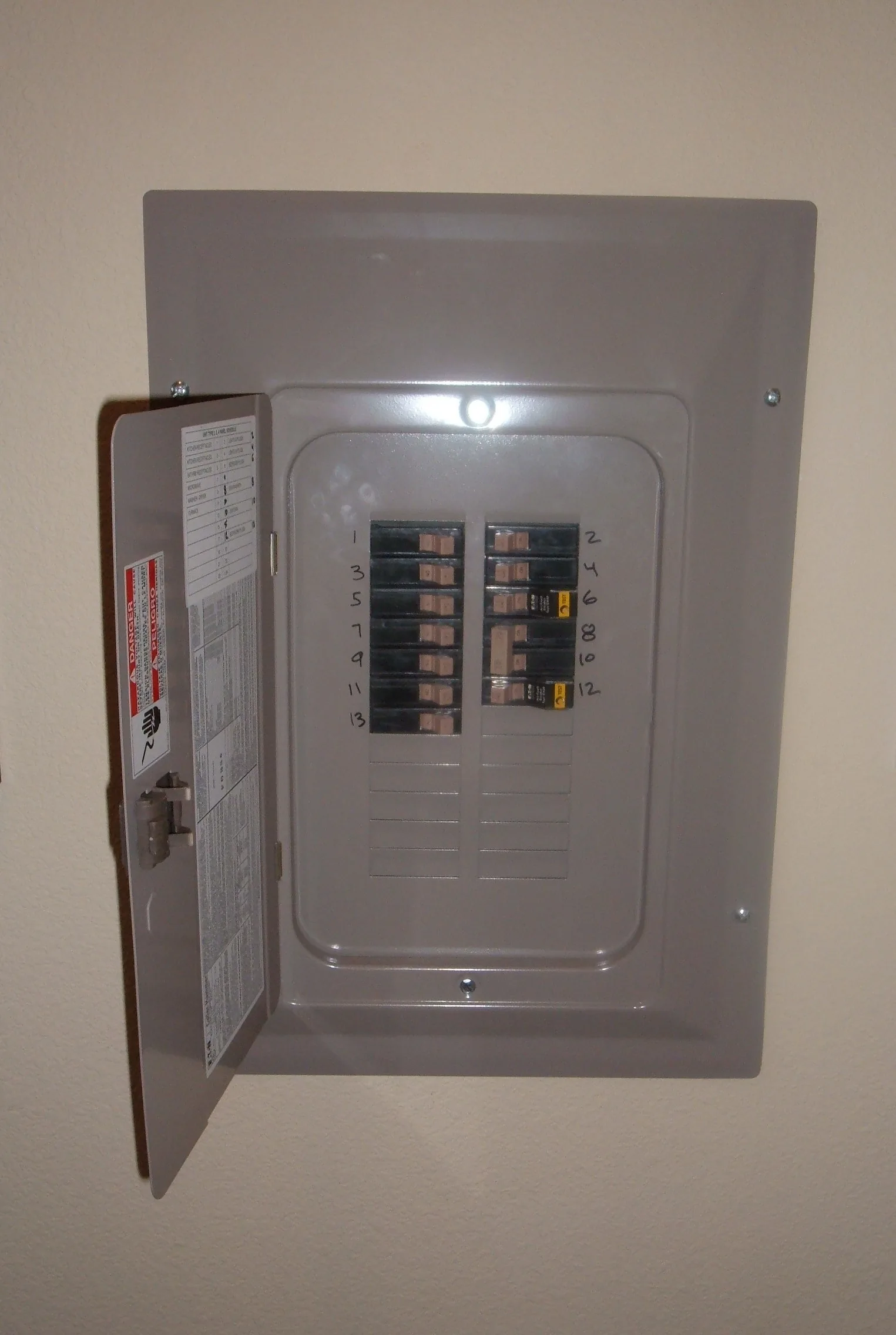
If you are unsure which pieces of that assembly are yours and which belong to the utility, our walkthrough of how power actually reaches your outlet names every component from the transformer to the receptacle and marks where the ownership line falls.
California’s Zone 0 rule, the ember-resistant band covering those first five feet, was still working through rulemaking with a phased rollout as of 2026, so what is legally required of you right now depends on your county and your local fire authority. The 100 foot defensible space requirement in state law is not new, though, and neither is your insurer’s interest in whether you have met it.
Vegetation, the Service Drop, and the One Span You Must Not Trim
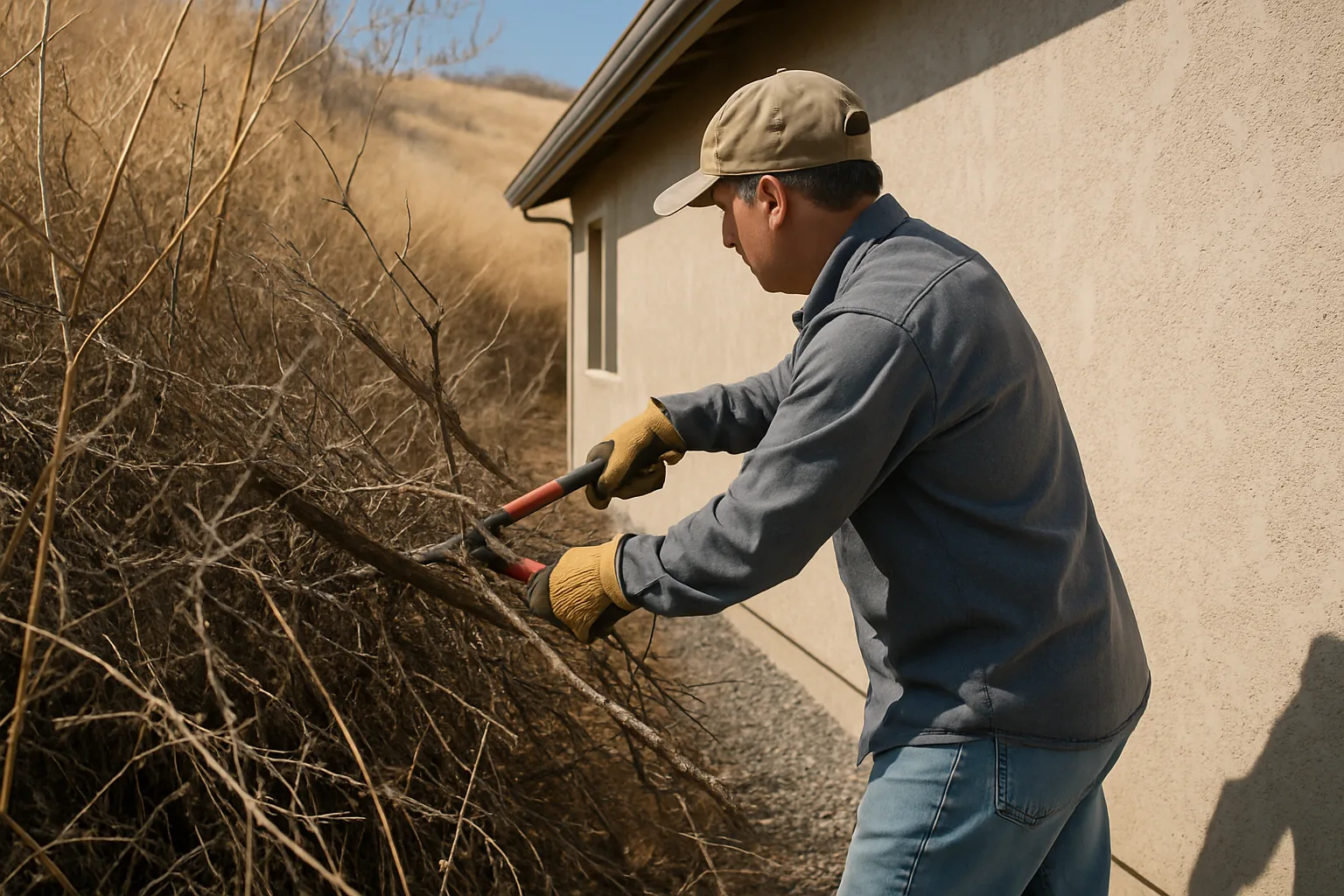
Utilities trim around their primary distribution lines on a cycle. The span running from the last pole to your house, the service drop, is a different animal, and in many utility territories the trimming around it falls to the customer.
Do not touch it. A service drop carries full utility voltage, the insulation on older drops is often weathered to nothing, and the neutral conductor is frequently bare. Homeowner electrocutions from pole saws near a service drop are a recurring line item in utility safety statistics. What you do instead is call the utility and ask for a temporary disconnect or a protective line sleeve so a tree crew can work safely. Most utilities provide this at no charge, and it takes scheduling rather than money.
For anything touching the primary lines, the ones on the crossarms out at the street, simply report it. Vegetation contact with a distribution line is among the leading ignition causes in wildfire country and is precisely the failure a shutoff is called to prevent. A leaning tree reported in September is a maintenance ticket. The same tree in a November wind event is a headline.
What Undergrounding Actually Changes for You
Burying the lines is the structural fix, and Los Angeles is now attempting it at neighborhood scale. An AECOM report prepared for the city recommends extensive underground power delivery in Pacific Palisades as part of the long-term restoration plan after the January 2025 fires, with the Los Angeles Times putting the cost around $650 million. Undergrounding is not exotic there; roughly a third of the LADWP distribution network is already buried.
For a homeowner, the important detail is what happens at your property line. Undergrounding the street does not automatically underground you. Your overhead drop becomes a buried service lateral, which means a trench across your yard, new conduit and a riser, usually a new meter enclosure, and frequently a panel or service upgrade because the work triggers current code. Utilities generally cover their side of the service point and the customer covers theirs, which is why residents in Altadena have reported connection figures running upward of $20,000. Budget for the conversion as a real project, and vet whoever quotes it with the same care you would use in an emergency; our list of questions to ask before hiring an electrician applies just as well to planned work.
There is also a genuine tradeoff, and LADWP has been candid about it. Interim general manager David Hanson put it plainly at a community meeting: “We love undergrounding circuits for their resiliency, however if there is an issue with circuits it takes us longer to restore power so that’s the tradeoff.” Buried lines fail far less often, but when they do fail, locating the fault takes longer than driving the line and looking at it.
The upside most homeowners care about is quieter than the fire math. Wind cannot push a buried conductor into a tree, so underground circuits are generally not swept into a shutoff footprint. Getting off the overhead system is, in practice, getting off the PSPS list. Do not expect it quickly, though. A Burns and McDonnell analysis notes that fewer than 100 firms across North America have full capability in high-voltage underground installation and repair, against many thousands supporting overhead work. The workforce, not the will, is the bottleneck.
Coming Home After a Fire
If fire came near the house, treat the electrical service the way you would treat it after a flood: assume it is compromised until an electrician says otherwise. Radiant heat degrades conductor insulation without leaving char anyone can see, so equipment that looks survivable often is not. Melted or bubbled insulation, a deformed or discolored meter enclosure, a service drop sagging lower than it used to, scorching around the mast, or any smell of burnt plastic at the panel all mean the same thing: leave the main open and call for an inspection before anything gets re-energized.
The utility will not reconnect a damaged service on your say-so. Expect the same sequence as any other disaster: a licensed electrician inspects and repairs, the local building department permits and signs off, and the utility reconnects against that clearance. Do not let anyone shortcut it because you want the lights on tonight.
The Bottom Line
Wildfire preparedness for your electrical system splits cleanly in two. One half is the outage: a shutoff is announced, it lasts a day or three, it ends only after crews have walked the lines, and your backup plan has to work in weather where a hot engine in dry grass is its own hazard. The other half is the hardware: your meter, mast, and panel sit in the five feet around the house that decides whether an ember finds a home, and the drop overhead is the one span you clear by phone rather than by ladder.
Undergrounding will fix a lot of this eventually, and if your utility is burying your street, it is worth understanding the trench, the cost split, and the code upgrades before the invoice arrives. Fire codes, defensible space rules, permit requirements, and utility service rules vary by county and municipality, so confirm the specifics with your local fire authority, your building department, and a licensed electrician in your area.
Further reading (sources)
- EC&M on the plan to bury power lines across the Palisades burn area
- California Public Utilities Commission for how a public safety power shutoff gets called and lifted
- Insurance Institute for Business & Home Safety with research on the ember-resistant buffer around a house
- Southern California Edison covering what happens during a shutoff and how restoration works
- California Wildfire & Forest Resilience Task Force from the draft Zone Zero defensible space regulations