The Years After the Shock: Long-Term Health Effects of an Electrical Injury
Published on October 4, 2026

The shock was months ago. Maybe it came from a frayed cord, a power tool, or a box you were sure was dead. Someone drove you to the emergency room, the ECG came back normal, and you went home with a discharge sheet and a story to tell. Since then, a few things have changed. The hand that took the current goes numb or tingles. You get headaches you never used to get. You sleep badly, and your concentration at work is not what it was. Nobody, possibly including you, has connected any of it to the shock.
That is the half of the story this guide covers. Our article on the hour after an electric shock handles the emergency itself. If a shock has just happened, start there: call 911 for fainting, chest pain, a racing or irregular heartbeat, trouble breathing, a seizure, or a deep burn, and leave the circuit off until an electrician has found the fault. This guide picks up afterward, with what researchers find when they follow people for years, which symptoms deserve a return visit to a doctor, and why notes made on the day of a shock can matter later, especially if it happened at work.
One thing first, because it is true and it matters: most shocks leave nothing behind. A Danish team that tracked thousands of union electricians week by week concluded that electrical shocks are common but rarely cause health effects. The problems below affect a minority of people. They are easy to miss because they tend to arrive late and do not look electrical.
How Researchers Followed People for Years After a Shock
Most of what doctors knew about electrical injury used to come from burn units, which see the worst cases, and from single case reports. That made it hard to tell whether an ordinary shock has lasting effects.
A group of Danish occupational medicine researchers tackled that with national registers. They found 14,112 adults recorded with an electrical injury between 1996 and 2014 and matched each one with up to 10 people of the same sex and age who were hurt the same year: once with sprain or dislocation patients, once with eye injury patients, and once with people in the same occupation. They then compared diagnoses for up to 20 years. Matching like this separates the effect of the shock from the effect of having any injury at all, or of doing manual work. Most of these injuries were not dramatic. About two thirds of the hospital cases involved a stay of less than a day.
Other studies fill in the rest. Swedish researchers surveyed 510 electricians who had taken current through the body and tested some of them in the clinic. A Toronto burn center and its partner rehabilitation hospital followed 122 patients for years after more serious injuries, 91 percent of them hurt at work. French emergency physicians phoned adults at least a year after a shock that the emergency department had judged benign. Of the 48 they reached, 82 percent reported at least one complication, most often neurological or psychological. That study was small and relied on patients’ own reports, but it fits the pattern.
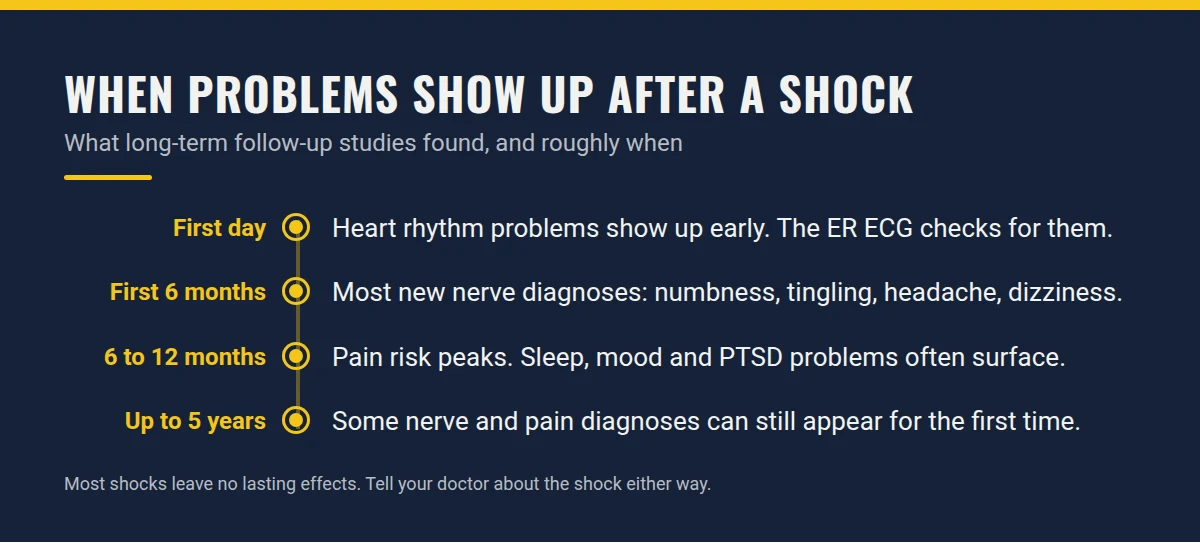
A review written for family physicians in Canada explains why this gets missed. The long-term effects of an electrical injury can be subtle, and they may not appear until one to five or more years after the injury, which makes them hard to tie to an accident long past.
Nerves: Numbness, Tingling, Headaches and Dizziness
The clearest long-term signal in the Danish data is in the nervous system. Compared with the matched groups, people with an electrical injury had a higher risk of:
- Damage to a single nerve in an arm or leg, which doctors call mononeuropathy. It was the most common nerve diagnosis, probably because hands and feet are the usual entry and exit points for current.
- Disturbed skin sensation, meaning numbness, tingling, burning, or pins and needles.
- Nerve root and plexus disorders, problems where nerves leave the spine or branch out through the neck and shoulder.
- Headache, migraine and vertigo, the spinning kind of dizziness.
- Epilepsy, convulsions and involuntary movements.
The same study brought reassuring news. People with an electrical injury showed no increased risk of Parkinson’s disease, multiple sclerosis, essential tremor, or other degenerative diseases of the nervous system.
Most of these diagnoses were made within six months of the injury, and the researchers say delayed onset is not the norm. Still, for most of the common diagnoses they could not rule out new cases up to five years later, and the risks were higher when the injury meant more than a day in the hospital.
Swedish electricians describe the same picture. In a survey of 523 of them, the symptoms that most often lingered were pain, muscle weakness and loss of sensation, more so after high voltage and “no let go” accidents, where the muscles clamp onto the source. When a Swedish team examined 23 electricians who still had symptoms, about half had abnormal sensitivity to warmth or cold, a pattern consistent with damage to the smallest nerve fibers. The team recommends thermal threshold testing, along with tests of touch and hand dexterity, to measure this kind of injury objectively.
The path the current took may matter less than people assume. In another Danish study, 6,960 union electricians answered a short questionnaire every week for 26 weeks, and nearly a quarter of them reported at least one shock. Blacking out or losing memory of the shock was rare. It was reported more often, though, when the current crossed the body, hand to hand or hand to foot, than when it went in and out on the same side, even though none of these shocks touched the head. The numbers were too small to be conclusive, but they are reason enough to mention headaches, dizziness or memory trouble to a doctor after a shock that was “only” through the hands.
Pain That Outlasts the Burn
The Danish team also looked at a diagnosis that sounds vague and is easy to wave away: unspecified pain, the code a doctor uses when a patient clearly hurts but no specific cause turns up. People with an electrical injury were about 30 percent more likely to receive it than people treated for a sprain, and nearly twice as likely as people in the same trades who had not been shocked. They were also more likely to be diagnosed with unspecified soft tissue disorders.
The risk ran highest 6 to 12 months after the injury, but at five years it was still about double that of the same-trade group. Most people diagnosed with unspecified pain got that diagnosis more than a year after the injury, and the risk was higher after more severe injuries. The researchers suggest that people in this group may benefit from a fresh evaluation at a specialized pain unit.

At the severe end, Australian pain specialists reviewed 15 people assessed for compensation claims after serious electrical injuries. Pain was widespread in 10 of them, 12 met the criteria for post-traumatic stress disorder, and their disability was generally more severe than their clinical records indicated. It is a small and selected group, but it shows how easily lasting harm goes unrecorded.
Sleep, Mood and Memory: The Part Nobody Asks About
A serious shock is a brush with death compressed into a second, and for some people the mind keeps replaying it. Among the Danish electricians in the weekly study, numbness, cramps, tremor, ringing in the ears, dizziness and flashbacks all became more common in the week of a shock. Most of those faded, but the ringing in the ears and the flashbacks lingered.
In the Danish register data, the risk of anxiety and adjustment disorders, and especially post-traumatic stress disorder (PTSD), was highest shortly after the injury. Depression showed a weaker, short-lived link. Other problems took longer to show up, including sleep disorders and somatoform disorders, which are physical symptoms without a clear physical cause. The authors stress that most of these outcomes are rare, so the absolute risk stays low even where the relative risk is high.
Among people hurt badly enough to need rehabilitation, the rates are much higher. In the Toronto group, more than half were diagnosed with at least one psychiatric condition, most often PTSD (33 percent) and major depression (25 percent). Sleep difficulties affected 68 percent, and memory and concentration problems 59 percent. The median time to a psychiatric diagnosis was more than ten months, and low voltage injuries produced these problems about as often as high voltage ones.

If you worry that you will not be believed, one finding is worth knowing. A Chicago study compared 63 electrical injury patients with 22 electricians who had never been shocked. The injured group reported more physical, cognitive and emotional symptoms, and their complaints were not related to whether they were involved in litigation.
The memory picture is more nuanced. The Swedish electricians reported more attention problems and more anxiety than a comparison group, yet 23 of them with lingering complaints scored as well as matched controls on formal tests of memory and attention. The researchers caution that this does not rule out real cognitive effects in people who have symptoms. The strongest predictors of later trouble were feeling mortal fear during the accident and having symptoms, especially mental ones, for more than a week afterward, and the researchers say those two signs should prompt medical and psychological follow-up. Pain, poor sleep, anxiety and low mood all blunt concentration (a Chicago study of 50 patients linked higher pain to slower attention and processing), and all of them can be treated.
Do not wait it out. Chicago researchers who followed electrical injury survivors for an average of 12 years found that those with high depression scores at their first evaluation adjusted worse and were less likely to be back at work, and a separate four-year follow-up found the same pattern. Treat mood problems early.
Eyes: Cataracts Are Real, Mostly After Current Near the Head
Electric cataract, a clouding of the eye’s lens caused by current, has been described in medical journals for more than a century. Most reported cases involved current that entered or left the body on the head or near the eyes, often at high voltage. An older burn center series cited by the Danish team found cataracts in about 6 percent of severely injured patients, appearing 1 to 12 months after the injury.
For everyday shocks, the Danish data are reassuring. Across the same 14,112 injuries, there was no increase in cataract compared with the matched groups at any point from six months on. The researchers conclude that cataract is not a delayed effect of electrical injury in general, and that routine cataract screening after every shock is not needed.

So the advice splits by path. If the current, or an arc flash, reached your head, face or neck, get an eye exam and tell the eye doctor what happened. Physicians cited in the Danish paper recommend monitoring by an eye specialist when an injury involved the head and neck. After a hand to hand shock, blurred vision, glare or halos around lights still deserve a check, and you should mention the shock.
The Heart: Mostly a First-Day Question
The heart is where the long-term news is best. A Danish nationwide study compared 11,462 people seen at a hospital after an electric shock between 1994 and 2011 with five people of the same age and sex for each. Five-year survival was no different. Heart disease and heart procedures afterward were very rare, and the serious rhythm problems in the records happened at the time of the shock, not later. From one month to one year afterward, heart disease was no more common than in the comparison group, apart from heart failure, which mostly affected people who already had heart disease.
Occasionally a shock does damage the heart muscle, and that shows up on the early tests. In one such case, French cardiologists followed a young worker’s heart with MRI scans for 18 months. If your ECG and blood tests were normal, the heart is the part of this you can mostly stop worrying about, though new palpitations, fainting or chest pain always need prompt attention.
Symptoms That Should Send You Back to a Doctor
None of these symptoms proves the shock caused it, and all of them have other common causes. That is exactly why your doctor needs to hear about the shock. Book a visit, and mention the injury, if in the months after a shock you notice:
- Numbness, tingling, burning or weakness in a hand, arm or leg, especially one the current passed through, or you keep dropping things and fumbling small tasks.
- Pain that has not faded, or pain that has spread beyond where you were hurt.
- New headaches, migraines, dizziness or spinning, or ringing in your ears.
- Twitching, jerking or other movements you cannot control.
- Sleep that will not settle, nightmares or flashbacks, or dread at the panel or on the job site.
- Low mood, irritability or anxiety that is not lifting.
- Memory or concentration trouble that is affecting work or home.
- Blurred vision, glare or halos, particularly if the current or an arc was near your head.
Call 911 for a seizure, a blackout, chest pain, a racing or irregular heartbeat, or sudden trouble breathing.
A few things help you get taken seriously:
- Tell every clinician about the shock. Give the date, what you touched, the voltage if you know it, and where the current went in and out. Bring the ER discharge papers.
- Ask for the right referral: neurology for nerve symptoms (ask whether thermal threshold testing makes sense), pain medicine, an eye exam, a psychologist or psychiatrist for sleep, mood or PTSD, or occupational medicine for a work injury.
- Expect to explain. Swedish electricians described clinicians who said “household” current was not dangerous, and being sent home after the routine checks with no follow-up. One said he had missed having a check five or ten years later, because he felt he had gotten worse.
Write It Down the Day It Happens
If symptoms appear a year after a shock, the record made at the time is often the only thing connecting the two. The Canadian review notes that in compensation medicine, establishing what caused a problem is a considerable challenge when the injury may not leave objective clinical findings.
Shocks also go unreported, particularly in the trades. The Danish electricians rated 73 percent of the shocks they reported “not at all severe,” and only a few led to contact with health services. Only about a quarter of the Swedish electricians in the survey had sought medical care after their accident. In interviews, Swedish electricians said shocks are treated as something that comes with the job, that reporting felt like admitting carelessness, and one said a supervisor asked him not to report his accident so the company would not “look bad.” Swedish electricians are advised to seek medical care whenever current passes through the body, or after an arc, lightning, loss of consciousness, a burn, numbness or cramping, even if the accident does not seem severe.
Here is what to record, ideally the same day:
- When and where, and what you were doing.
- The source: the tool, cord, appliance, outlet, wire or panel, and its voltage if you know it.
- The path and the contact: where the current went in and came out, how long it lasted, and whether you could let go.
- What happened to you: whether you fell, blacked out, or have a gap in your memory.
- Witnesses: the names of anyone who saw it or helped.
- Photos of the source and of any marks on your skin. Keep the device rather than throwing it away.
- Medical records: the name of the ER or clinic, and copies of the discharge papers and test results.
- The days after: how you felt, and especially any symptom that lasted more than a week.
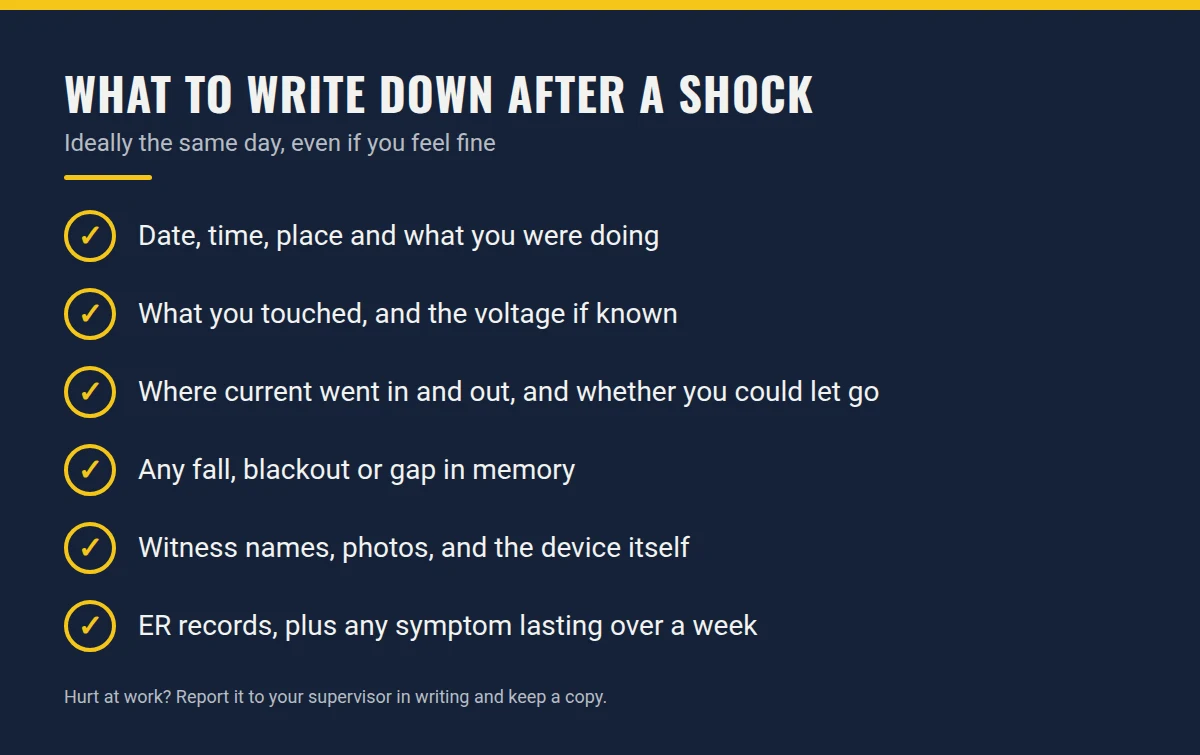
If it happened at work, tell your supervisor in writing and keep a copy. Workers’ compensation is run by each state, and notice deadlines can be short. California, for example, warns that a worker who does not report an injury within 30 days could lose the right to benefits. It also tells workers to let the medical staff know the injury is job related, and says it is illegal for an employer to punish or fire a worker for having a job injury or asking for benefits.
Federal OSHA rules back this up. An employer must record a work injury that causes loss of consciousness or needs medical treatment beyond first aid. Employers must have a way to report injuries that does not discourage reporting, and they may not fire or discriminate against an employee for reporting one. An employee, or a former employee, can ask for a copy of the OSHA incident report describing their own injury, and the employer must hand it over by the end of the next business day.
The stakes are real. In the Danish registers, electrical injuries raised the risk of long-term sick leave and lower work participation. In the Toronto rehabilitation group, 61 percent went back to their old jobs, more than half of them with modified duties, and 19 percent could not return to any work.
At home there is no workers’ compensation, but the same record helps your doctor. If a product shocked you, keep it; our guide to checking for electrical product recalls explains how to report it to the Consumer Product Safety Commission. If you rent, tell your landlord in writing. None of this is legal advice, and your state’s workers’ compensation agency can tell you the deadlines that apply where you live.
Fix What Shocked You
The long-term research is the best argument for making sure the same fault never shocks anyone twice. A shock from an outlet, switch, cover plate or appliance means something is wrong, whether that is a ground that was never connected, a missing GFCI, worn insulation, or a damaged cord. Leave the circuit off or the device unplugged until a licensed electrician has found the cause. A tingle from a metal box or cover plate that trips no breaker is the classic sign of a missing ground pigtail inside the box, and GFCI protection is the device built to cut a ground fault shock short. If the shock came from an overhead line, read our guide to power line contact and the ten foot rule before anyone goes near it again. And before you let anyone open the panel, verify the electrician’s license with your state board.
The Bottom Line
Most shocks leave no trace, and if your ECG was normal, the heart is unlikely to cause trouble later. What the long-term studies do find, in large matched groups, is a higher risk of nerve damage in the limbs the current crossed, headaches and dizziness, lasting pain, and sleep and mood problems tied to the trauma, sometimes surfacing months or years after the ER sent you home. Cataract is a real risk mainly when current or an arc reached the head. Tell your doctors about the shock, push for the right referral, and treat sleep, pain and mood problems early. Write the shock down the day it happens, report it if you were at work, and have the fault fixed before anyone touches that circuit again.
This article is general information, not medical or legal advice. Electrical codes and permit rules vary by municipality, so a licensed local electrician is the right person to find and repair the fault.
Further reading (sources)
- Nielsen and colleagues on nerve and brain diagnoses in the years after 14,112 Danish electrical injuries
- Poulsen and colleagues for the risk of unspecified pain and soft tissue disorders after an electrical injury
- Kærgaard and colleagues on electrical injury and the long-term risk of cataract
- Biering and colleagues with mental disorders after electrical injury in a matched Danish cohort and sick leave and work participation afterward
- Biering, Kærgaard, Carstensen and Nielsen from the Danish electricians cohort: how often shocks happen and how few lead to care, which symptoms linger afterward, and blackouts and memory gaps after cross-body shocks
- Hansen and colleagues covering survival and heart disease after electric shock in a Danish nationwide cohort
- Gilles and colleagues on tracking heart muscle damage with MRI for 18 months
- Thomée, Österberg, Rådman and Jakobsson with cognition and mental wellbeing in Swedish electricians after shocks
- Thomée and Jakobsson from interviews with electricians about medical care, follow-up and reporting
- Rådman and colleagues on lingering symptoms in a survey of Swedish electricians and nerve testing in electricians with remaining symptoms
- Radulovic and colleagues for psychiatric diagnoses and return to work after electrical injury in Toronto
- Chauveau and colleagues on long-term complications after shocks first judged benign
- Pliskin and colleagues with symptoms in electrical injury patients compared with unshocked electricians
- Hahn-Ketter and colleagues covering psychiatric outcomes more than a decade after injury and how early emotional symptoms predict adjustment four years on
- Lun and colleagues for chronic pain, PTSD and movement disorders in 15 compensation claimants
- Dorociak and colleagues on how pain affects attention and thinking after electrical injury
- Wesner and Hickie with a review for family physicians on the delayed effects of electrical injury
- California Division of Workers’ Compensation on reporting a work injury and the 30-day warning
- 29 CFR 1904.7 for which work injuries an employer must record
- 29 CFR 1904.35 on the right to report a work injury without retaliation and to get a copy of the incident report