Electric Shock Drowning: The Hidden Summer Hazard at Docks, Marinas, and Pools
Published on May 28, 2026

Every summer, families gather at lakeside docks and freshwater marinas to cool off, and nearly every summer a few of them die from a hazard they never saw, never heard, and never had a chance to swim away from. Electric shock drowning, usually shortened to ESD, happens when stray alternating current leaks out of faulty boat or dock wiring and energizes the water around it. A swimmer who paddles into that invisible zone does not get the dramatic, sparking jolt people picture. Instead the current quietly locks up their muscles, they lose the ability to stay afloat, and they go under. Because there is no burn, no splash, and no obvious cause, the death is almost always recorded as an ordinary drowning. That is exactly why ESD has stayed hidden in the statistics for so long.
If you own a private dock, keep a boat at a freshwater marina, or have a backyard pool, this is a risk worth understanding before the season ramps up. The reassuring part is that ESD is almost entirely preventable with a short list of electrical protections and one yearly visit from a licensed electrician. Lead with this rule above all others: if you ever feel a tingle, a buzz, or a numb sensation while you are in the water, do not swim toward the dock or the ladder. Turn around, swim back the way you came, and get out at the natural shoreline. Swimming toward the metal is swimming toward the source.
What Electric Shock Drowning Actually Is
ESD is the passage of a typically low level AC current through a person’s body while they are immersed in fresh water. It does not take much. A current of only 10 milliamps, far below the level that trips a standard circuit breaker, is enough to make the skeletal muscles seize. The swimmer cannot command their arms and legs to move, and in water that means they cannot keep their head up. Higher currents reach the heart, and medical reviews of electrical injury note that even survivors can develop dangerous heart rhythm disturbances in the hours that follow. The cruel detail is that the voltage involved is ordinary 120 volt household power, the same current running your dock lights or a battery charger on a boat, not some exotic high tension line.
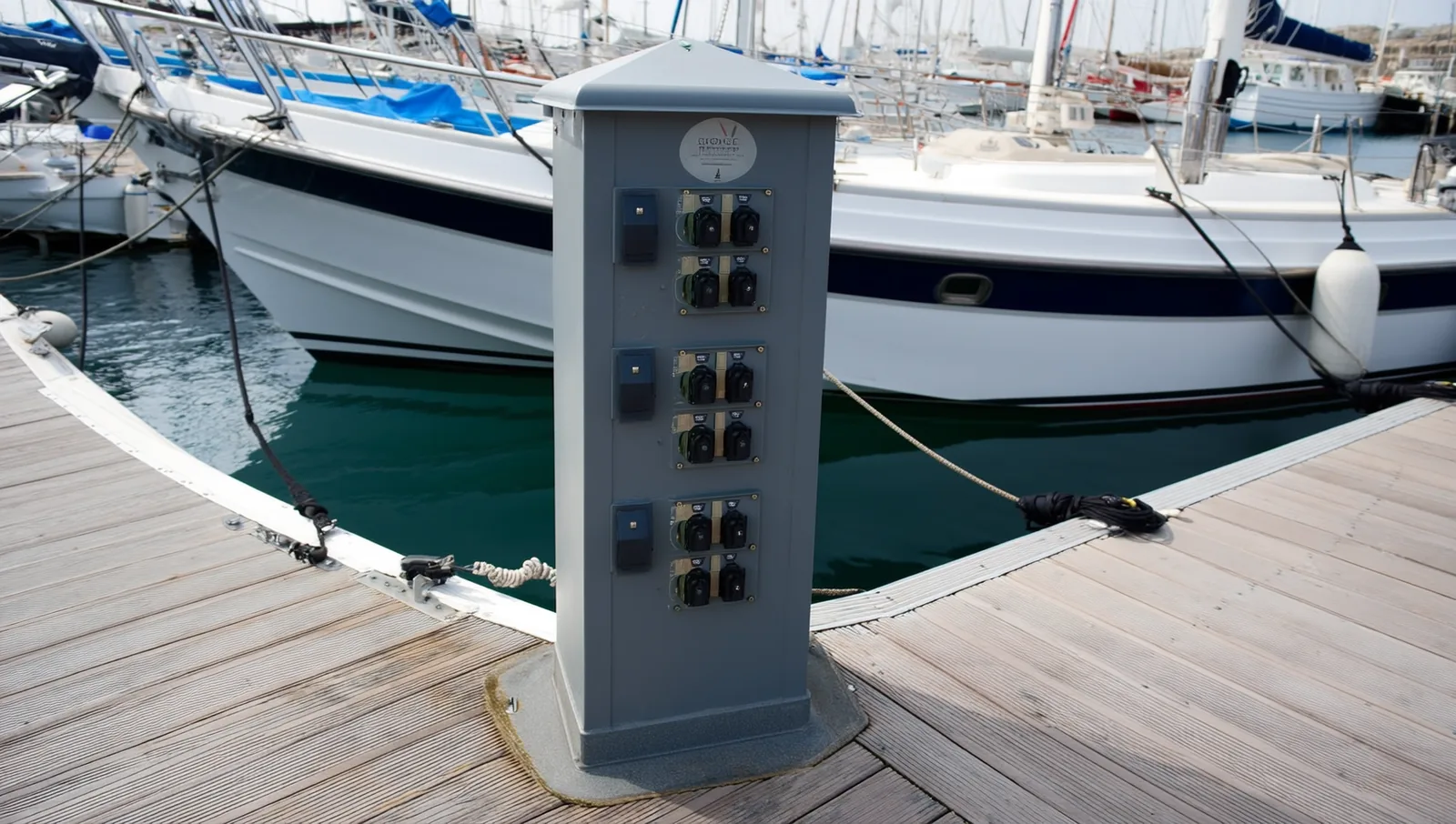
Most ESD deaths happen at public and private marinas and docks, where shore power brings AC electricity right to the water’s edge. A single miswired boat, a damaged shore power cord, or a corroded connection on a dock pedestal can put current into the water without tripping anything, and the dock looks completely normal from above.
Why Fresh Water Multiplies the Danger
ESD is overwhelmingly a freshwater phenomenon, and the reason comes down to conductivity. Salt water is full of dissolved ions, so it conducts electricity far better than the human body does. In the ocean or a salt marsh, stray current flows through the water around a swimmer and largely ignores them. Fresh water is different. Lake, river, and pond water is a poor conductor, which means a human body, salty on the inside, becomes the path of least resistance. The current chooses to flow through the swimmer instead of the water. That is why the same fault that would be shrugged off at a coastal marina can be lethal at a lake dock.
It also explains why ESD spikes in summer. The water is warm, people are swimming near docks where boats are plugged in, and the seasonal boats coming out of winter storage are the ones most likely to have developed a wiring fault. The National Electrical Code keeps tightening its marina and dock requirements precisely because this combination keeps claiming lives.

The Warning Signs Almost Everyone Misses
ESD gives warnings, but they are subtle and easy to dismiss. Take any of them seriously:
- A tingling, prickling, or numb sensation while swimming. This is the single most important sign. People often describe their limbs feeling heavy or buzzy right before they get into trouble.
- Swimmers near a dock suddenly unable to move, or calling for help with no obvious reason such as a cramp or a wave.
- Dock lights that flicker or dim, breakers that trip for no clear reason, or a mild shock felt when touching a metal ladder, railing, or boat fitting from the water.
- Tingling the moment you grab a metal dock ladder while still partly submerged.
None of these guarantee an energized zone, but all of them justify getting everyone out of the water and shutting off power until an electrician checks the system.
If Someone Is in Trouble: Rescue Without Becoming the Next Victim
The instinct to jump in after a struggling swimmer is exactly what turns one ESD victim into two or three. The water around them may still be energized, and rescuers who dive in are frequently the ones who die. Follow the lifeguard principle of reach and throw, but do not go.
First, get the power off. Find the shore power pedestal or the main breaker for the dock and shut it down. Cutting power removes the source of the current and is the single most effective thing a bystander can do. Then throw a life ring, a flotation cushion, or anything that floats, and reach with a non conductive object such as a wooden oar or a fiberglass pole. Call 911 immediately, because anyone who has been in an energized area needs medical evaluation for delayed cardiac effects even if they seem fine. Do not enter the water yourself until you are certain the power is off.
The Private Dock Owner’s Inspection Checklist
If you own the dock, the wiring is your responsibility, and almost none of this is do it yourself territory beyond the visual checks. Run through this list with a licensed electrician who knows the marine and waterfront sections of the code:
- GFCI protection on every dock receptacle and circuit. A ground fault circuit interrupter trips at around 5 milliamps and protects people directly.
- ELCI protection on the feeder. An equipment leakage circuit interrupter trips at 30 milliamps and guards the whole shore power system. Newer code editions require it, and boats themselves should carry ELCI or isolation transformer protection serviced to American Boat and Yacht Council standards.
- Equipotential bonding of every metal part. Ladders, railings, metal pilings, and pump housings should be bonded together so there is no voltage difference between them and the surrounding water for current to push across.
- Annual leak current testing. A licensed electrician uses a clamp meter to measure whether any current is escaping into the water, then traces the fault. This is the test that catches a problem before it catches a swimmer.
- A clearly marked emergency shutoff and visible no swimming signage at the dock.
Leak current testing and bonding repairs are skilled, code driven work, so this is a job for a vetted professional, not a handy neighbor. Before you hire, walk through the basic questions every homeowner should ask an emergency electrician and confirm the license and insurance with your state board. For a sense of what a service call and testing visit runs, our breakdown of average emergency electrician charges sets expectations. Waterfront systems also take a beating from weather, so pair this with the seasonal steps in our hurricane and severe storm electrical preparedness guide if you are on the coast or a big lake.
Pools and Hot Tubs Are Not Exempt
Swimming pools sit under their own demanding section of the National Electrical Code, and the same physics that kills at a dock applies in a backyard. A failing pool pump motor, an underwater light with degraded insulation, or a nicked wire feeding the equipment pad can energize the water or the metal around it. The code’s answer is an equipotential bonding grid, a network of bonded copper that ties the rebar in the pool shell, the ladders, the handrails, the pump, and any nearby metal into one electrical unit, so a person can never bridge two parts sitting at different voltages.

Because bonding is buried in the structure, you cannot inspect most of it yourself. What you can do is watch for the warning signs (a tingle on the ladder, a light that flickers when the pump runs, a faint shock at the diving board) and treat any of them as a reason to keep everyone out and call for help. If you are unsure whether a flickering light or a faint tingle counts as urgent, our guide on when a problem is an emergency rather than a routine repair helps you make the call.
The Bottom Line
Electric shock drowning is invisible, it strikes strong swimmers as easily as weak ones, and it is almost always preventable. The defenses are not complicated: GFCI and ELCI protection, proper equipotential bonding, a yearly leak current test by a licensed electrician, and a firm no swimming rule near any powered dock or marina. Remember that codes and permit rules vary by municipality, so the right professional will know your local requirements as well as the national ones. Spend an afternoon and a service call this spring, keep people away from the metal, and a hazard that has quietly killed swimmers for decades becomes one your family never has to think about.
Further reading (sources)
- Electric Shock Drowning Prevention Association on what ESD is and how to prevent it
- BoatUS for avoiding electric shock drowning around boats and docks
- West Marine with how ELCI and GFCI protection differ
- Safe Electricity via its guide to preventing deadly shocks around boats and docks
- EC&M on a refresher quiz covering ESD and NEC marina requirements
- European Heart Journal for how electric shock disrupts the heart and muscles