Hardwired Smoke Alarms: Interconnection, the 10-Year Clock, and Why the Chirp Will Not Stop
Published on October 6, 2026
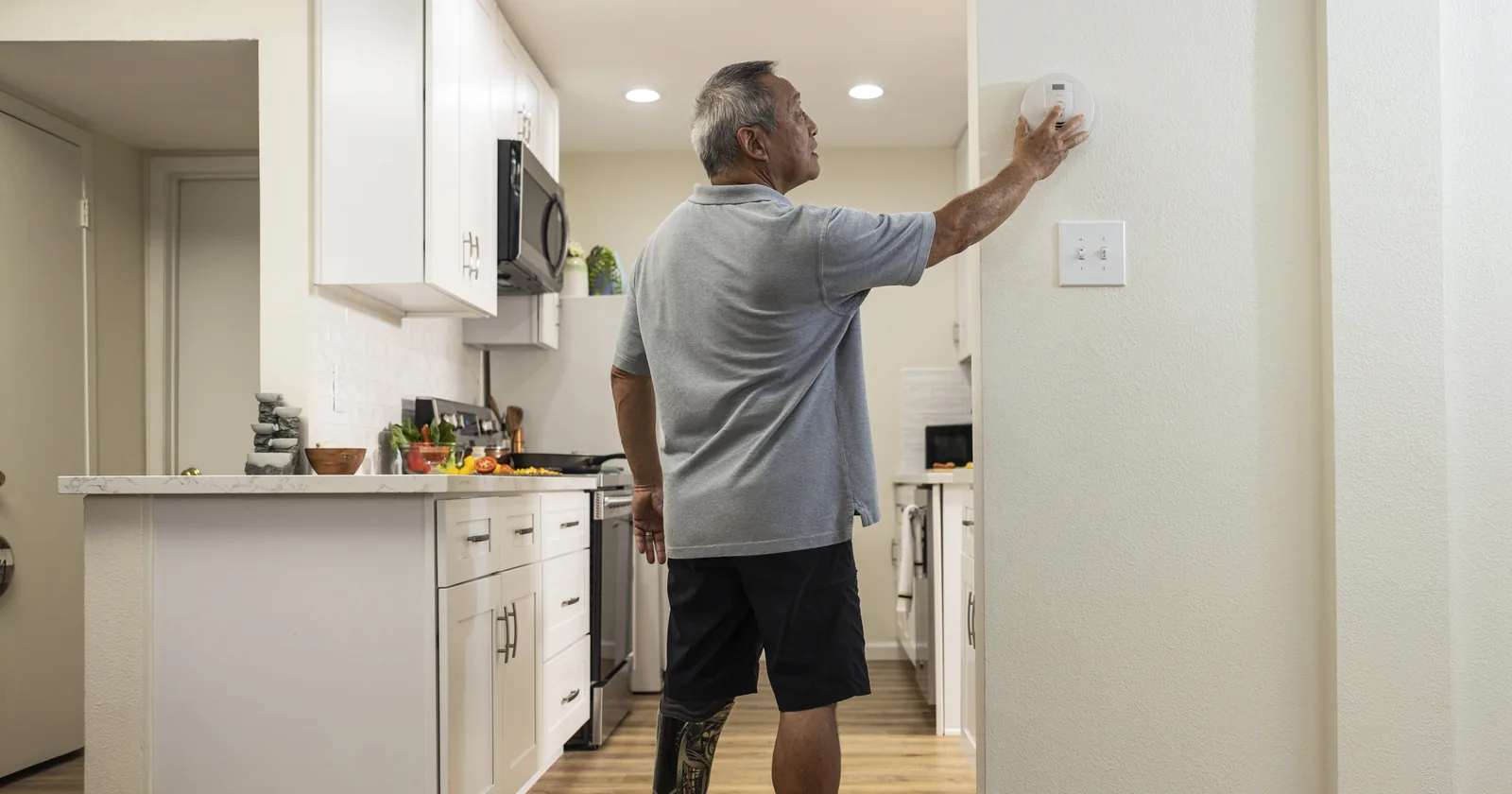
One short chirp from the hallway ceiling, then another a minute later, usually starting around three in the morning. It is one of the most common smoke alarm complaints there is, and the most dangerous response is the one people reach for half asleep: pulling the alarm down and leaving it down. Most American houses built since about 1989 have smoke alarms wired into a 120 volt circuit and linked so that when one sounds, they all sound. Those wired alarms are the most dependable kind, and they still chirp, wear out, and get disabled.
First, know a chirp from an alarm. A single short beep every 30 to 60 seconds is a trouble signal, not a fire warning. A full, continuous alarm is a fire until proven otherwise: get everyone out, close doors behind you, and call 911 from outside. The National Fire Protection Association (NFPA) warns that you could have as little as two minutes to escape once a smoke alarm sounds, so do not go looking for the cause. If a combination alarm is sounding its carbon monoxide pattern, get everyone into fresh air and call 911. And if an alarm or the box behind it smells of hot plastic, looks scorched, or keeps losing power, turn that circuit off at the panel if you can reach it safely and call a licensed electrician.
Fire Prevention Week runs October 4 to 10 this year, and the clocks fall back on Sunday, November 1, a natural day for fresh backup batteries. This guide covers how interconnection works, where codes want alarms, the 10-year date on the back, why wired alarms chirp, and what replacing a set or remodeling involves.
Wired Alarms Work Better, and Fail in Their Own Ways
NFPA’s June 2024 report on smoke alarms, covering home fires from 2018 through 2022, makes the case for wiring plainly. Hardwired alarms, with or without a backup battery, operated in 94 percent of the fires large enough to set them off, against 85 percent for battery-only alarms. Homes with wired alarms had half of the reported fires among homes with alarms but only 29 percent of the deaths, while battery-only homes had 44 percent of the fires and 66 percent of the deaths. Compared with homes that had no alarms and no sprinklers, the death rate per 1,000 fires was 71 percent lower where wired alarms with a battery were present.
Wired is not foolproof. Fire departments responded to an average of 19,119 home fires a year in which smoke alarms should have operated and did not, fires that killed an average of 403 people a year. When a hardwired alarm with battery backup failed, the most common identified reason was a missing or disconnected battery (27 percent of failures), followed by a power failure, shutoff or disconnect on the wiring side (16 percent) and lack of cleaning (12 percent). For wired alarms with no battery at all, power problems led, at 31 percent.
The report is blunt about why batteries go missing. The low-battery chirp gets treated as a nuisance, and “even people committed to fire safety may disable an alarm that starts chirping in the middle of the night.” Its remedy is a new backup battery every year, before the chirp starts. A wired alarm’s weak points, in other words, are the battery nobody thinks it needs and the circuit nobody thinks about.
What a Wired Alarm Needs From the House
A wired smoke alarm runs on household current and keeps a battery for outages. The International Residential Code (IRC), the model code most states build their residential rules on, requires exactly that in new homes: primary power from the building wiring, battery power when that is interrupted, and wiring that is permanent “and without a disconnecting switch other than those required for overcurrent protection.” In plain terms, a breaker can turn your alarms off, but a wall switch never should. If the alarms in your house go dark with a light switch, that is a wiring fault to have corrected.
NFPA 72, the fire alarm code the IRC points to, adds the details an electrician works to. The alarms’ power has to come from either a dedicated branch circuit or the unswitched part of a circuit that also serves lights and receptacles. With narrow exceptions, neither a wall switch nor a ground-fault circuit interrupter (GFCI) may be the thing that cuts that power, and alarms on an arc-fault (AFCI) protected circuit must have a backup battery. That last rule comes up constantly, because bedroom circuits generally need AFCI protection under the National Electrical Code. St. Paul, Minnesota, for one, requires the power to any newly wired smoke alarm to be AFCI protected, and our guide to AFCI and GFCI protection explains what those devices guard against. When an AFCI trips, the alarms on that circuit drop to battery until someone resets it.
The backup battery is not passive, either. NFPA 72 requires the alarm to supervise it and to give “a distinctive audible and visible trouble signal” when the battery is removed, disconnected or low. That signal is the chirp, and it is the alarm doing exactly what the code asks of it.
How Interconnection Works
In a wired set, each alarm is fed by cable with three conductors plus a ground: a hot (usually black), a neutral (white), and a third conductor, usually red, that carries the alarm signal between units. When any alarm senses smoke, it signals on that wire and every alarm on the line sounds. The IRC requires this wherever more than one alarm is required, which means almost every house, so that “the actuation of one alarm will activate all of the alarms.” Listed wireless alarms meet the same rule by radio.
The reason is hearing. NFPA’s report notes that a closed bedroom door is likely to delay a stand-alone alarm’s response to a fire on the other side of it, and that a stand-alone alarm on another floor or behind a closed door may not be loud enough to wake someone elsewhere in the house. The Consumer Product Safety Commission (CPSC) adds that children, older adults and people with hearing loss may sleep through an alarm.
Not every wired house has it. CPSC notes that homes built before 1989 typically had stand-alone, battery-only alarms, while new homes after 1989 got wired, interconnected ones, so a house from the early 1980s may have wired alarms that were never linked.
Three practical points follow from how the interconnect works:
- The units must speak the same language. Alarms on one interconnect must come from the same manufacturer or be listed as compatible, and the installation manual names the models that qualify, along with the most devices one line can carry. A mismatched unit may stay silent when the others sound.
- Heat and CO alarms can share the line. NFPA’s guidance keeps smoke alarms out of garages, so a garage gets a heat alarm instead, and our article on where you charge the e-bike explains why one that interconnects with the alarms inside is worth having. Washington now requires one in new garages attached to a house. A compatible CO alarm or combination unit can join the set too.
- Test the link, not just the horn. Press the test button on each alarm in turn, and every alarm in the house should sound each time. One that stays silent is off the interconnect, incompatible, or failing.
Where Current Codes Want Alarms
The 2021 IRC lists the required locations in Section R314.3:
- In each sleeping room.
- Outside each separate sleeping area, in the immediate vicinity of the bedrooms.
- On each additional story, including basements and habitable attics, but not crawl spaces or uninhabitable attics. In a split level with no door between adjacent levels, an alarm on the upper level can cover a lower level that is less than one full story below it.
- At least 3 feet horizontally from the door or opening of a bathroom with a tub or shower, unless that would rule out a required location.
- In the hallway and the adjoining room, where a room open to a hallway serving bedrooms has a ceiling at least 24 inches higher than the hallway’s.
Your state or city may enforce an older edition or add rules of its own, so treat that list as the national baseline rather than the last word.
NFPA’s guidance adds the placement details: on the ceiling or high on a wall (4 to 12 inches below the ceiling and at least 4 inches from a corner), at least 3 feet from air vents and ceiling fan blades, never in an unfinished attic without heat or air conditioning, and never where temperatures fall below 40°F or rise above 100°F. On a sloped ceiling, the alarm goes at or within a foot of the highest point.
Cooking is the classic source of nuisance alarms, and a nuisance alarm is the classic reason an alarm gets disabled. NFPA 72 wants smoke alarms at least 10 feet from a cooking appliance unless they are designed for the area, and one that has to sit 10 to 20 feet from the stove should be photoelectric or have a hush button that silences it temporarily without disabling it. NFPA’s guidance allows multi-criteria (smart sensing) alarms as close as 6 feet when the manufacturer’s instructions permit. The IRC sets its own minimum distances by alarm type, so check the edition your town enforces.

The alarms have improved here too. The eighth edition of UL 217, the safety standard for smoke alarms, has applied to alarms tested since June 30, 2024. It added a cooking nuisance test, in which alarms are mounted 10 feet from an electric range turned to full power with frozen hamburger patties cooking, along with tougher tests for smoldering and flaming fires in polyurethane foam, a material common in modern sofas and mattresses. An alarm built to that edition is better at ignoring dinner and better at catching a furniture fire.
As for sensors, ionization alarms respond faster to flaming fires and photoelectric alarms to smoldering ones. Since nobody can predict which kind of fire a house will have, CPSC and NFPA both recommend installing both types, or dual-sensor alarms that contain both.
The 10-Year Clock on the Back
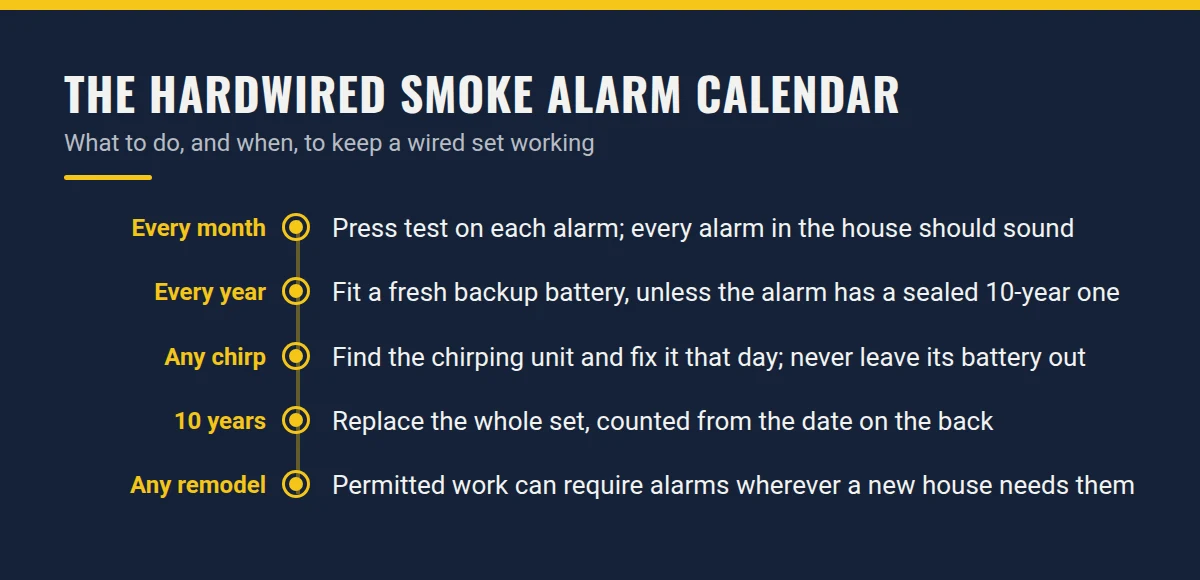
Smoke alarms do not last forever. NFPA’s guidance is to replace every smoke alarm when it is 10 years old, counted from the date of manufacture printed on the outside or back of the unit, not from the day you bought or installed it. If there is no date at all, replace it. Sensors wear out with age and can become slower to detect a fire, which is why the rule applies even to an alarm that still passes its test. The U.S. Fire Administration gives the same schedule for wired alarms: test monthly, replace the backup battery at least once a year, and replace the entire alarm every 10 years, or sooner if it fails a test or gives an end-of-life warning.
Reading the date on a wired alarm usually means taking it down. Most twist off their mounting plate and hang from a plug-in connector. Many manuals say to turn off the circuit first, which is sensible on a ladder with your hands next to a 120 volt connection. Leave the connector and the wires behind it alone, and if you see scorching, loose wires, or no electrical box behind the alarm, stop and call an electrician, who can also read every date for you while quoting the replacement.
Two kinds of backup battery are common, and they change what the fall clock change means for you:
- A replaceable battery, usually a 9 volt or AA. Change it at least once a year, and the November 1 clock change is as good a reminder as any. Use the battery type printed on the alarm.
- A sealed 10-year lithium battery. There is nothing to change. When the alarm gives its end-of-life warning, NFPA’s advice is to replace the entire alarm right away. NFPA’s report flags a side effect of clock-change reminders: people sometimes swap a long-life lithium battery for a conventional one that dies much sooner. If your alarm was built around a 10-year battery, leave the battery alone and just test it.
Combination smoke and CO alarms follow the manufacturer’s replacement schedule, which is what NFPA points to rather than a fixed number of years, so check the label.
Why a Hardwired Alarm Chirps, and How to Make It Stop
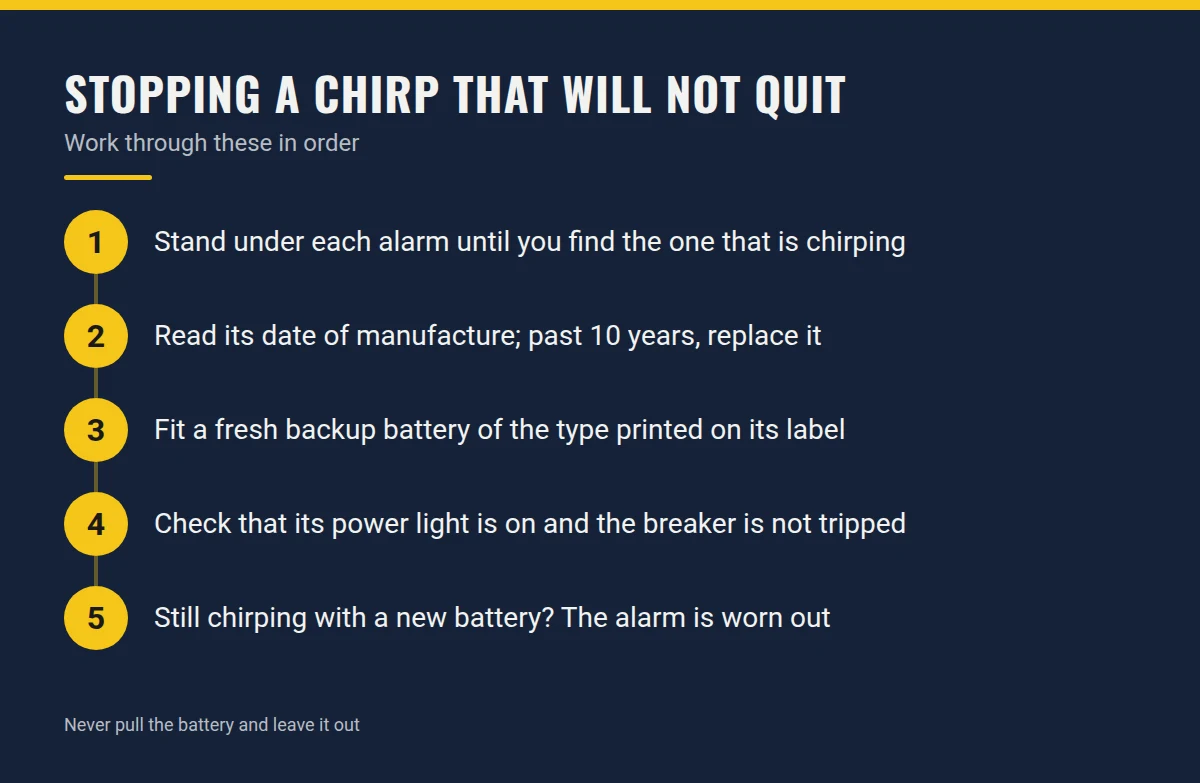
Start by finding the right alarm. In most conventional wired sets the interconnect carries only the alarm signal, so a low-battery chirp comes from the one unit that has the problem. Hallways bounce sound, and a chirp that seems to come from a bedroom can be the alarm just outside it. Stand under each unit for a minute or two; on many models a light flashes with each chirp. Then work through the causes in order.

A low backup battery. NFPA’s guidance is direct: a single chirp every 30 or 60 seconds means the battery is low and must be changed. The middle-of-the-night timing has a plain explanation. A battery near the end of its life can hold its voltage on a warm afternoon and sag when the house cools before dawn, which pushes it below the alarm’s warning threshold. That is why the chirp so often starts at 3 a.m. and stops by breakfast. The battery is still failing, so replace it that day.
A battery change that did not take. Use the battery type the label calls for, make sure the battery door or drawer closes fully, and pull out any shipping tab. A few models keep chirping after a battery change until they are reset, and the manual gives the procedure. If every alarm chirps the morning after a long outage, the batteries carried the house through it and are now low, so replace them all.
The alarm is worn out. If a fresh battery does not stop the chirp, NFPA’s guidance treats that as the alarm reaching the end of its life, and it must be replaced. Check the date on the back. If it is close to or past 10 years, you have your answer. Many newer alarms also give a distinct end-of-life signal, decoded on the label or in the manual.
It has lost its 120 volts. A wired alarm without house power runs on its battery until the battery gives out, then chirps. Look for a tripped breaker or AFCI, a plug-in connector that has worked loose, or an alarm someone wired through a switch. Most wired alarms have a small power light, and if it is out while the circuit is on, the alarm is not getting power. Reset a tripped breaker once. If it trips again, or an alarm keeps losing power with the breaker on, call an electrician, because an intermittent connection in a ceiling box can run hot.
Dust, bugs, steam or a bad location. NFPA counted lack of cleaning in 12 percent of the failures of wired alarms with battery backup. Dust and insects in the sensing chamber cause false alarms and, on some models, trouble chirps. Clean alarms the way the manufacturer’s instructions say, which usually means gently vacuuming the vents. Steam from a shower and air from a supply register cause trouble too, which is why the 3 foot rules exist.
Whatever the cause, do not pull the battery and leave the alarm on the counter. “Disabling a smoke alarm or removing the battery can be a deadly mistake,” the U.S. Fire Administration warns, and CPSC calls disabling an alarm to stop nuisance alarms a potentially fatal mistake. Use the hush button for burnt toast. If an alarm is badly placed, move it, and with a wired alarm that is a job for an electrician, since moving the alarm means moving its box and cable.
Replacing an Interconnected Set
When one alarm in a set reaches 10 years, the others almost always have too, because they went in together. Replace the whole set at once. That keeps every unit on the same clock and avoids the compatibility trouble of mixing a new alarm into an old line.
The replacement should be like for like or better. Minnesota’s State Fire Marshal spells out the rule for existing buildings: new alarms go in the same locations, use the same power supply as the alarms they replace, and stay interconnected if the old ones were. A battery-only alarm is not a replacement for a wired one, because it throws away the wiring the house was built with.
This is electrician work. The U.S. Fire Administration says only qualified electricians should install hardwired smoke alarms, and some cities require a permit even for a straight swap. In St. Paul, replacing or reinstalling a wired smoke alarm takes an electrical permit and an inspection, and only a licensed electrical contractor or a homeowner doing the work personally can pull that permit. Check with your local building department, and before any electrician starts, ask for a license number and proof of insurance and confirm both.
What the electrician checks on a replacement:
- The connector. A replacement from the same product family often plugs into the existing harness. A different brand gets its own harness, spliced in at the box, or the manufacturer’s adapter. Splices belong inside the electrical box, and the alarm mounts to the box.
- The third wire. The interconnect conductor has to reach every alarm and actually link them. In a house that was never interconnected, that is where wireless units, or new cable fished through the attic, come in.
- The circuit. Alarm power should not pass through a wall switch or depend on a GFCI, and new bedroom wiring generally needs AFCI protection.
- Aluminum wiring. In a house built or added onto between 1965 and the mid 1970s, the branch circuit at the alarm may be aluminum while the alarm’s leads are copper. That splice is exactly the kind of connection CPSC wants made with one of its recognized methods, which our guide to aluminum branch wiring repair lays out.
For the alarms themselves, look for dual-sensor units or a mix of ionization and photoelectric, built to the current UL 217 edition, with a sealed 10-year backup battery if you would rather not change batteries every year. If the house has a fuel-burning appliance or an attached garage, the IRC also wants carbon monoxide alarms outside each sleeping area, and listed combination smoke and CO alarms can do both jobs. After the swap, test every alarm, confirm the whole set sounds from each one, and put the manufacture date in your calendar for ten years out.
There is no honest national price for the job. Industry estimates vary, and the bill depends on how many alarms you have, whether the existing boxes and harnesses can be reused, whether interconnect cable has to be added, and how high the ceilings are.
Adding Alarms During a Remodel
Remodels are where many homeowners first meet the smoke alarm code. Under the IRC, when an alteration, repair or addition requires a permit, the whole dwelling has to be equipped with smoke alarms in the locations required for a new house, not just the room being worked on. Work on exterior surfaces is exempt (roofing, siding, windows, doors, a porch or a deck), and so is work on plumbing or mechanical systems, such as a furnace replacement. Carbon monoxide alarms follow the same trigger and the same exemptions.
Electrical-only work is where jurisdictions split. Rockville, Maryland’s building department, applying the 2015 IRC, ruled that rewiring counts as an alteration that triggers the upgrade, while a service upgrade (what the bulletin calls a heavy up) or a fixture or appliance replacement does not. Washington’s adopted version of the code exempts electrical work outright. Ask your building department before you assume either way.
Two provisions take the sting out of it. The IRC allows the alarms added under this rule to be battery powered, and wireless interconnected alarms satisfy the interconnection requirement, which Rockville’s bulletin confirms. So meeting the code does not have to mean cutting into finished ceilings. Still, open walls and ceilings are the cheapest chance you will get to run three-wire cable, and CPSC recommends upgrading to wired alarms with battery backup during a renovation. A new bedroom needs an alarm inside it, an alarm in the area just outside it, and a link to the rest of the set.
Smoke alarms are one of the clearest cases where an older house stops being grandfathered, and our piece on whether old wiring is really grandfathered explains the general rule. Write the alarm work into the contract, too; our guide to managing a remodel’s electrical scope covers what to get in writing so the alarms are not left for the final inspection to discover.
The Bottom Line
Wired, interconnected smoke alarms are the most reliable kind, but they depend on two things a house does not maintain on its own: a working backup battery and an unbroken circuit. A chirp means one of them, or the alarm itself, needs attention. Find the unit, check its date, replace the battery, look at the power side, and replace the alarm if the chirp survives a new battery. Never pull the battery to buy a quiet night. Replace the whole set every 10 years from the date on the back, keep it wired and interconnected, and expect a permitted remodel to bring every room up to today’s locations.
Electrical codes, permit rules and the code edition in force vary by municipality, so confirm the specifics with your local building department and a licensed electrician.
Further reading (sources)
- National Fire Protection Association on how hardwired and battery-only smoke alarms performed in home fires from 2018 to 2022, and why they failed
- NFPA with its 2026 educational messages on smoke alarm placement, chirps and the 10-year rule
- U.S. Consumer Product Safety Commission for where smoke alarms go, why interconnection helps, and upgrading during a remodel
- CPSC covering nuisance alarms, chirping batteries and replacing alarms every 10 years
- U.S. Fire Administration on testing, backup batteries and who should install hardwired alarms
- International Code Council with the IRC’s required smoke alarm locations and its interconnection rule
- Washington State Legislature for the state’s adopted smoke alarm section, with its power source, remodel and garage rules
- SecurityInfoWatch from Greg Kessinger’s column on the NFPA 72 power rules for household smoke alarms
- Minnesota State Fire Marshal on replacing smoke alarms in existing buildings
- City of Saint Paul with its permit, box and AFCI rules for wired smoke alarms
- City of Rockville covering which permitted projects trigger smoke and CO alarm upgrades
- UL Solutions for the 2024 changes to the UL 217 smoke alarm standard
- UL Standards & Engagement on how the cooking nuisance test works
Feature photo by U.S. Consumer Product Safety Commission, Public domain, via Wikimedia Commons (cropped).