Where You Charge the E-Bike Matters: Battery Charging, Outlets, and Flash Burns at Home
Published on October 1, 2026

In a lot of homes, something with a lithium-ion battery is charging tonight: the e-bike in the hall, a teenager’s scooter, the hoverboard from last Christmas, a pair of drill packs on the workbench. When those batteries fail, federal investigators keep finding the same thing. Of 106 e-bike fires the Consumer Product Safety Commission (CPSC) investigated in depth, 62 started while the bike was charging, and scooters and hoverboards showed the same pattern. A battery that fails on the charger fails wherever the charger happens to be, and in many homes that is right beside the way out.
First, the emergency rule. If a battery is hissing, popping, smoking or venting vapor, do not pick it up or try to carry it outside. New York City’s fire department, FDNY, tells people to leave the area, close the door behind them and call 911. It is blunt about the rest: fire extinguishers do not work on lithium-ion battery fires, and a pack can reignite minutes, hours or even days after the visible fire is out.
This guide is for households with e-bikes, scooters, hoverboards and cordless tool packs. It covers what burn units are seeing, where to charge and where never to, the outlet and circuit work an electrician can actually do, what the certification marks mean, and how to read a pack that is starting to fail.
Charging Is When Most Battery Fires Start
CPSC staff expect about 19 million e-bikes, scooters, hoverboards and similar products to be in use in an average year from 2026 through 2030, 11 million of them e-bikes. The agency’s April 2026 report on these products, covering 2017 through 2024, counts the deaths it knows of from lithium-ion battery fires: 19 involving e-bikes, 15 involving e-scooters and 11 involving hoverboards.
Fire was the most common hazard in the agency’s in-depth investigations of all three products. Of 106 investigated e-bike fires, 62 began while the bike was charging. For e-scooters, 51 of 88 fires began during charging or just after it finished, and for hoverboards it was 105 of 173. Five of the e-bike fires traced back to faulty electrical wiring or an overloaded extension cord, and aftermarket battery packs or chargers turned up in at least four.
Timing makes it worse. Wang and colleagues, burn specialists at Rui Jin Hospital in Shanghai, reviewed seven years of patients burned in fires started by e-bike battery chargers. Fifty-six of the 63 were hurt between 9 p.m. and 7 a.m., when most people are asleep, and the authors note that waking from sleep slows the reaction a fire demands. Seventy-eight percent had inhalation injuries, against 31 percent of other flame burn patients, and 7 of the 63 died. Seven people jumped from their buildings to escape. The authors point to bikes left charging in narrow ground-floor passageways, where a fire blocks the escape route.
Shanghai is far from a typical American house, but the habit is not. In a survey by UL Standards & Engagement, the nonprofit that develops the UL standards for these products, 49 percent of e-bike owners who charge at home said they block their home’s fire exits with the bike.
The Flash Burns Small Children Get
Fire is not the only injury. Zhao and Shen, at Beijing Jishuitan Hospital, reviewed 12 years of children brought to their emergency department with electrical flash burns from e-bike batteries: 82 children from 2009 through 2020, 78 percent of them boys, with an average age of 3.5. Most of the burns were on the fingers, and they peaked from May through August. A 2024 review of burns linked to e-bikes and scooters, by Warner-Levy, Herieka and Sheikh, describes how it happens: a child pinches or touches a metal object to the pins of the charging socket on an e-bike or its battery, the battery short-circuits, and the flash burns the hand.
All of those burns were minor, and all healed within two weeks with wound care. The mechanism is the part worth understanding. CPSC staff note that most micromobility batteries are rated below 60 volts DC and do not present a shock hazard from the battery itself. What a lithium-ion pack can do is push a very large current through anything that bridges its terminals. A key, a hairpin or a scrap of wire across two pins heats in an instant, and the arc and the hot metal burn the fingers holding it. The same physics is behind the standard warning in cordless tool manuals against carrying a battery pack in a pocket or toolbox with keys, coins, nails or screws that can connect one terminal to the other.
Certified equipment is designed against this. In CPSC’s summary of UL 2849, the e-bike standard, external terminals that a consumer could touch and use for charging must be designed to prevent inadvertent short circuiting. A bargain pack or charger with no certification carries no such assurance. In a house with small children:
- Store removable packs and chargers out of reach, which is one of the review’s recommendations, and never let a child carry, plug in or unplug one.
- Close the cover over the charging port when the charger is not connected, if your bike or pack has one.
- Keep keys, coins, hairpins and metal toys away from the bike’s charging port and from loose packs.
- Keep charging out of play areas, so a curious toddler is never alone with a charging bike.
If it happens, cool the burn under cool running water, not ice, for at least 5 and up to 30 minutes, which is MedlinePlus’s first aid for minor burns, then cover it with a clean dressing. MedlinePlus lists any burn caused by electricity among those that warrant a call to 911, and notes that burns on the hands can be particularly serious, so do not watch and wait at home. If there is any chance current passed through the child’s body, from a damaged charger cord rather than the battery, our guide on what to do in the hour after an electric shock explains why someone who seems fine still needs checking.

Battery packs belong on the same list as the cords and outlets in our guide to childproofing a home’s electrical system. Roberts and Meltzer, in a review of children’s electrical injuries, note that children’s injuries tend to happen in the household, and they sort electrical injuries by source into low voltage, high voltage, lightning and electrical arc exposure. A battery flash is the arc kind.
Where to Charge, and Where Never To
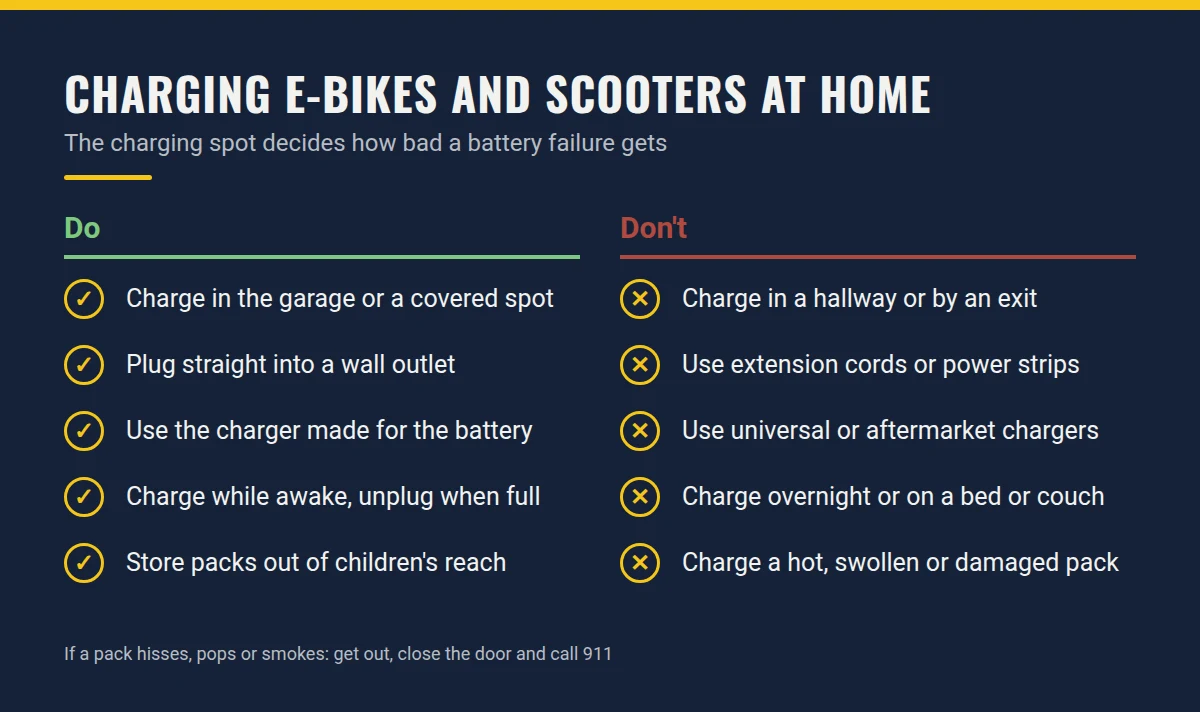
Most charging advice is about the battery. The part you control completely is the room. FDNY’s rules are short: never block your primary way in or out of a room, never charge on a bed, under a pillow or near a couch, never charge overnight, and never leave an e-bike or e-scooter charging unattended. UL Standards & Engagement adds that you should not charge in locations that block fire exits, entryways, front doors or hallways. In a typical house, that rules out:
- The front hall, the hallway outside the bedrooms, and the foot of the stairs. Those are the escape route, and FDNY describes battery fires as aggressive fires that spread rapidly.
- Beside any door or window you would use to get out, including the back door.
- Bedrooms, for the same reason nobody should charge overnight: people who are asleep are slow to wake and slow to get out.
- On or near soft furnishings, such as a bed, a couch, a pile of laundry or a rug.
- Shared hallways and stairwells in an apartment building, which are everyone’s way out.
The better spot, if you have one, is a garage or a covered outdoor area: a hard floor such as concrete, nothing that burns within a few feet, and a door you can close between the charging spot and the living space. FDNY says to store and charge batteries away from anything flammable, which in a garage means away from gas cans, paint, cardboard and the recycling. Keep the bike out of the 3 feet of clear space in front of the electrical panel too, since plenty of panels live in the garage; our guide to where a panel is allowed to live explains that working space.

Temperature is the catch. FDNY says to keep batteries and devices at room temperature, and UL Standards & Engagement warns against charging in extreme heat or cold. An unheated garage in January or a closed one in August can sit outside the range printed in your manual. UL 2849 does test e-bike packs for the move from an unheated winter garage into a heated house, but that is a durability test, not permission to charge a cold pack. If the garage is too cold or too hot, a removable pack can come inside to charge, as long as it goes somewhere that follows the rules above.
If you have no garage or porch, choose the indoor spot by the same logic: a room nobody has to pass through to get out, a hard floor, nothing flammable nearby, a working smoke alarm within earshot, and a door you can close. Charge while someone is awake and home, and unplug when the pack is full.
The Outlet Side: What an Electrician Can Actually Fix
FDNY’s rule for the charger itself is to plug directly into a wall outlet, never into a power strip, and never to overload an outlet. The reason shows up in CPSC’s files. Besides the five e-bike fires tied to faulty wiring or an overloaded extension cord, the agency’s 2026 proposed rule describes an apartment fire that killed a 5-year-old girl and a 36-year-old woman. The batteries were charging on an aftermarket charger plugged into an extension cord.
A single e-bike charger draws far less than a space heater, and its input rating is printed on the charger’s label. The cord rule is less about one charger tripping a circuit than about what the cord adds: two more connections that can loosen and heat, a jacket that gets pinched in a door or cooked under a rug, and a strip that soon has the scooter and the tool packs on it as well. Our extension cord guide covers how daisy-chained strips and buried cords start fires.
The fix for a charging spot without an outlet is an outlet, not a longer cord. This is where an electrician earns the visit:
- A receptacle where you actually charge. The 2026 National Electrical Code, as Minnesota’s inspection checklist lays it out, calls for at least one receptacle in each vehicle bay of an attached or detached garage, no more than 5½ feet off the floor, plus a 20-amp circuit for the garage receptacles. If the only outlet in your garage is the one on the ceiling for the door opener, or across the room behind the freezer, adding one at the charging spot is a modest job.
- Ground-fault protection. The same checklist requires GFCI protection for receptacles in garages, accessory buildings and outdoors, and an older garage outlet may not have it. Our guide to AFCI and GFCI protection explains what each device does.
- The right outdoor receptacle. For a carport or covered porch, a receptacle in a wet location must be listed as weather resistant (marked WR) and sit under a cover that stays weatherproof with the cord plugged in, marked extra duty. Most chargers are built for dry, indoor use, so the charging spot still needs a roof.
- A worn receptacle. If the charger’s plug sits loose or falls out, or the plug or cover plate gets warm, the contacts inside have worn. Stop using that outlet and have the receptacle replaced.
- A heat alarm in the garage. The U.S. Fire Administration (USFA) says smoke alarms are not required or designed for garages, where temperature, humidity, dust, fumes and insects set them off. It recommends a heat alarm that can interconnect with the home’s smoke alarms, so a garage fire sets off every alarm in the house. In a home with hardwired, interconnected alarms, tying one in is work for an electrician.
There is a limit to all of this. Current code puts bedrooms, hallways, living areas and similar rooms on arc-fault protection, and garages and outdoor outlets on ground-fault protection. Those devices watch the house wiring and whatever is plugged into it. A cell in thermal runaway is a chemical fire inside the pack, which FDNY describes as an uncontrollable, self-heating state, and tripping a breaker does not stop it. Better outlets make the charging spot safer. The location and your habits are what limit the damage when a pack fails anyway.
Chargers, Certification, and What UL 2849 Means
Three UL standards cover these products. UL 2849 covers the whole electrical system of an e-bike, including the battery, the battery management system and the charger. UL 2272 covers scooters, hoverboards, electric skateboards and electric unicycles. UL 2271 covers battery packs for light electric vehicles, including replacement packs sold on their own.
Certification is not yet required nationally, and in stores it is not common. When CPSC staff checked brick-and-mortar retailers in 2023, only 10 of 93 e-bikes displayed a mark from an accredited certification lab, against 17 of 19 other products such as scooters. The agency calls that survey small and not representative, and it did not cover online sellers.
New York City has required certification for e-bikes, e-scooters and their batteries sold, leased or rented in the city since September 16, 2023, though the law does not reach devices already in use unless they are resold or rented. Nationally, CPSC published a proposed mandatory standard on June 24, 2026. It would require all three UL standards with additions: battery enclosures that cannot be opened with common household tools, a test that the battery management system refuses to charge a pack that is too hot, and a reverse polarity test to protect packs from incompatible chargers. The comment period closed August 24, 2026, and as of this writing the rule is still a proposal.
To check what you own or are about to buy:
- Look for a lab’s certification mark and the standard number on the bike, scooter, battery or charger, or on the packaging and paperwork. New York requires sellers to show the certification, logo or name of the testing laboratory in exactly those places.
- Do not insist on the UL logo. UL is one of several labs on OSHA’s list of nationally recognized testing laboratories, along with Intertek, CSA Group, TÜV SÜD and others. A mark from a recognized lab against the right standard is what you are looking for.
- Read the claim, not the adjective. “Meets UL standards” in a product listing is the seller talking, not a lab.
Chargers deserve the same care. FDNY says to always use the correct battery, cord and power adapter, and never aftermarket or generic batteries or chargers. Aftermarket chargers turned up in at least 10 of CPSC’s investigated hoverboard fires. In 2024 CPSC told consumers to stop using two universal chargers for 36-volt micromobility batteries, sold online for $10 to $31, after 47 reports of fire or other thermal incidents, and both sellers refused to recall them. A charger that fits the plug is not necessarily a charger made for the pack, and CPSC’s proposed reverse polarity test exists because a mismatched charger can damage the battery. Use the charger that came with the battery or the maker’s own replacement.
Homemade and rebuilt packs belong in the same category. Seven of the 19 e-bike battery fire deaths in CPSC’s report were tied to homemade battery packs or bike repair shops. If a pack is worn out or damaged, replace it with the manufacturer’s pack.
Swelling, Hissing, Heat: Reading a Pack That Is Failing
Packs usually give some warning. UL Standards & Engagement lists swelling or bulging, noticeable overheating during charging, damage from a crash or collision, strange smells, and smoke. An extremely hot pack, unusual smells, smoke, and hissing or popping sounds can mean thermal runaway has begun. CPSC’s investigators describe the same signs from the other side: scooter fires announced by popping sounds, burning smells and sparks.
What you do depends on which signs you see.
Hissing, popping, smoke or vapor. Treat it as a fire that has not shown flames yet. Do not pick it up, carry it outside or reach for an extinguisher. Get everyone out, close the door behind you and call 911. USFA’s handout on flood-damaged batteries gives the same instruction: if a battery is putting out smoke or gas or making popping or hissing sounds, move to a safe distance and notify the fire department.
Swollen, cracked, dented or dropped hard, but cool and quiet. Stop riding it and stop charging it. Unplug the charger at the wall. Do not leave it on a bedroom floor or in a hall closet while you decide what to do. USFA’s advice for flood-damaged packs is a sensible model for any damaged one: a metal or other non-combustible tub, at least 6 feet from the house and anything else that can burn. Never put a lithium-ion battery in the trash or a recycling cart. Call the manufacturer or your local household hazardous waste program about disposal.

Two habits prevent failures that show up again and again in CPSC’s files:
- Let it cool before you charge it. CPSC’s proposed rule would require a warning to let an e-bike cool down after a ride before plugging it in. One case in the rulemaking: a hoverboard on a replacement charger, ridden until the battery died and set to charge in the garage, exploded a short time later.
- Not weeks on the charger, not months dead. The rulemaking also describes a scooter that caught fire after about a year plugged in, and a fire that killed two children, involving a scooter battery that had sat unused for more than three months. Follow the manual’s storage advice, unplug the charger when the pack is full, and charge a stored pack on the maker’s schedule.
A Charging Plan for the Whole Household
Most of this comes down to a few decisions made once:
- Pick one charging spot on purpose, ideally the garage or a covered outdoor area when the temperature allows, and never on the way out of the house.
- Put a wall outlet there, GFCI protected where code requires it, so no extension cord or power strip is ever needed. If there is none, have an electrician add one.
- Use the charger made for each battery, and choose certified equipment when you buy or replace.
- Charge while someone is awake and home, and unplug when the pack is full. Never overnight.
- Let packs cool after a ride and warm up after a cold garage before they go on the charger.
- Store removable packs and chargers out of small children’s reach, with port covers closed.
- Add a heat alarm in the garage that interconnects with the smoke alarms inside.
- Make sure everyone knows the rule: if a battery hisses, pops or smokes, get out, close the door and call 911.
The Bottom Line
Where you charge decides how bad a battery failure gets. Most of the e-bike, scooter and hoverboard fires CPSC investigates start during charging or just after it, and the burn unit studies add two warnings: fires at night catch sleeping people behind blocked exits, and small children can burn their fingers on a battery’s charging pins. Put the charging spot where a fire cannot cut off the way out, plug straight into a wall outlet, use the charger made for the pack, charge while you are awake, and keep packs away from small hands. Hand the outlet, GFCI and alarm work to a licensed electrician, and treat a hissing pack as a fire.
Electrical codes, permit rules and the code edition in force vary by municipality, so confirm the specifics with your local building department and a licensed electrician.
Further reading (sources)
- Zhao and Shen on 82 children’s flash burns from e-bike batteries at a Beijing hospital
- Warner-Levy, Herieka and Sheikh with a review of burns from e-bikes and scooters, including how children short the charging pins
- Wang and colleagues for seven years of burns from e-bike charger fires in Shanghai
- Roberts and Meltzer covering how children’s electrical injuries happen and are treated
- U.S. Consumer Product Safety Commission from its April 2026 report on micromobility deaths, injuries and hazard patterns
- CPSC with its 2024 warning about two universal chargers for micromobility batteries
- Federal Register on CPSC’s proposed safety standard for micromobility batteries
- FDNY for its rules on charging and storing lithium-ion batteries
- NYC Department of Consumer and Worker Protection on the city’s certification requirement for e-bikes, scooters and batteries
- UL Standards & Engagement with where not to charge and the warning signs of a failing battery
- Minnesota Department of Labor and Industry from its 2026 code inspection checklist for one-family dwellings
- U.S. Fire Administration on heat alarms for garages and handling flood-damaged lithium-ion batteries
- OSHA for its current list of nationally recognized testing laboratories
- MedlinePlus covering first aid for burns and when to call 911