Aluminum Branch Wiring: The Three Repairs CPSC Recognizes and the Ones That Fail
Published on September 26, 2026
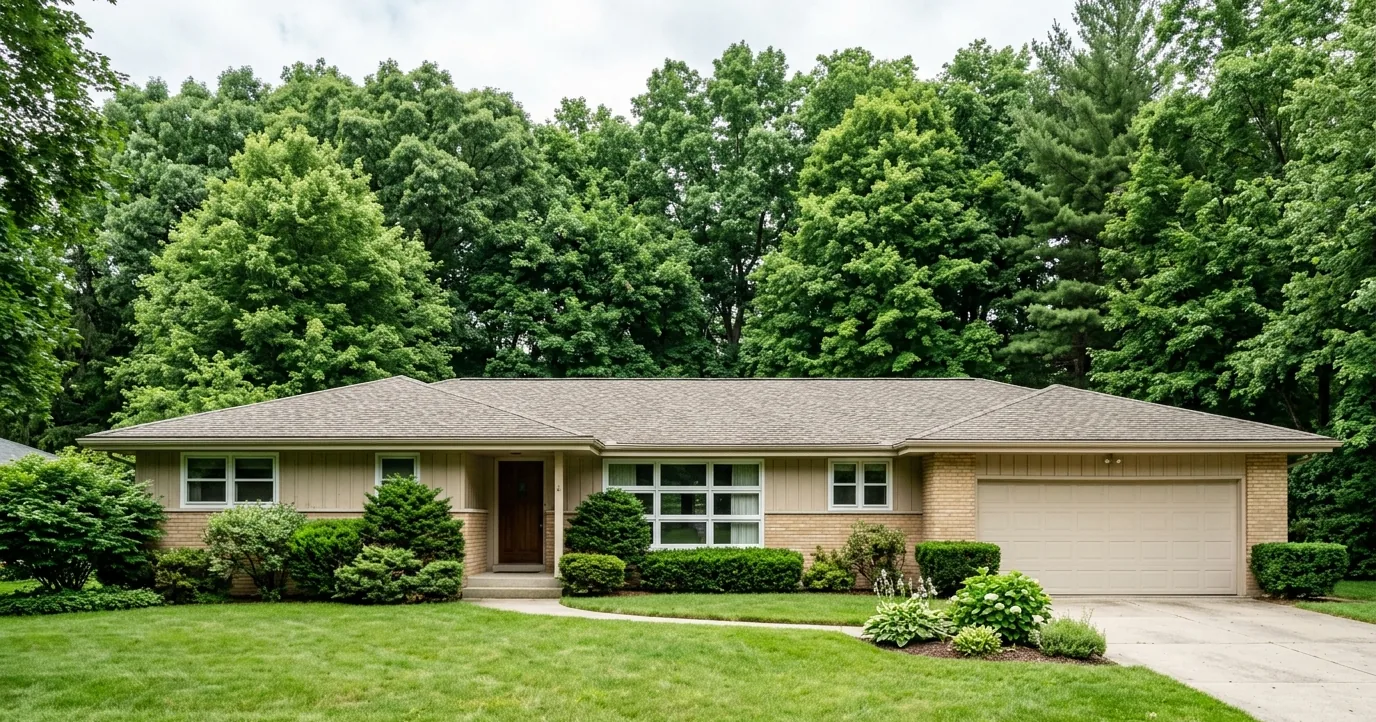
On April 28, 1974, two people died in a house fire in Hampton Bays, New York. Fire officials traced it to an aluminum wire connection that had overheated at a wall receptacle. That spring the Consumer Product Safety Commission held hearings on aluminum wiring in homes, and by June it estimated that about two million homes and mobile homes had been built with aluminum wiring since 1965.
If your house was built or added onto between 1965 and the mid 1970s, some of that wire may be in your walls. The hazard CPSC investigated is not in the wire itself but at its ends: every screw terminal, splice, and device where an aluminum conductor meets something else. So the repair is not one fix. It is a treatment of every connection in the house, and CPSC recognizes exactly three ways to do it. Several cheaper fixes are still sold as repairs, and CPSC’s own testing says they are not.
One thing comes first. If a switch or outlet cover plate is hot to the touch, you smell burning plastic near one, lights flicker for no clear reason, or a circuit has stopped working, turn that circuit off at the panel if you can reach it safely, stop using it, and call a licensed electrician. Those are the warning signs CPSC lists, and it adds that failing aluminum connections seldom give a warning that is easy to spot, and some have overheated with no warning at all. If you see smoke or flame, get everyone out and call 911. If you are not sure how to cut the power, our guide to shutting off power to a house starts at the main breaker.
Why It Fails at the Connections
Underwriters Laboratories listed aluminum wire for interior wiring in 1946, but for years builders used it mostly on a few heavy circuits, such as electric dryers and ranges. A copper shortage in the mid 1960s changed that, and builders began running aluminum to the ordinary 15 and 20 amp circuits that feed outlets, switches, and lights. Around the same time, steel terminal screws were replacing brass ones on receptacles. The wire of that era, known in the trade as AA-1350 or EC grade, was 99.5 percent pure aluminum in a hard temper.
A 1980 study at the National Bureau of Standards, now NIST, set out why a joint between that wire and a steel screw works loose:
- Expansion and contraction. Aluminum and steel expand at different rates, so every heating and cooling cycle squeezes and relaxes the joint. Current does it, and so does the weather: a receptacle on an outside wall cycles even when nothing is plugged in.
- Creep. Under steady pressure, aluminum slowly deforms away from whatever is clamping it, even at room temperature. A terminal screw can relax its grip over the years without anyone touching it.
- Workmanship. Screws that were never tightened enough, or that loosened when the stiff wire was folded back as the device was pushed into its box.
A loose joint has less contact area, so its resistance rises and it runs hotter, which loosens it further. CPSC calls the damage cumulative. At the end of that road is what the researchers called a glowing connection, a small sustained arc under the screw head. A tight connection carrying 15 amps gives off about 80 milliwatts of heat. Glowing connections have been reported at up to 36 watts, close to what a small incandescent bulb gives off, inside a box in the wall, and the center of the glow can top 1,200 degrees Celsius. One was reported to keep glowing for more than 100 hours, though most do not last that long. The arcing also makes the aluminum react with the steel screw and the brass plate, forming compounds that conduct far worse than any of the three metals, so once a joint has started to glow, the damage is in the metal itself.
The risk has been measured, too. When CPSC’s contractor, the Franklin Research Institute, surveyed outlets in homes built before 1972, aluminum-wired houses were 55 times as likely as copper-wired ones to have at least one outlet connection reach the study’s definition of fire hazard conditions. The survey covered only outlets, not splices, lights, or appliances, and it collected nothing on aluminum-wired houses built after 1972.
Better materials came next. Aluminum alloys in the AA-8000 series, whose creep rates are very close to copper’s, were listed and manufactured beginning in 1972, and devices marked CO/ALR, built for aluminum and fitted with brass screws, arrived about the same time. The NEC did not specifically require AA-8000 alloy until 1987. None of that changes connections already made in a 1968 house, and CPSC’s advice to repair aluminum wiring that has not been remediated makes no exception for later houses.
How to Tell Whether You Have It
Start with dates. CPSC says houses built before 1965 are unlikely to have aluminum branch wiring, while cable installed between 1965 and the mid 1970s may, whether it went into a new house, an addition, or a circuit that was added or rewired then. A 1950s house with a 1970 family room can have aluminum in the addition and copper everywhere else.
Then read the cable, not the wall. Nearly all of it went in as ordinary plastic-sheathed cable, the type CPSC notes is often called “Romex,” with nothing on the outside to set it apart from copper. Where cable runs exposed in an unfinished basement, attic, or garage, look along the jacket for “AL” or “ALUMINUM,” printed or embossed every few feet. A flashlight held at a low angle across the jacket makes embossed letters readable. There is also a size clue. Aluminum branch cable was sized one step heavier than copper for the same job: 12 AWG on 15 amp circuits and 10 AWG on 20 amp circuits, where copper would be 14 and 12.
Two findings change the answer:
- “CU-clad” or “copper-clad” next to “AL.” That is copper-coated aluminum, a different product, and CPSC says its repair recommendations do not cover it. Have an electrician evaluate it on its own terms.
- Heavy stranded aluminum. Service entrance cable and the big circuits for an electric range or dryer can be aluminum as well, but they use much larger conductors, and CPSC’s repair guidance does not apply to them. Insurers can treat them differently too: Florida’s state-created insurer, discussed below, accepts multi-strand aluminum while refusing unremediated single-strand branch wiring. Those heavy circuits have their own issues, which our guide to 240 volt circuits covers.
What you should not do is open the panel or pull devices out of their boxes to look. If the markings are not visible, CPSC’s advice is to have a qualified electrician make the call. In a sale, a home inspector often gets there first, as covered below.
The Three Repairs CPSC Recognizes
CPSC holds any repair method to three tests. It has to be safe, it has to be effective, and it has to be permanent, and a product meant for temporary or emergency use that may fail over time does not count as permanent. Measured that way, the agency’s Publication 516, whose current edition dates from June 2011, approves exactly three methods.
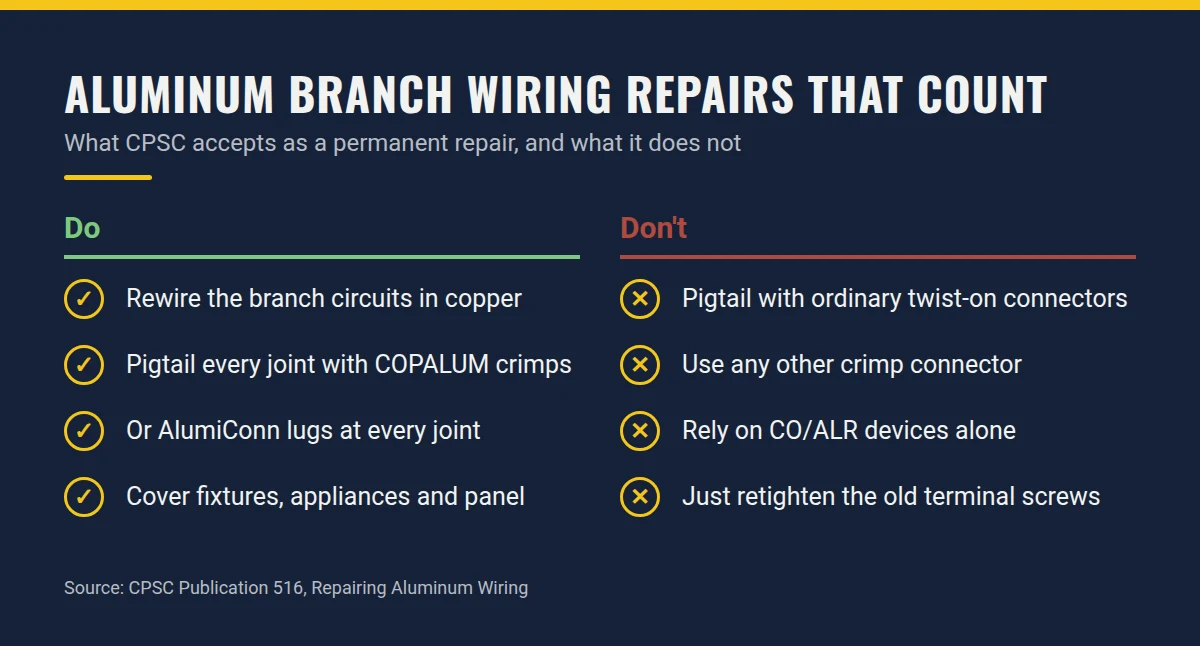
1. Replace it with copper. New copper branch circuits go in, and the old aluminum is abandoned in the walls. CPSC calls this the best method available, since it removes the aluminum instead of managing it, and admits that for many homes it is impractical or prohibitively expensive. The house decides how hard it is: a single story over an open basement with an accessible attic is a very different job from a finished split level with no crawl space. If a remodel is already planned, open walls are the cheapest chance you will get, and our guide to managing a remodel’s electrical scope covers writing it into the contract.
2. COPALUM crimp pigtails. A short piece of copper wire, called a pigtail, is joined to the end of each aluminum conductor with a COPALUM connector, a metal sleeve compressed by a dedicated power tool and precision die with upwards of 10,000 pounds of force. CPSC describes the result as, in effect, a cold weld. An insulating sleeve goes over the joint, and the copper end then connects to the receptacle, switch, or fixture. CPSC bases its recommendation on research, laboratory tests, and demonstration projects it sponsored, along with more than a quarter century of field experience, and notes that the work is practical in an occupied, furnished home. The limit is access. Only electricians trained by the manufacturer are authorized to install it, and CPSC acknowledges it may not be available in every area.
3. AlumiConn lug pigtails. Where COPALUM is not available, CPSC says the AlumiConn connector may be considered the next best alternative. It is the same pigtail approach, with the joint made inside a small setscrew lug instead of a crimp. In its 2011 guide, CPSC noted that the connector had performed well in initial tests but was too new to have a long safety record. The quality lives in the workmanship, which is why CPSC wants a qualified electrician doing it. Setscrew connectors are meant to be tightened to the manufacturer’s torque value with a torque screwdriver, and overtightening can damage a connection as surely as leaving it loose.
Whichever method is used, it has to reach every connection involving aluminum, not only the device that failed. CPSC’s list includes receptacles, switches, dimmers, light fixtures, junction boxes, the panel, and every appliance wired directly to an aluminum branch circuit, such as a dishwasher, heater, or air conditioner. That scope is what drives the price, and it is what an insurer will ask about.
The two pigtail methods have a side benefit. Once every termination is copper, you can use standard receptacles and switches again, including GFCI outlets and dimmers.
The Fixes CPSC Says Do Not Work
Cheaper fixes get offered for an obvious reason, and CPSC says so directly: two of them, pigtails made with twist-on connectors and CO/ALR devices, are often recommended by some electricians because they cost substantially less than COPALUM. CPSC does not consider either one an acceptable permanent repair.
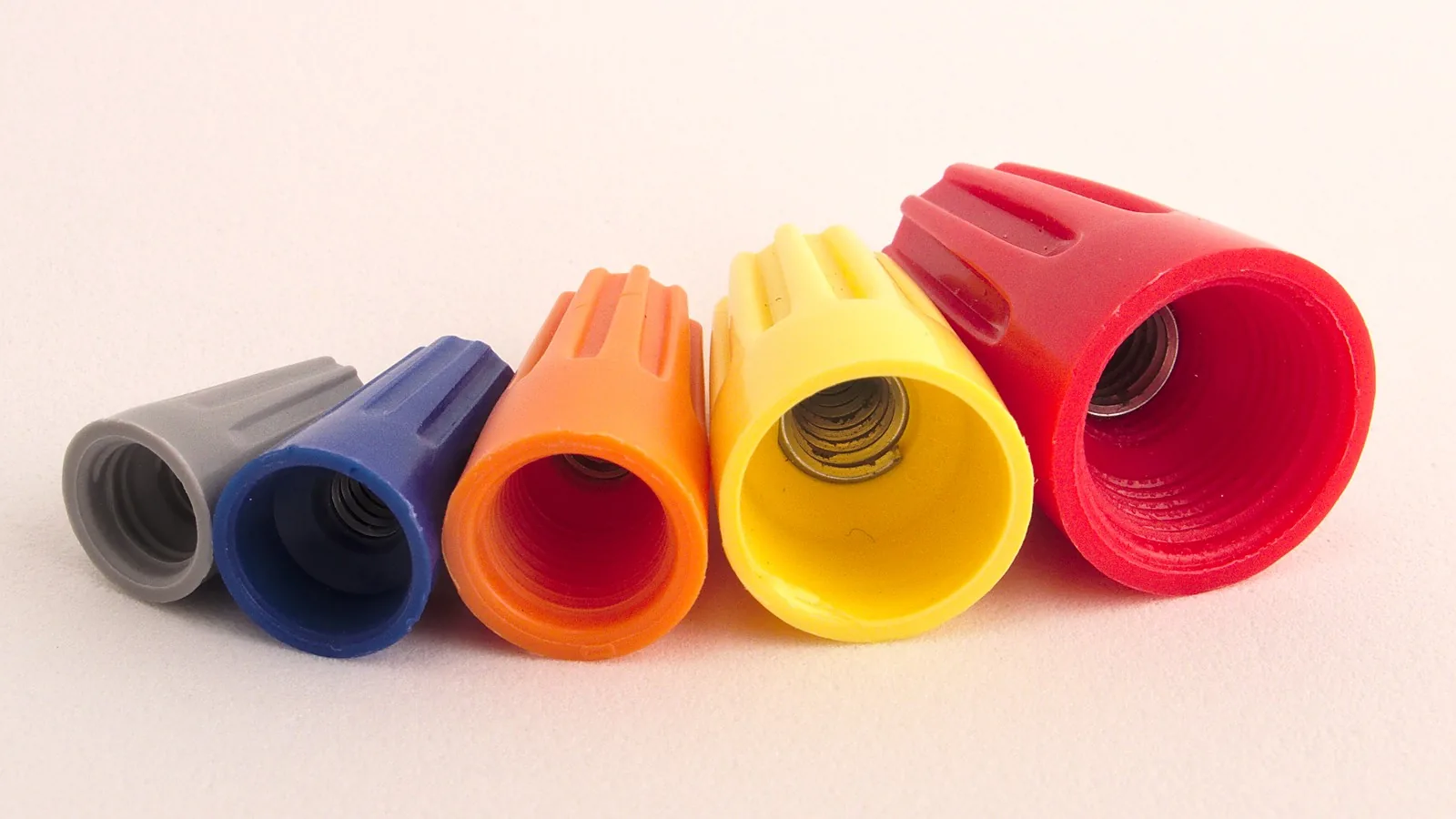
Pigtails made with twist-on connectors. This looks like the COPALUM method, a copper pigtail at every connection, except that an ordinary twist-on wire connector holds the aluminum and copper together. In CPSC-sponsored laboratory and life tests, substantial numbers of these connectors overheated severely. Surveys of electricians and inspectors describe their performance with aluminum as highly variable and often poor, and CPSC warns that some of these “repairs” may fail more often than the original connections did. A twist-on connector rated for aluminum to copper has one role in CPSC’s guide: an emergency, temporary repair of a single failed termination, followed by a full repair as soon as possible.
Other crimp connectors. Retailers sell many kinds of crimp connectors, including types installed with a pliers-style hand tool. CPSC says none of them has been evaluated for joining copper to aluminum, and it strongly recommends against using them.
CO/ALR devices as the whole-house fix. Switches and receptacles marked CO/ALR are designed to take aluminum wire directly, and in 1974 they were exactly what CPSC told homeowners to use when a device needed replacing. At the time, the agency did not generally recommend adding more wires and splices to existing boxes. If a previous owner swapped in CO/ALR devices and called the house fixed, they were following advice that was current then. CPSC’s position has moved. It now says CO/ALR devices perform better with aluminum than ordinary devices when carefully installed, but they have failed laboratory tests using the kind of aluminum wire found in existing homes, under conditions simulating normal use, and they are not made for every part of the system, such as permanently wired appliances and ceiling light fixtures. Its verdict: at best, an incomplete repair. A CO/ALR device is still acceptable as a temporary fix for one failed termination.
A round of screw tightening. Going through the house to tighten every terminal deals with looseness for a while, not the creep and expansion behind it. It is not on CPSC’s list, and it is not something to attempt yourself.
Two more shortcuts are plain code violations:
- Ordinary devices on aluminum. Under the 2023 NEC, a 15 or 20 amp receptacle not marked CO/ALR may be used with copper and copper-clad aluminum only (Section 406.3(D)(1)). The 2026 edition reorganized the article, and its Section 406.10(2) now says any wiring device not marked CO/ALR may not terminate aluminum directly. That includes the GFCI outlet, dimmer, or smart switch someone wants to add, unless it goes on a copper pigtail made by one of the approved methods.
- Push-in terminals. The spring-clip holes on the back of many receptacles are for 14 AWG solid copper only, and UL says they are not intended for aluminum or copper-clad aluminum at all.
What It Costs, Tier by Tier
There is no honest national price for this job. The same repair costs very different amounts in different regions and houses, and industry estimates vary widely. What stays consistent is the order of the tiers and what moves the price within each.
- Cheapest up front: CO/ALR swaps and twist-on pigtails. They cost less because they skip the specialized connector, the trained installer, or the parts of the house they cannot reach. Measured against what an insurer or a buyer will accept, they can turn out to be the most expensive choice, because the job ends up being paid for twice.
- Middle: a complete pigtail repair. COPALUM or AlumiConn at every aluminum connection. The price follows the connection count and how easy the boxes are to work in. Whether a trained COPALUM installer works in your area can decide which of the two you are really choosing between.
- Highest: rewiring in copper. New cable fished through finished walls and ceilings, patching and painting, and a permit and inspection for the new circuits. It is also the only tier that retires the aluminum for good.

Two habits make quotes comparable:
- Count before you call. Every receptacle, switch, light fixture, junction box, and hardwired appliance on an aluminum circuit is a repair point, and most hold more than one aluminum conductor. A quote that says “aluminum remediation” with no method and no count cannot be compared with anything.
- Ask what is included. Fixtures, hardwired appliances, junction boxes in the attic or basement, and the terminations at the panel are all part of the repair CPSC describes. A low quote that quietly leaves them out is not a lower price for the same job.
And check with your insurer before you choose a method. A repair your carrier will not accept is money spent twice.
Finding Someone Qualified to Do It
Start with a licensed electrician, and check the license yourself; our guide to verifying an electrician’s license shows how in about five minutes. Then ask the questions that separate someone who has done this repair before from someone who has only read about it:
- Which of the three CPSC methods will you use, and why that one?
- For COPALUM, are you trained and authorized by the manufacturer to use the tool?
- For AlumiConn, what torque value applies, and what tool will you use to reach it?
- Will the repair cover every aluminum connection, including fixtures, appliances, junction boxes, and the panel?
- Will you pull a permit? CPSC’s guide closes by saying that all changes to installed wiring should be done and inspected under local regulations.
- What will I get in writing? You want an itemized record of every location repaired and the method used, signed by the licensed electrician.

The answers that should end the conversation: an offer to “just tighten everything,” a plan built on CO/ALR swaps alone, twist-on pigtails described as permanent, or a quote that never names a method.
What Insurers and Home Buyers Ask
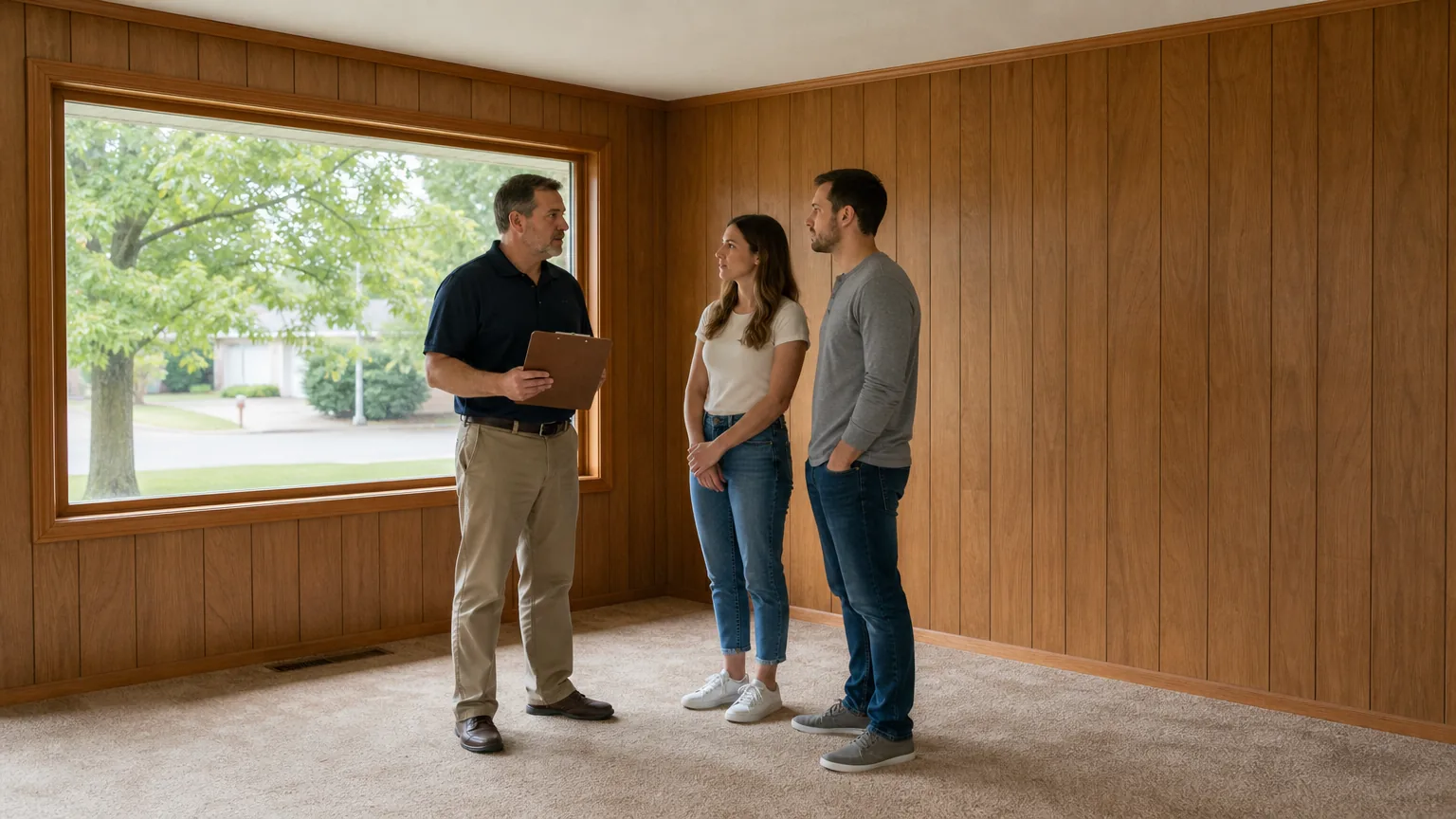
In a sale, the home inspector is often the first to raise it. InterNACHI’s Standards of Practice for home inspectors require the inspector to report the presence of solid conductor aluminum branch circuit wiring as in need of correction whenever it is readily visible. If you are selling, expect it in the buyer’s report. If you are buying, expect to negotiate over it.
Insurers ask next, and some spell out exactly what they will accept. Citizens Property Insurance, Florida’s state-created insurer, says properties with single-strand aluminum branch circuit wiring are not acceptable unless the house has been completely rewired in copper or every aluminum-to-copper connection has been repaired by the COPALUM crimp method or the AlumiConn connector method, with documentation of all the work. It says no other product is accepted. Its sample 4-Point Inspection Form, which a Florida-licensed inspector fills out for underwriting, has a box for each of those two connectors and calls for separate documentation of any single-strand remediation, certified by a licensed electrician. A CO/ALR retrofit is not on the list. Other carriers set their own rules, so ask yours in writing before you pick a method.
For buyers, the paperwork is what closes the question. A documented repair, with the method, the locations, the permit, and the electrician’s signature, turns a line in an inspection report into a settled item. Keep it with the house records. Whether the wiring was legal when it went in does not enter into any of this; our piece on whether old wiring is really grandfathered explains why “legal when installed” is a different question from insurable or safe.
The Bottom Line
Aluminum branch wiring is a reason to act on your own schedule rather than a failed connection’s. With a pigtail repair the wire can stay in the walls, but its connections cannot stay as they are. CPSC recognizes three permanent repairs: rewiring in copper, COPALUM crimp pigtails, and AlumiConn lug pigtails, applied to every aluminum connection in the house. Twist-on pigtails, other crimp connectors, CO/ALR devices on their own, and a round of screw tightening are not on that list, whatever they cost. Get a quote that names the method and counts the connections, confirm your insurer accepts that method, pull the permit, and keep the paperwork.
Electrical codes, permit rules, and the code edition in force vary by municipality, so confirm the specifics with your local building department and a licensed electrician.
Further reading (sources)
- Consumer Product Safety Commission on the three permanent repairs it approves and the fixes it rejects, in Publication 516
- CPSC with its 1974 recommendations, which pointed homeowners to CO/ALR devices
- Newbury and Greenwald for how a loose aluminum connection starts to glow and what the arcing does to the metal
- IAEI Magazine on pre-1972 aluminum wire, the AA-8000 alloys that followed it, and CO/ALR devices
- IAEI Magazine’s UL Question Corner covering why push-in terminals take 14 AWG solid copper only
- EC&M with how the 2026 NEC treats devices not marked CO/ALR
- InterNACHI for the inspection standard that flags solid aluminum branch wiring
- Citizens Property Insurance on the only aluminum wiring repairs it accepts for coverage
- Citizens Property Insurance with the aluminum wiring section of its 4-Point Inspection Form