How Power Actually Reaches Your Outlet: A Homeowner's Map of the Home Electrical System
Published on September 3, 2026
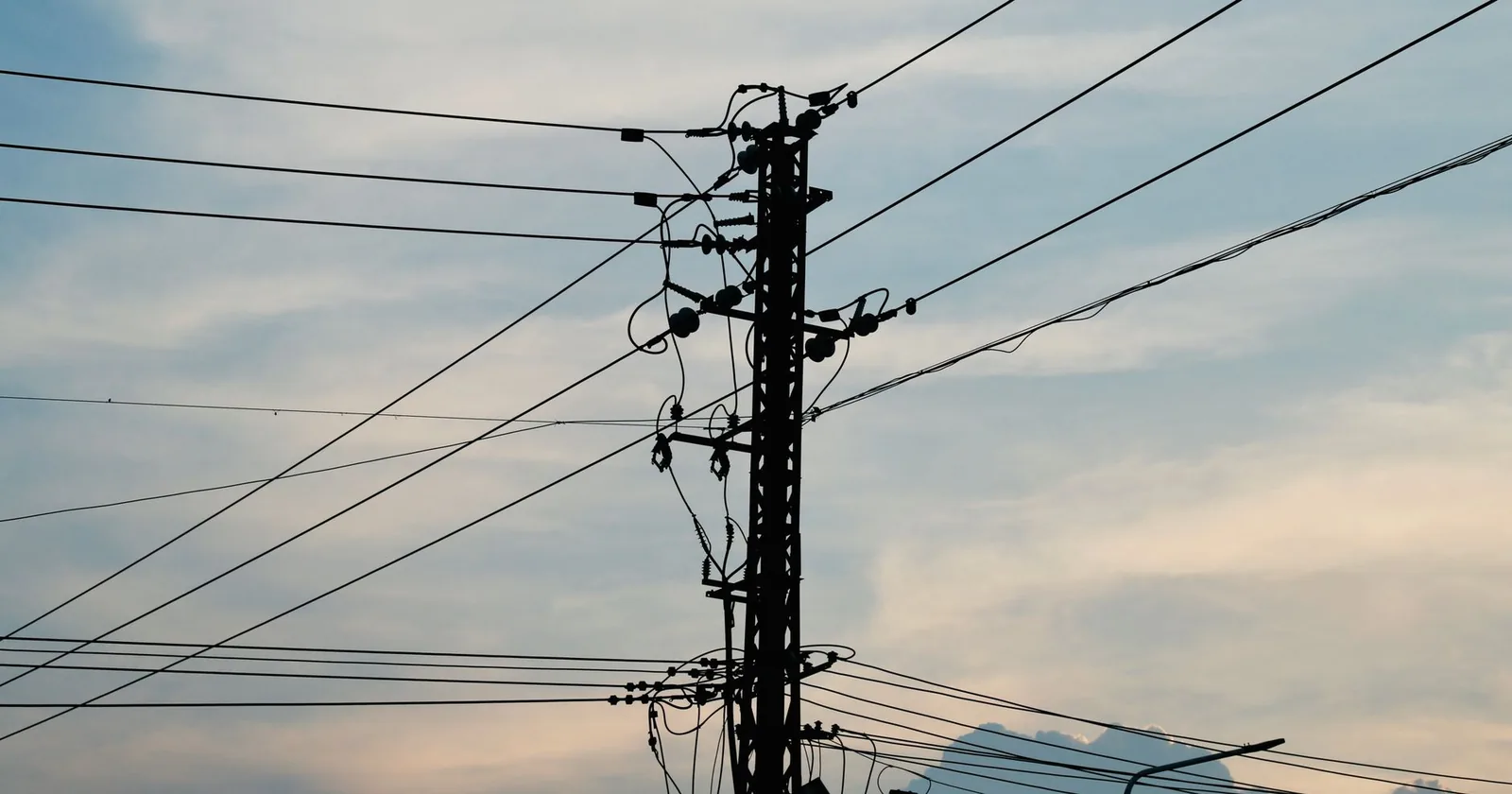
Somewhere in the middle of every electrical problem, somebody uses a word you are supposed to already know. The electrician on the phone asks whether the trouble is upstream of the panel. The utility dispatcher wants to know whether the meter is dark on the line side. A neighbor who knows a little tells you it sounds like a load side issue. All of it assumes you carry a picture in your head of how power gets from the street to the lamp in your living room, and most homeowners have never had a reason to build one.
This is that picture. Electricity in a house travels a single path with about nine stops on it, and every stop has a name, an owner, and its own characteristic way of failing. Learn the chain once and two things get easier. You can describe a fault accurately at 2 a.m. instead of saying the lights are doing something weird, and you can usually tell within a minute whether the person you need is the power company or an electrician.
The Whole Chain in One Paragraph
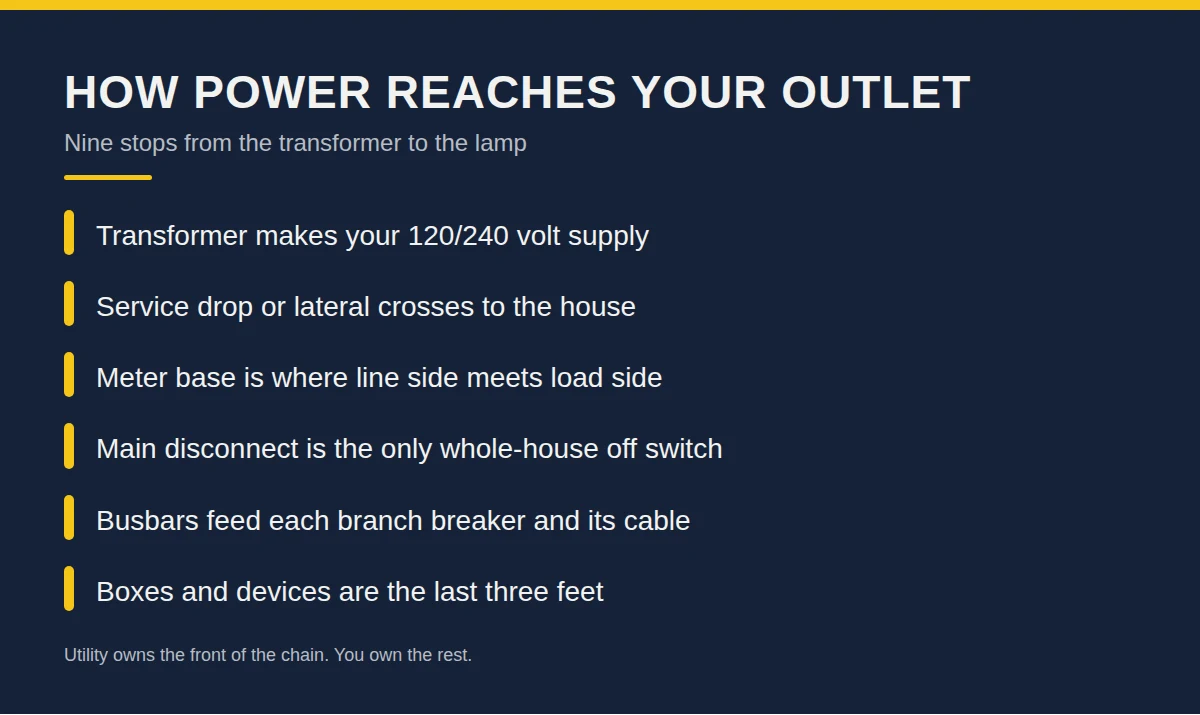
Power leaves a transformer on a pole or in a green cabinet at ground level. It crosses to your house on a service drop overhead or a service lateral buried underground. Overhead, it enters at a weatherhead on top of a mast and runs down to the meter. The meter measures it and hands it to your main disconnect, the single breaker that can turn off the entire house. Past the main, the power lands on two busbars inside the panel. Each branch breaker clips onto a busbar and feeds one cable out into the walls. That cable ends at a box, the box holds a splice or a device, and the device is the outlet or switch you actually touch.
Two boundaries on that chain matter more than the rest. The first is the service point, where the utility’s property ends and yours begins. The second is the main disconnect, which is the only place in the whole system where you can shut everything off. Almost every confusing conversation about a home electrical fault is really a question about which side of one of those two lines the problem sits on.
The Transformer: Where Your Voltage Is Made
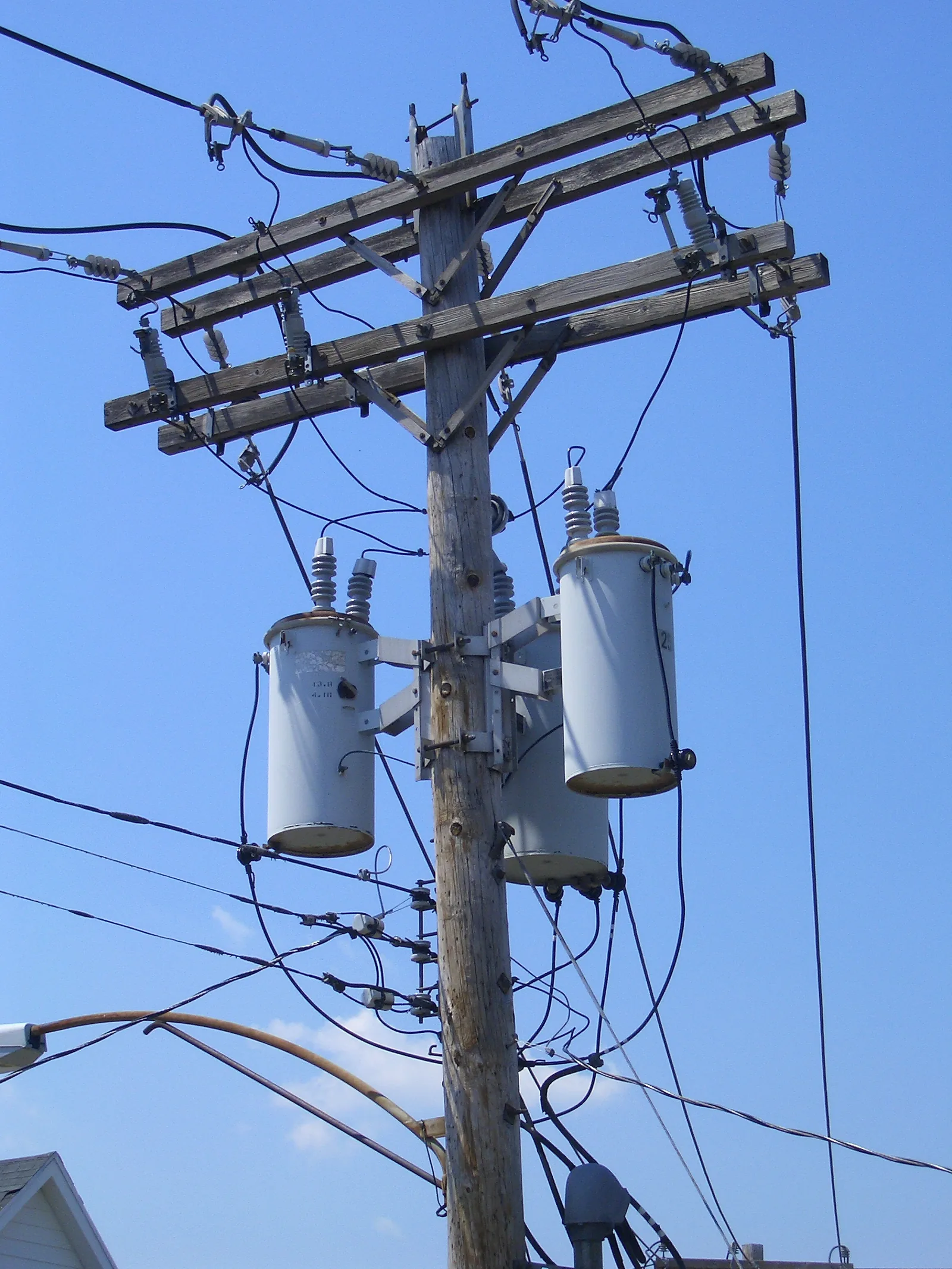
The wires running down your street carry thousands of volts, far too much for a toaster. The transformer serving your house steps that down to the split single phase supply that every American home runs on: two hot legs plus a neutral tapped from the center of the transformer’s secondary winding.
That center tap is the reason your house has two voltages. Measure either hot leg to the neutral and you get 120 volts, which runs lights, outlets, and small appliances. Measure between the two hot legs and you get 240 volts, which runs the dryer, the range, the water heater, and the air conditioner. Your panel deliberately splits circuits between the two legs so the load sits roughly even.
It also explains the single most misread outage symptom in residential work. When one leg is lost anywhere between the transformer and your panel, roughly half your 120 volt circuits go dead while the other half work fine, and the 240 volt appliances misbehave in odd ways. Our walkthrough of how to triage a power outage covers what that pattern means and who owns each possible cause.
The Service Drop, the Mast, and the Weatherhead
From the transformer, three conductors run to your building. If they come through the air, that span is the service drop, and it terminates at a weatherhead: the hooded fitting on top of a metal pipe called the service mast. The conductors dip below the weatherhead in a deliberate sag, the drip loop, so rain runs off instead of following the wire into the pipe. If your service is underground, the buried run is a service lateral, and it comes up into the meter through conduit instead.
This is where ownership changes hands, at a spot called the service point. The exact location is set by your utility rather than the code, but for most overhead homes the rule of thumb holds: the utility owns the drop and the connection to your weatherhead, and you own the weatherhead, the mast, the conductors inside it, and the meter enclosure bolted to your wall. The meter itself usually belongs to the utility even though the box it plugs into is yours.
That split is the whole reason a storm-damaged service can leave you waiting. A utility crew will reconnect a drop they pulled loose, but if the mast has torn away from the wall or the weatherhead is cracked, that repair is yours to hire out, permit, and get inspected before anyone will reconnect you. The line also lands somewhere completely different in other kinds of housing. In a manufactured home community, half the electrical system belongs to the park and the demarcation sits at a lot pedestal rather than at your wall.
The Meter Base: Where Line Side and Load Side Are Born
The meter socket is a steel enclosure with four heavy jaws inside. Two are fed from the service conductors coming in. Two feed the conductors heading to your main disconnect. Plug the meter into those jaws and everything passing through gets counted.
Those two pairs of jaws are the physical origin of the phrase people keep using at you. Everything on the incoming pair is the line side. Everything on the outgoing pair is the load side. The difference is not academic: nothing you own protects the line side. There is no breaker between your meter and the transformer, only a fuse on the utility’s equipment sized to protect their network rather than your house. Those conductors stay live at full utility current even when your main breaker is off and every light in the house is out.
The code treats that stretch as its own category. Section 230.46 requires that any splicing device used on service conductors, whether a splice or tap device, a power distribution block, or a pressure connector, be marked “suitable for use on the line side of service equipment” or the equivalent. Ordinary connectors that would be perfectly legal six inches downstream are not allowed there.
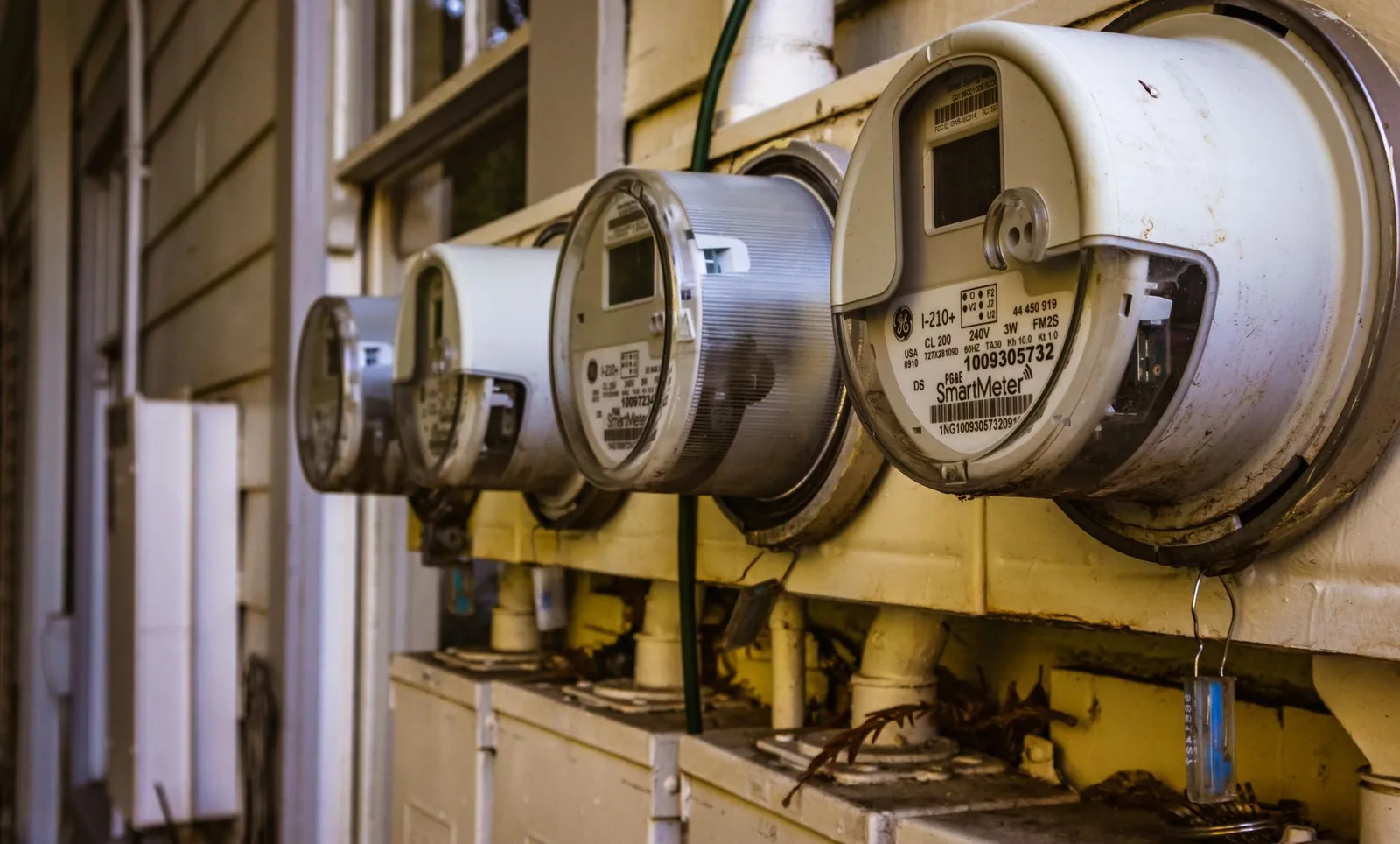
Meter bases fail in ways you can see from the driveway: rust streaks below the enclosure, scorching or soot around the cover, a fogged or cracked window, a socket sagging away from the siding, or a burning smell nearby. All of those are worth a phone call. What you never do is break the utility seal on the ring. That is their equipment and their liability, and on the line side it is also the one part of your house with no overcurrent protection at all.
The Main Disconnect: The Only Switch That Turns Everything Off
Past the meter, the conductors reach the main disconnect. In most homes it is the large double breaker at the top of the panel, labeled with the service rating: 100, 150, 200 amps. In newer or utility-required installs it may be a separate disconnect mounted outside next to the meter.
The main is the boundary that matters during an emergency, because it is the only device that de-energizes the entire load side of your system at once. Turning off a branch breaker kills one circuit. Turning off the main kills every circuit. Neither one touches the service conductors between the meter and the main, which is exactly why removing a panel cover is not homeowner work no matter how many breakers are off.
The number stamped on that main breaker is also the ceiling on everything your house can draw at one time. Our guide to reading your panel and service capacity covers what each rating actually runs and what it takes to move up a size.
Inside the Panel: Two Busbars and Two Bars That Are Not the Same
Behind the cover, the main feeds two vertical hot busbars. The breaker slots alternate between them going down the panel, which is why a 240 volt appliance breaker is twice as tall and occupies two adjacent slots: it has to grab both legs. Each ordinary 120 volt breaker clamps onto whichever bar its slot touches.
Alongside the busbars sit two terminal strips that homeowners routinely blur together, and the distinction is worth getting right because electricians use the words precisely. The neutral bar lands the white wires, which are grounded conductors. A grounded conductor is one that is intentionally connected to ground and carries current in normal operation. The ground bar lands the bare or green wires, which are equipment grounding conductors. Those carry no current at all until something faults. The code cares enough about neutral integrity to require in Section 200.4 that the continuity of a grounded conductor not depend on a connection to a metal enclosure, raceway, or cable armor. It has to be a real conductor, all the way back.
In the service panel those two bars are deliberately tied together by the main bonding jumper. In every subpanel downstream, they must be kept separate. Getting that backwards is one of the most common defects found in older houses, and it puts normal return current onto the grounding system where nobody expects it.
The Grounding Electrode System: The Part That Carries No Power
Branching off the service is a system that never carries a watt of what you pay for: a grounding electrode conductor running from the panel to ground rods, a concrete-encased electrode in the footing, or a metal underground water pipe. Its job is to reference your whole system to earth and to give lightning and utility surges somewhere to go.
Because it does nothing visible day to day, it gets neglected and abused. Clamps corrode, a landscaping crew cuts a rod conductor, or a plumbing repair with a plastic section quietly breaks the bond that used to run through the water pipe. Installers cut corners with it too. The 2026 NEC tightened Section 250.64(G) to prohibit routing a grounding electrode conductor through mounting and drainage openings, closing a loophole around weep holes in the bottom of enclosures, which had been a common shortcut even though they were never meant for that.
Branch Circuits: The Part Behind Your Walls
A branch circuit is one breaker plus everything it feeds. The breaker’s rating is chosen for the wire, not the appliance: 14 gauge copper gets a 15 amp breaker, 12 gauge gets 20 amps. The cable leaves the panel, runs to the first box on that circuit (electricians call that stretch the home run), and continues from box to box.
Some circuits serve one appliance and nothing else, which is why a range, a water heater, and an EV charger each get their own. Others daisy-chain a whole bedroom. A multiwire branch circuit uses two hot legs sharing one neutral, an efficient arrangement that becomes dangerous if the shared neutral opens or if someone works on half of it thinking the circuit is dead.
Protection lives at the head of the circuit or at the first device on it. AFCI and GFCI functions can sit in the breaker or in the receptacle, which is why a dead patio outlet is so often a tripped GFCI in a bathroom. If you are trying to work out why one keeps letting go, our diagnostic guide to repeated breaker trips sorts an overload from a short, a ground fault, or a genuine nuisance trip, and our comparison of AFCI and GFCI protection explains which hazard each one actually watches for.
Boxes, Splices, and Devices: The Last Three Feet
Every connection in the house has to happen inside a box, and every box has to stay accessible. Splices are joined with wire connectors, and where several wires need to reach one screw terminal, they are joined together with a short pigtail out to the device instead of stacking them.
That humble pigtail is a genuine code requirement, not a style preference. Section 250.148 requires a connection made for no other purpose between a metal box and the equipment grounding conductors landing in it. A missing green pigtail is one of the most frequently photographed violations in the trade, and it matters because the metal jacket of interlocked MC cable does not by itself provide an effective ground fault current path. Without that jumper, a metal box can sit there ungrounded while looking perfectly finished.
At the very end of the chain is the device: the receptacle, the switch, the dimmer. The 2026 NEC formalized how tradespeople already talk about these by renaming Article 406 to “Wiring Devices” and restructuring it alongside Article 404, so snap switches and dimmers are now classified as wiring devices too.
Devices are also where a startling share of house fires begin, because they are the only part of the system that gets physically worked. Contacts wear out. Push-in backstab terminations relax over years of heating and cooling. A screw terminal never quite tightened turns into a resistive joint that warms every time the circuit is loaded. Loose connections do not trip breakers, they just get hot, which is why a warm or discolored outlet is treated as urgent even when everything still works.
Saying It Right at 2 a.m.
With the chain in mind, the vocabulary stops being intimidating. Upstream means closer to the transformer. Downstream, or load side, means further from it. The service is everything from the drop to the main disconnect. A branch circuit is one breaker and its territory. The line side of the meter is utility property with no breaker protecting it.
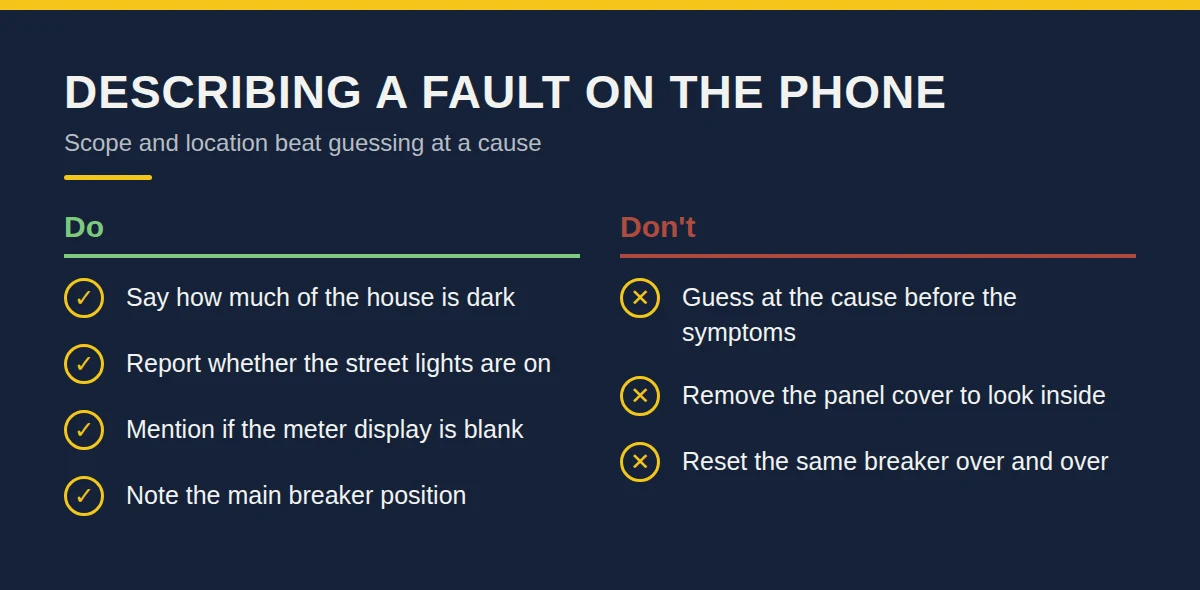
What actually helps on the phone is describing symptoms in terms of scope and location rather than guessing at a cause. Compare these two calls:
- Weak: “The power is acting up and I think something is wrong with the wiring.”
- Strong: “The whole house is dark, the street lights are on, my meter display is blank, and the main breaker is still in the on position.”
The second one tells an electrician the fault is almost certainly between the transformer and the meter, before anyone gets in a truck. Three more worth memorizing: half the house dead with the dryer refusing to heat points at a lost leg at the service. Lights brightening on one side of the house while dimming on the other points at an open neutral, which is an emergency. One room dead with the breaker snapping back off the instant you reset it points at a short on that branch circuit.
Two things override all of it. If you can see a downed conductor, stay at least 35 feet back, assume it is live, and call 911 and the utility. If there is smoke, a burning smell, or buzzing from a panel or outlet, get everyone out first and make the call from outside.
The Bottom Line
Your home’s electrical system is a chain, not a mystery: transformer, service drop or lateral, weatherhead and mast, meter base, main disconnect, busbars, branch breaker, cable, box, device. The utility owns the front of it up to the service point. You own the rest. The main disconnect is the only switch that kills the whole load side, and nothing at all protects the line side of your meter.
Knowing the order pays for itself the first time something goes wrong, because a described fault gets a faster and cheaper response than a vague one. Everything past the panel cover is licensed work, and codes, permit requirements, and utility service rules vary by municipality, so confirm the specifics with your local building department, your utility, and a licensed electrician in your area.
Further reading (sources)
- EC&M on why splicing devices used on service conductors need line side marking
- EC&M for what a grounded conductor is and the continuity it has to keep
- Electrical Safety Foundation International on how a home electrical system is put together
- OSHA for what grounding is and why the path to earth must stay continuous
- NFPA with what the National Electrical Code is and how it is applied