Holiday Lights Without the Fire: Decorating Safely From Halloween Inflatables to the Last String of the Season
Published on September 20, 2026

Somewhere between the first Halloween inflatable going up in early October and the last strand of lights coming down in January, the average American house quietly takes on a second electrical life. For three months it runs an exterior load it was never designed around, plugged into outlets that spend the rest of the year empty, through cords that live outside in rain, frost, and road salt. Most houses get through it fine. The ones that do not tend to fail in ways that were visible weeks earlier to anyone who knew where to look.
Before anything else, the rule that outranks every tip below. If you smell burning plastic near a decoration, see a plug or cord that is hot to the touch, or watch a light string spark, unplug it at the wall if you can reach the plug safely and leave it unplugged. If there is smoke or flame, get everyone out and call 911 rather than fighting it. Water on an energized fire can shock you, and a decoration that has already started smoking is not something to carry outside.
What Actually Catches Fire, and When
The season’s fire numbers are small but sharply concentrated. NFPA’s research on Christmas tree fires found that from 2016 to 2020, US fire departments responded to an average of 160 home fires a year that began with the ignition of a Christmas tree, causing two deaths, 11 injuries, and $12 million in property damage annually. What matters for our purposes is the cause breakdown: electrical distribution or lighting equipment was involved in 44 percent of them, and electrical failure or malfunction was the single largest contributing factor at 34 percent. Lamps and bulbs accounted for 19 percent, wiring and related equipment another 19 percent, and cords or plugs 6 percent.
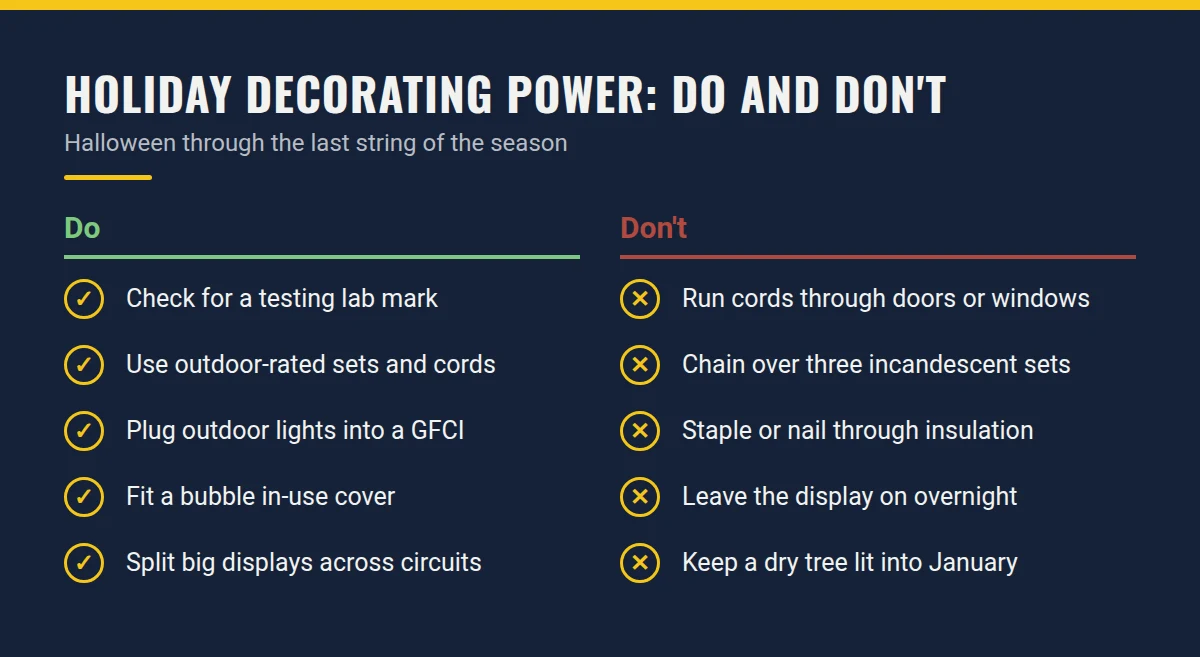
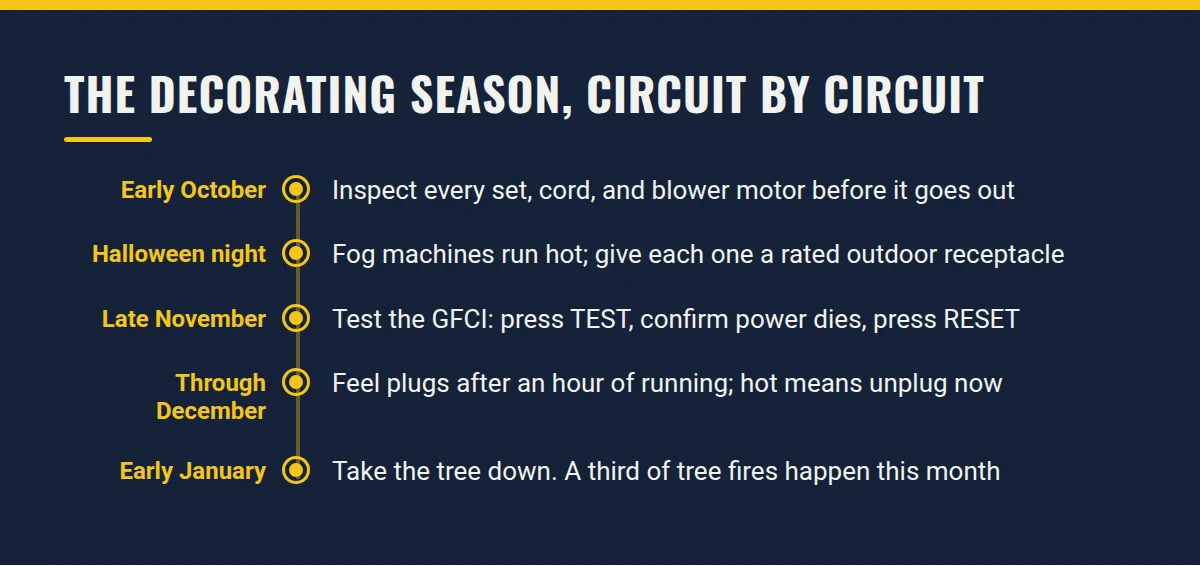
The timing is the part most people get wrong. Forty-one percent of those fires happened in December, but a further 33 percent happened in January. A tree that is still standing on January 10th, dried out and still lit every evening, is statistically one of the more dangerous objects in an American house.
Injuries outnumber fires by a wide margin. CPSC estimates roughly 14,900 people were treated in emergency rooms for holiday decorating injuries during the 2023 season, about 160 a day, with nearly half of them falls. That number is worth holding on to, because it means the ladder is more likely to hurt you than the wiring is, and the two hazards usually show up on the same afternoon.
Read the Label Before the Ladder Comes Out
Seasonal light strings are certified under UL/ANSI 588, the safety standard for seasonal and holiday decorative lighting, and the listing mark tells you where a set is allowed to live. UL Solutions uses a color code that takes two seconds to check: a green holographic label means indoor use only, and a red holographic label means the set is rated for indoor or outdoor use. A set with no recognized testing lab mark at all is not a bargain, it is an unknown.
Extension cords carry their own marking. A cord type printed with a W in the code, such as SJTW, has a jacket built to survive moisture, sunlight, and temperature swings. A cord without the W is an indoor cord, and its insulation will dry out and crack after a season on the patio. Our guide to extension cord safety and gauge selection covers how to read the rest of that string of letters and how to match wire gauge to the load.
The indoor set stretched around a porch rail is the classic October mistake. Indoor insulation is thinner, the sockets are not sealed, and a set that behaves perfectly in a dry living room will track current across a wet socket the first time there is heavy dew.
How Many Strings Can One Outlet Carry?
CPSC’s guidance is blunt and worth memorizing: never string together more than three sets of incandescent lights, and never overload an outlet. For LED sets the number is much higher, sometimes forty or more, but do not guess it. The U.S. Fire Administration’s instruction is the correct one for every type of set: read the manufacturer’s instructions for how many strands may be connected. That figure is printed on the tag molded to the plug end, and it is specific to that product’s wire gauge and connected wattage.
The thing that trips people up is that the outlet is not the limit. The circuit is. A standard 15-amp, 120-volt branch circuit can deliver 1,800 watts on paper, but holiday lighting runs for hours at a stretch, which makes it a continuous load, and continuous loads are sized to 80 percent of the breaker rating. That leaves about 1,440 usable watts, shared by every outlet on that breaker, not just the one you are looking at. The porch receptacle, the outlet inside the front door, and the garage receptacle are very often the same circuit.
Inflatable decorations are where the arithmetic goes sideways, because their blower motors run continuously rather than just when the display looks full. Three inflatables and a fog machine can quietly consume most of a circuit before a single light string is plugged in. If your display keeps growing, spread it across two or three different circuits rather than one very long daisy chain, and if you do not know which outlets share a breaker, flip one breaker off and walk the house to find out.
If a breaker starts tripping once the display is up, that is the system doing its job. Our diagnostic guide to why a breaker keeps tripping walks through telling an honest overload apart from a short circuit or a ground fault, which matter very differently outdoors.
Outdoor Plugs Need Two Things, Not One
The first is GFCI protection. A ground fault circuit interrupter compares the current going out with the current coming back, and when the difference reaches about 0.006 amperes, roughly six milliamps, it cuts power faster than a blink. CPSC notes that outdoor receptacles have required GFCI protection under the National Electrical Code since 1973, so most houses built or rewired in the last fifty years already have it. If yours does not, a portable GFCI adapter that plugs into the receptacle is an inexpensive stopgap for the season, though the real answer is a properly protected outdoor receptacle.
The second thing, which far more people miss, is the cover. A flat flip lid keeps rain out of an empty outlet and does nothing once a plug is sitting in it. The federal wiring rule, mirrored in OSHA’s general industry standard at 1910.305(j)(2)(vi), names holiday lights by name: a receptacle in a wet location feeding a product that is unattended while in use needs an enclosure that stays weatherproof with the plug cap inserted or removed. That is the bubble-style in-use cover, the hinged plastic dome deep enough to close over a plugged-in cord. If your outdoor receptacle has the flat lid propped open by a cord all December, you have an unprotected connection in the weather, and swapping the cover is a small job for an electrician who is already on site.
Test the GFCI before the season starts, not after. Press TEST, confirm power dies, press RESET. A device that will not trip on the test button is failed and needs replacing. For the difference between this kind of protection and the fire-focused kind, see our comparison of AFCI and GFCI protection.
Halloween Gear Has Its Own Problems
Halloween decorations sit outside for the wettest, windiest weeks of autumn and frequently just stay there until the holiday sets go up over them. Three habits keep them out of trouble.
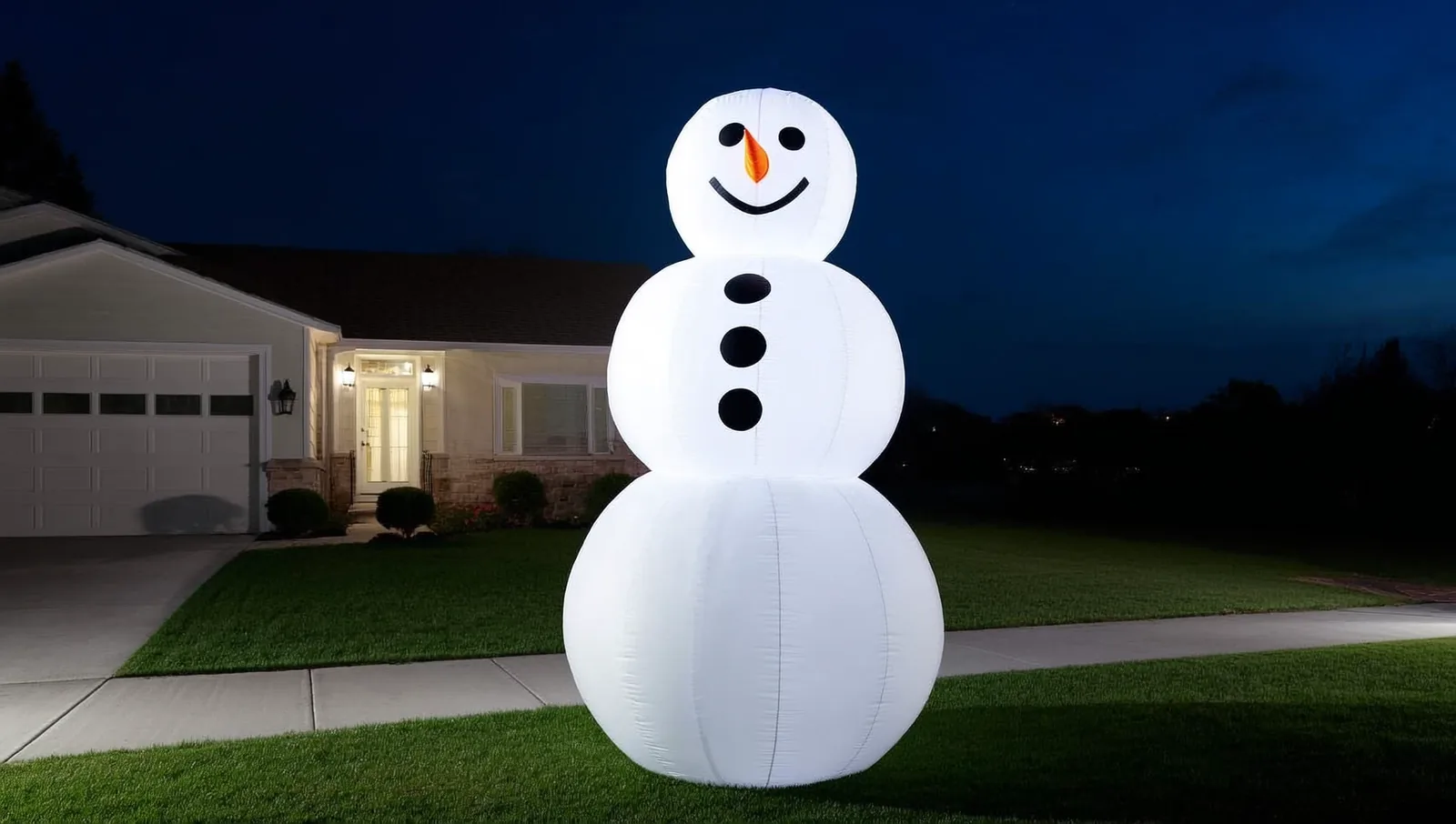
Keep the connections up and dry. Cord-to-cord joints should sit off the ground where water does not pool, and every cord entering a connection should hang in a drip loop so that water running down the cable drips off the low point instead of into the plug. Staking a cord flat across the lawn where the sprinkler and the leaf blower both find it is asking for a nicked jacket.
Treat fog machines as appliances, not decorations. They work by heating an element, which makes them a high-draw device closer in character to a space heater than to a light string. They belong plugged into a properly rated outdoor receptacle on their own, never into a chain of cords or a power strip carrying half the display.
Inspect the motors, not just the lights. NFPA’s exterior holiday lighting guidance makes the point that the blower motors and power cords on animated and inflatable decorations take real damage in storage and should be checked for wear before they go out. A blower that has been folded into a bin with a kinked cord for eleven months is the part of the display most likely to be running hot on Halloween night.
Cords Through Doors and Windows: Don’t
Every year someone runs a cord from an inside outlet, through a window sash or a door jamb, and out to the display. The code treats flexible cord as temporary wiring, and specifically bars running it through doorways and windows where a closing door or sash can pinch it. The damage is invisible, because the crushed spot is inside the jamb, and it gets a little worse every time the door closes.
The same logic rules out cords under rugs, stapled through their insulation, or nailed to trim. Use insulated cord clips or plastic light-hanging hooks, which grip the jacket without piercing it, and keep runs off walkways where a guest arriving in the dark can catch a foot. If the only way to power your display is a cord through a window, what you actually need is an outdoor receptacle, and that is straightforward electrician work.
Look Up Before You Climb
Nearly half of those 14,900 emergency room visits were falls, and the roofline is exactly where holiday lights want to go. Use a ladder rated for your weight plus what you are carrying, set it on firm level ground, and keep three points of contact.
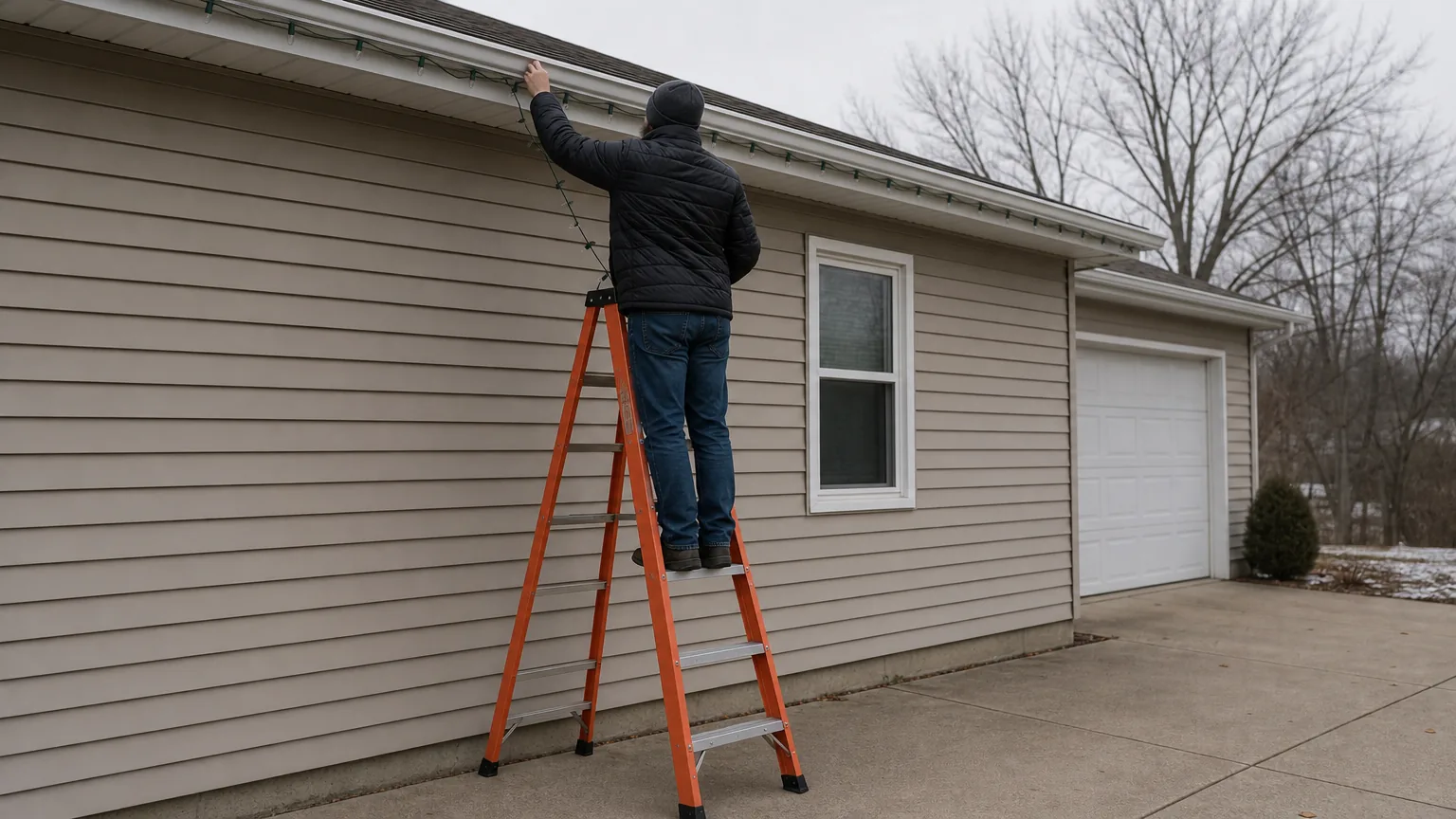
There is a second hazard above the gutter that gets far less attention. The service drop, the set of conductors running from the utility pole to your house, usually lands at a mast or weatherhead near the roof edge, often within arm’s reach of where you are stapling lights. An aluminum ladder, a gutter run, and an overhead conductor make a lethal combination, and fiberglass is not permission to get close. Our guide to overhead power line contact and the ten-foot rule covers where those wires run and what to do if a ladder does make contact. If your display needs to go anywhere near the service point, that section of the job belongs to a professional.
Before You Reuse Last Year’s Sets
A thirty-second check per string catches almost every failing set. CPSC’s advice is to examine each set, new or old, for broken or cracked sockets, frayed or bare wires, and loose connections, and the U.S. Fire Administration is equally direct: throw away strands with frayed or pinched wires.

- Run the whole length through your hands and feel for stiff, brittle, or flattened sections in the jacket.
- Check every socket for cracks, scorch marks, or a bulb that wobbles loose.
- Look at the plug and the end connector for discoloration, melted plastic, or bent prongs.
- Check the fuse in the plug body, and if it has blown, replace it with the same rating rather than a larger one.
- Feel the plug after an hour of running. Warm is a warning. Hot means unplug it now.
A damaged set cannot be taped back into a safe one. Cut the plug off so nobody retrieves it from the bin and buy a replacement. While you are sorting through old gear, it is worth running the model through the recall databases: our guide to checking whether a device is under recall explains where the date code hides and how to search by product type rather than brand.
Timers deserve a line of their own. An outdoor timer must be rated for outdoor use and for the amperage of everything downstream of it. A cheap indoor timer carrying a full roofline is a failure point with a clock attached. Whatever you use, the display should not run unattended overnight or while the house is empty.
When It Is Time to Call an Electrician
Some symptoms are normal seasonal annoyances and some are warnings. A GFCI that trips during heavy rain is often telling the truth about water in a connection: dry it out, restore the drip loops, and reset it. A breaker that trips when you add the last string is usually an honest overload, and the fix is splitting the display across circuits.
Call an electrician when any of these show up:
- A receptacle, plug, or cover plate that is warm, discolored, buzzing, or smells of hot plastic.
- A breaker that keeps tripping after you have removed load, or one that will not reset.
- A GFCI that will not trip when tested, or will not stay reset with nothing plugged in.
- A tingle from a metal railing, gutter, downspout, or light fixture housing.
- No outdoor receptacle at all, or an outdoor receptacle with no GFCI protection and no in-use cover.
Verify any electrician’s license and insurance with your state board before work starts, and expect a permit for new exterior circuits, because code adoption and permit rules vary by municipality. Our list of questions to ask before hiring an emergency electrician covers what to confirm on the phone.
The Bottom Line
The season’s electrical risk is not exotic. It is an indoor set used outdoors, one circuit asked to carry a display that grew by three items a year, a flat outlet cover propped open in the rain, and a dry tree still lit in the second week of January. Read the label before you hang anything, count strings against the manufacturer’s limit rather than the number of free sockets, get a real in-use cover over any outdoor plug, and take the tree down when it stops drinking. Electrical codes and permit requirements vary by municipality, so confirm the specifics with your local building department before adding exterior circuits.
Further reading (sources)
- NFPA Research on how Christmas tree fires break down by cause and by month
- NFPA with electrical safety tips for exterior holiday lighting, including the motors on animated displays
- CPSC for the emergency room injury estimate and the three-set rule for incandescent strings
- CPSC covering what a GFCI detects and when outdoor receptacles first required one
- UL Solutions from the bulletin explaining the green and red holographic labels on light strings
- 29 CFR 1910.305 on the weatherproof enclosure required where holiday lights are left plugged in
- U.S. Fire Administration for inspecting light strands and following the manufacturer’s connection limit